<?xml version="1.0" encoding="utf-8"?><feed xmlns="http://www.w3.org/2005/Atom" ><generator uri="https://jekyllrb.com/" version="3.10.0">Jekyll</generator><link href="https://ammrat13.org/feed.xml" rel="self" type="application/atom+xml" /><link href="https://ammrat13.org/" rel="alternate" type="text/html" /><updated>2026-06-01T02:39:22+00:00</updated><id>https://ammrat13.org/feed.xml</id><title type="html">Ammar Ratnani&apos;s Site</title><subtitle>Ammar Ratnani&apos;s personal website. It&apos;s fairly minimal, containing little more than an about section and some blog posts.</subtitle><author><name>Ammar Ratnani</name><email>ammrat13@gmail.com</email></author><entry><title type="html">Leja Points in the Knuth-Eve Algorithm</title><link href="https://ammrat13.org/2026/03/10/knutheve_leja.html" rel="alternate" type="text/html" title="Leja Points in the Knuth-Eve Algorithm" /><published>2026-03-10T00:00:00+00:00</published><updated>2026-03-10T00:00:00+00:00</updated><id>https://ammrat13.org/2026/03/10/knutheve_leja</id><content type="html" xml:base="https://ammrat13.org/2026/03/10/knutheve_leja.html"><![CDATA[<p>Recently, I've been writing a lot about the <a href="https://en.wikipedia.org/wiki/Knuth%E2%80%93Eve_algorithm" title="Wikipedia: Knuth-Eve algorithm">Knuth-Eve algorithm</a>. I
even wrote a Fortran implementation of it <a href="https://github.com/ammrat13/knuth-eve-algorithm" title="GitHub: ammrat13/knuth-eve-algorithm">on my GitHub</a>. The
code there is certainly not production-ready. For starters, it panics on
failures instead of returning error codes. More importantly though, I did not
consider round-off error when writing it; the code is almost certainly not
numerically stable. That goes for both encoding and for decoding, where
low-precision formats like BF16 or even FP8 would likely be used.</p>

<p>Recall that the encode step of the Knuth-Eve algorithm involves repeatedly
dividing a polynomial by quadratics of the form @@(x^2 - \alpha_i)@@. We have a
set of @@\alpha_i@@ values that we need to get through, but we can freely choose
the order in which we process them. The decode step iterates through all the
@@\alpha_i@@s in the reverse order that the encode step processed them. So it
makes sense to think that we might be able to improve the numerical stability of
the decoder by judiciously sorting the @@\alpha_i@@s during the encode.</p>

<p>I asked Gemini about this. Specifically, I asked it about evaluating polynomials
of the form</p>

<p>%% p_h(x) = (((y \cdot (x - \alpha_1) + \gamma_1) \cdot (x - \alpha_2) + \gamma_2) \cdots) \cdot (x - \alpha_m) + \gamma_m. %%</p>

<p><sup id="fnref:knutheve-recovery" role="doc-noteref"><a href="#fn:knutheve-recovery" class="footnote" rel="footnote">1</a></sup> Gemini observed that we can distribute everything to get</p>

<p>%%
\begin{align*}
    p_h(x) =\,\,&amp;
        \gamma_m \nl
        &amp;+ \gamma_{m-1} \cdot (x-\alpha_m) \nl
        &amp;+ \gamma_{m-2} \cdot (x-\alpha_m)(x-\alpha_{m-1}) \nl
        &amp;+ \cdots \nl
        &amp;+ \gamma_1 \cdot (x-\alpha_m)(x-\alpha_{m-1})\cdots(x-\alpha_2) \nl
        &amp;+ y \cdot (x-\alpha_m)(x-\alpha_{m-1})\cdots(x-\alpha_2)(x-\alpha_1).
\end{align*}
%%</p>

<p>This looks much more complicated, and it would take many more operations to
directly evaluate. But, polynomials of this form are well-studied — they are
in <a href="https://en.wikipedia.org/wiki/Newton_polynomial" title="Wikipedia: Newton polynomial">Newton form</a>. In fact, the factorization we were using can be
seen as extension of <a href="https://en.wikipedia.org/wiki/Horner%27s_method" title="Wikipedia: Horner's method">Horner's method</a> to Newton polynomials.</p>

<h2 id="newton-polynomials">Newton Polynomials</h2>

<p>The concept of Newton interpolation was new to me, so I'll spend some time on
it. It seems its main use-case is when you want to construct a polynomial
approximation for some function @@f@@ over some (for our purposes, compact) set
@@S \subset \CC@@.<sup id="fnref:approx-ex-power" role="doc-noteref"><a href="#fn:approx-ex-power" class="footnote" rel="footnote">2</a></sup><sup id="fnref:approx-ex-matrixpoly" role="doc-noteref"><a href="#fn:approx-ex-matrixpoly" class="footnote" rel="footnote">3</a></sup> This approximation
is constructed incrementally. At each iteration, you pick some new point @@x_i
\in S@@ and then use it to extend the approximating polynomial @@p@@, increasing
its degree by one so that it agrees with @@f@@ at the new point @@(x_i,
y_i)@@.<sup id="fnref:approx-idea" role="doc-noteref"><a href="#fn:approx-idea" class="footnote" rel="footnote">4</a></sup> Normally, that step of extending @@p@@ could potentially
affect all of its terms. For example, all of the coefficients could change if
the <a href="https://en.wikipedia.org/wiki/Monomial_basis" title="Wikipedia: Monomial basis">monomial basis</a> is used, and the basis functions themselves
change if the <a href="https://en.wikipedia.org/wiki/Lagrange_polynomial" title="Wikipedia: Lagrange polynomial">Lagrange basis</a> is used.</p>

<p>The idea behind Newton interpolation is to construct a basis where this
"invalidation" doesn't happen. Let @@n_0(x) = 1@@, @@n_1(x) = (x - x_0)@@, and
in general</p>

<p>%% n_d(x) = \prod_{i=0}^{d-1} (x - x_i). %%</p>

<p>We'll write our interpolating polynomial as a linear combination of these basis
functions; so if it has degree @@d@@, it would be</p>

<p>%% p_d(x) = \sum_{i=0}^d c_i \cdot n_i(x) %%</p>

<p>for some coefficients @@c_i@@. As a concrete example, suppose we wanted to
interpolate through the points below.</p>

<table>
  <thead>
    <tr>
      <th style="text-align: center">@@i@@</th>
      <th style="text-align: right">@@x_i@@</th>
      <th style="text-align: right">@@y_i@@</th>
    </tr>
  </thead>
  <tbody>
    <tr>
      <td style="text-align: center">0</td>
      <td style="text-align: right">0.00</td>
      <td style="text-align: right">1.000</td>
    </tr>
    <tr>
      <td style="text-align: center">1</td>
      <td style="text-align: right">-1.00</td>
      <td style="text-align: right">0.500</td>
    </tr>
    <tr>
      <td style="text-align: center">2</td>
      <td style="text-align: right">-0.50</td>
      <td style="text-align: right">0.707</td>
    </tr>
    <tr>
      <td style="text-align: center">3</td>
      <td style="text-align: right">-0.25</td>
      <td style="text-align: right">0.841</td>
    </tr>
  </tbody>
</table>

<p>The basis polynomials would be</p>

<p>%%
\begin{align*}
n_0(x) &amp;= 1 \nl
n_1(x) &amp;= (x - 0.00) \nl
n_2(x) &amp;= (x - 0.00) \cdot (x + 1.00) \nl
n_3(x) &amp;= (x - 0.00) \cdot (x + 1.00) \cdot (x + 0.50),
\end{align*}
%%</p>

<p>and the coefficients would be</p>

<p>%%
\begin{align*}
c_0 &amp;= 1.0000 \nl
c_1 &amp;= 0.5000 \nl
c_2 &amp;= 0.1716 \nl
c_3 &amp;= 0.0413.
\end{align*}
%%</p>

<p>As you may have noticed, unlike other polynomial interpolation schemes, the
basis polynomials used in Newton interpolation are not fixed — they depend on
the data points. So for instance in the example above, if we sampled at @@x_2 =
-0.75@@ instead of @@-0.5@@, we would have computed</p>

<p>%%n_3(x) = (x - 0.00) \cdot (x + 1.00) \cdot (x + 0.75).%%</p>

<p>In some sense, we are tailoring the basis to our dataset. Specifically, we are
choosing the basis so that @@n_d(x_i) = 0@@ for all @@i &lt; d@@; we're making it
so that the new basis polynomials vanish on all the datapoints we used before.
That property is what allows us to sidestep the "invalidation" I mentioned
earlier. In more detail, suppose we're on the iteration with index @@d@@ (which
is the @@(d+1)@@-th iteration) of the interpolation algorithm. We want to fit
coefficients @@c_i@@ to</p>

<p>%%
\begin{align*}
p_d(x_k)
  &amp;= \sum_{i=0}^d c_i \cdot n_i(x_k) \nl
  &amp;= \sum_{i=0}^{d-1} c_i \cdot n_i(x_k) + c_d \cdot n_d(x_k)
\end{align*}
%%</p>

<p>for @@k = 0, \cdots, d@@. But look at what happens when @@k = 0, \cdots, d-1@@.
In that case, @@n_d(x_k) = 0@@ by construction, and the equation above reduces
to</p>

<p>%% p_d(x_k) = \sum_{i=0}^{d-1} c_i \cdot n_i(x_k). %%</p>

<p>The key point is that, no matter what we pick for the last coefficient @@c_d@@,
it won't affect the value of the interpolating polynomial @@p_d@@ at the points
indexed @@k = 0, \cdots, d-1@@. In other words, we can treat fitting @@p_d@@ on
these first @@d@@ points as a subproblem. But that's exactly the problem we
solved on the previous iteration! We'll just carry the coefficients over, so
that</p>

<p>%% p_d(x) = p_{d-1}(x) + c_d \cdot n_d(x) %%</p>

<p>for all @@x@@. By construction, this interpolates the points indexed @@0,
\cdots, d-1@@. We just need make it pass through the last point @@(x_d, y_d)@@,
and that's easy enough to do by setting</p>

<p>%% c_d = \frac{y_d - p_{d-1}(x_d)}{n_d(x_d)}. %%</p>

<p><sup id="fnref:approx-coefcompute" role="doc-noteref"><a href="#fn:approx-coefcompute" class="footnote" rel="footnote">5</a></sup> The upshot is that Newton interpolation allows
incrementally computing the interpolating polynomial. Both the coefficients and
the basis functions don't change once we've computed them. I speculate this
property could be useful if we don't know beforehand how many points we'll need
to achieve some desired accuracy, or if some downstream task wants to
dynamically request greater precision when it's needed.</p>

<p>As a sidenote, the method I described here for computing the coefficients is not
the best one. It turns out the coefficients are <a href="https://en.wikipedia.org/wiki/Divided_differences" title="Wikipedia: Divided differences">divided
differences</a>, and the Wikipedia page for them gives an efficient
algorithm for computing them. Most importantly, it doesn't explicitly require
evaluating polynomials.</p>

<h2 id="leja-points">Leja Points</h2>

<p>As alluded to before, it appears that Newton interpolation is often used to
approximate a function @@f@@ over some set @@S \subset \CC@@. When
interpolating, we have latitude in choosing the points from @@S@@. The math will
work out no matter which points we choose, but perhaps we can improve the
numerical stability of the interpolation algorithm by choosing specific points.
<a href="https://doi.org/10.1007/BF02017352" title="Newton interpolation at Leja points">Reichel</a> reviews the work done by <a href="https://dx.doi.org/10.4064/ap-4-1-8-13" title="Sur certaines suites liées aux ensembles plans et leur application à la représentation conforme">Leja</a> in this
direction<sup id="fnref:leja-reichel" role="doc-noteref"><a href="#fn:leja-reichel" class="footnote" rel="footnote">6</a></sup>, and the rest of this section essentially summarizes
what they say.</p>

<p>As a sidenote, it's true that their results aren't specific to Newton
interpolation; the final statement of the theorem makes no reference to Newton
polynomials. Still, they seem to consider it the "default" way of solving this
problem. Indeed, their proof involves analyzing the interpolating polynomial
when written in Newton form.</p>

<h3 id="evaluating-numerical-stability">Evaluating Numerical Stability</h3>

<p>Let's say we fix the points @@x = \begin{pmatrix} x_0 &amp; x_1 &amp; \cdots \;
\end{pmatrix}^\intercal@@ at which we're evaluating @@f@@ ahead of time. We'll
sample to obtain @@y = \begin{pmatrix} y_0 &amp; y_1 &amp; \cdots \;
\end{pmatrix}^\intercal@@, and compute the interpolating polynomial @@p@@. Now
let's say we want to approximate @@f@@ at some new point, so we evaluate @@p@@
there. Unfortunately, the process of evaluating @@p@@ and even the process of
computing @@p@@ in the first place accumulate numerical errors. In reality,
we'll wind up using @@p + \delta p@@ instead. That perturbed polynomial
corresponds to some function values @@y + \delta y@@; if we had done the
interpolation (in exact arithmetic) with @@y + \delta y@@ instead of @@y@@, we
would have gotten @@p + \delta p@@ instead of @@p@@. Ultimately, we'd hope that
@@\delta y@@ isn't large compared to @@\delta p@@. If it is, that would mean
small errors when working with @@p@@ correspond to wildly different functions,
which would make it hard to accurately interpolate the function @@f@@ we
actually want.</p>

<p>The ideas in the last paragraph are usually expressed via the <a href="https://en.wikipedia.org/wiki/Condition_number" title="Wikipedia: Condition number">condition
number</a>. It turns out that the interpolating polynomial @@p@@ is linear
in the interpolation values @@y@@, where the linear transformation is
parameterized by the interpolation points @@x@@. (That's why we chose to fix
them ahead of time.) So, we can write @@p = T_x \, y@@ then contemplate</p>

<p>%%
\begin{align*}
\kappa(T_x)
  &amp;= \max \left[ \left( \frac{\lVert \delta y \rVert_\infty}{\lVert y \rVert_\infty} \right) \left( \frac{\lVert \delta p \rVert_{\partial S}}{\lVert p \rVert_{\partial S}} \right)^{-1} \right] \nl
  &amp;= \lVert T_x^{-1} \rVert \cdot \lVert T_x \rVert
\end{align*}
%%</p>

<p>I decided to spend some time here reviewing the logic underlying the condition
number since I found myself getting confused with the two different norms. For
@@y@@ we're just using the <a href="https://en.wikipedia.org/wiki/Uniform_norm" title="Wikipedia: Uniform norm">infinity norm</a>, but for @@p@@ Leja uses
the maximum magnitude of the polynomial on @@\partial S@@ the boundary of the
set @@S@@ we are interpolating over. It seems like a weird choice to ignore the
interior of @@S@@ completely, until you realize that the <a href="https://en.wikipedia.org/wiki/Maximum_modulus_principle" title="Wikipedia: Maximum modulus principle">maximum modulus
principle</a> guarantees that</p>

<p>%%
\lVert p \rVert_{\partial S} = \max_{x \in \partial S} |p(x)| = \max_{x \in S} |p(x)| = \lVert p \rVert_{S}
%%</p>

<p>(and likewise for @@\delta p@@). Regardless, a low value for @@\kappa(T_x)@@
signals numerical stability, so we seek to minimize it.</p>

<h3 id="choosing-points-for-stability">Choosing Points for Stability</h3>

<p>To minimize @@\kappa(T_x)@@, <a href="https://dx.doi.org/10.4064/ap-4-1-8-13" title="Sur certaines suites liées aux ensembles plans et leur application à la représentation conforme">Leja</a> proposes a "greedy" algorithm for
choosing points. Specifically, we choose the next point @@x_k@@ to maximize the
product of the distances from @@x_k@@ to all the points we chose before it:</p>

<p>%%
x_k = \argmax_{x \in S} \prod_{i=0}^{k-1} \left| x - x_i \right|.
%%</p>

<p><sup id="fnref:leja-pts-first" role="doc-noteref"><a href="#fn:leja-pts-first" class="footnote" rel="footnote">7</a></sup> We keep choosing points until we have enough, which in our
case is when we have a polynomial of sufficiently high degree. What we get in
the end is called a sequence of Leja points on @@S@@. (It need not be unique.)</p>

<p>That's how they're defined, but the motivation behind Leja's algorithm is
honestly a bit of a mystery to me. Intuitively, the objective function we
maximize when choosing these points should encourage them to spread out. Indeed,
all Leja points lie on @@\partial S@@. But how is that relevant? It could be as
simple as: we're taking the norm of @@p@@ over @@\partial S@@, so that will
naturally bound @@\lVert y \rVert_\infty@@ so long as all the @@x_i@@ lie on
@@\partial S@@. I don't see how <a href="https://doi.org/10.1007/BF02017352" title="Newton interpolation at Leja points">Reichel</a> would get his Formula
(2.20) otherwise.</p>

<p>Either way, if we choose the interpolation points @@x@@ to be Leja points, then
the condition number @@\kappa(T_x)@@ grows sub-exponentially with the degree of
the polynomial … if the capacity of @@S@@ is one. That constraint on the
capacity is treated like a technical condition, but it's quite important for us
so we'll spend some time on it.</p>

<h3 id="the-capacity-of-the-underlying-set">The Capacity of the Underlying Set</h3>

<p>The capacity of a compact set @@S \subset \CC@@ is defined in a bit of a
roundabout way. To compute it, you consider a particular vector field defined on
the exterior of @@S@@. It should be curl-free and divergence-free, and its flux
into @@S@@ should be @@2\pi@@. Then, we look at the potential function @@\phi@@
for this field<sup id="fnref:leja-capacity-potential" role="doc-noteref"><a href="#fn:leja-capacity-potential" class="footnote" rel="footnote">8</a></sup>. Far from the origin, the strength of
the vector field looks like @@|z|^{-1}@@, which means the potential function
looks like</p>

<p>%% \phi(x) \approx \ln |x| + C = \ln \frac{|x|}{c}, %%</p>

<p>for some constants @@C@@ and @@c = e^{-C}@@. By enforcing that @@\phi(x) = 0@@
on @@\partial S@@, we determine the values of the constants. The capacity of
@@S@@ is defined to be the value of @@c@@.</p>

<p>Intuitively, the capacity of @@S@@ seems to be a measure of its size, though
that's not immediately clear from the definition. More accurately, it seems to
be a measure of its perimeter @@\partial S@@. If @@\partial S@@ is small, the
vector field would have to become very strong to get the required flux into
@@S@@ through it. That would make climbing out of the potential to infinity more
difficult. The value of @@C@@ would increase, and @@c@@ would decrease. Vice
versa if @@\partial S@@ is large. Additionally, the capacity satisfies some
properties we'd expect from a measure of size. Scaling a set by some constant
factor scales its capacity by the same factor, for instance; so if @@S@@ has
capacity @@k@@, then @@\alpha S = \{ \alpha x : x \in S \}@@ has capacity
@@|\alpha| k@@.</p>

<p>It turns out that if @@x@@ is a sequence of Leja points on a set @@S@@ with
capacity @@c@@, then</p>

<p>%%
P_k := \prod_{i = 0}^{k - 1} |x_k - x_i| = \Theta(c^k),
%%</p>

<p>using <a href="https://en.wikipedia.org/wiki/Big_O_notation#Hardy's_%E2%89%8D_and_Knuth's_big_%CE%98" title="Wikipedia: Big O notation">big-Θ notation</a>.<sup id="fnref:leja-capacity-pklim" role="doc-noteref"><a href="#fn:leja-capacity-pklim" class="footnote" rel="footnote">9</a></sup> This makes some
intuitive sense. If @@c@@ represents the size of @@S@@, then @@|x_k - x_i|@@
should scale with @@c@@. As a result, multiplying @@k@@ terms of that form
should give something that scales with @@c^k@@. Here's another way to say that.
If @@S@@ is too big, the distances between points on @@\partial S@@ will be
greater than one on average, and @@P_k@@ will explode. If @@S@@ is too small,
the distances between the points will be less than one on average, and @@P_k@@
will go to zero. For some "goldilocks" sets though, which are neither too large
nor too small, @@P_k@@ converges to some positive constant. These are precisely
the sets with capacity one.</p>

<p>The product @@P_k@@ shows up several times in <a href="https://doi.org/10.1007/BF02017352" title="Newton interpolation at Leja points">Reichel</a>'s proof of
the statement from the last sub-section, specifically to bound @@\lVert T_x
\rVert@@. The proof assumes that @@P_k@@ neither grows nor shrinks exponentially
— it requires @@S@@ to have capacity one. If it doesn't have unit capacity,
their workaround is to just scale it first so that it does; remember, capacity
respects scaling by a constant factor. This works, so long as the capacity of
@@S@@ is non-zero.</p>

<h2 id="does-this-apply-to-us">Does This Apply to Us?</h2>

<p>Now let's come back to the original question. As a reminder, we wanted to sort
the @@\alpha_i@@ in the Knuth-Eve algorithm for better numerical stability. We
related this to the problem of choosing interpolation points for polynomials in
Newton form. It would seem that sorting the @@\alpha_i@@ in Leja order would be
a good choice.</p>

<p>Unfortunately, <a href="https://dx.doi.org/10.4064/ap-4-1-8-13" title="Sur certaines suites liées aux ensembles plans et leur application à la représentation conforme">Leja</a>'s and <a href="https://doi.org/10.1007/BF02017352" title="Newton interpolation at Leja points">Reichel</a>'s work doesn't directly
translate to our situation. We are doing Newton interpolation over the set @@S =
\{ \alpha_1, \alpha_2, \cdots \}@@, but (I believe) this set of isolated
points has capacity zero. There's no way to scale this set to have capacity one,
so the proof mentioned in the last section doesn't work for us. Others have
reported better numerical stability with Leja points, even outside their
original context. For instance, <a href="https://doi.org/10.1023/A:1025555803588" title="On the evaluation of polynomial coefficients">Calvetti</a> considers the problem of
computing the coefficients of a polynomial in the monomial basis given its
roots, and they find sorting the roots in Leja order reduces numerical error.
But in the end, the evidence isn't particularly convincing.</p>

<p>I implemented Leja sorting in my implementation of the Knuth-Eve algorithm. In
the code, I incorrectly said that</p>

<figure class="highlight"><pre><code class="language-fortran" data-lang="fortran"><span class="c1">! NOTE: This step doesn't have a solid foundation. It seems the literature</span><span class="w">
</span><span class="c1">! on this looks at the condition number when encoding, which is explicitly</span><span class="w">
</span><span class="c1">! not our concern. The ordering of the roots shouldn't have an impact on the</span><span class="w">
</span><span class="c1">! decoder's performance.</span></code></pre></figure>

<p>Indeed, the hope is that this could improve the decoder's numerical stability.
Unfortunately, this code isn't being used for anything, so I don't have a great
reason or a great way to benchmark it. Personally, if I were using the Knuth-Eve
algorithm for low-degree polynomials, I'd probably just try all the different
permutations of the @@\alpha_i@@, and take whatever gives the least error.</p>

<div class="footnotes" role="doc-endnotes">
  <ol>
    <li id="fn:knutheve-recovery" role="doc-endnote">
      <p>When we set @@y@@ to be what the remainder polynomial
@@r(x)@@ evaluates to, we recover the original polynomial with @@p(x) =
p_h(x^2)@@. <a href="#fnref:knutheve-recovery" class="reversefootnote" role="doc-backlink">&#8617;</a></p>
    </li>
    <li id="fn:approx-ex-power" role="doc-endnote">
      <p>For a concrete example, suppose we want to approximate
@@f(x) = 2^x@@ over the (real) interval @@[-1, 0]@@. We might want to do
this, say, as a subroutine of some library code that computes the function
@@2^x@@ for arbitrary @@x \in \RR@@. <a href="#fnref:approx-ex-power" class="reversefootnote" role="doc-backlink">&#8617;</a></p>
    </li>
    <li id="fn:approx-ex-matrixpoly" role="doc-endnote">
      <p>For another example, the
<a href="https://www.tipota.org/MatrixPolynomials.jl/dev/" title="MatrixPolynomials.jl">MatrixPolynomials.jl</a> package reduces the problem of
approximating functions of matrices to approximating complex functions. When
the spectrum of the input matrix is constrained, it can bound the region of
the complex plane in which the function needs to be approximated, at which
point it can use Newton interpolation. <a href="#fnref:approx-ex-matrixpoly" class="reversefootnote" role="doc-backlink">&#8617;</a></p>
    </li>
    <li id="fn:approx-idea" role="doc-endnote">
      <p>This is the same idea found in <a href="https://en.wikipedia.org/wiki/Lagrange_polynomial" title="Wikipedia: Lagrange polynomial">Lagrange
interpolation</a>, and <a href="https://en.wikipedia.org/wiki/Polynomial_interpolation" title="Wikipedia: Polynomial interpolation">polynomial
interpolation</a> in general. <a href="#fnref:approx-idea" class="reversefootnote" role="doc-backlink">&#8617;</a></p>
    </li>
    <li id="fn:approx-coefcompute" role="doc-endnote">
      <p>Note that this will never divide by zero. We defined
@@n_d@@ in terms of its roots, and it doesn't have @@x_d@@ as a root —
only @@x_0, \cdots, x_{d-1}@@. <a href="#fnref:approx-coefcompute" class="reversefootnote" role="doc-backlink">&#8617;</a></p>
    </li>
    <li id="fn:leja-reichel" role="doc-endnote">
      <p>The main contribution of Reichel's paper seems to be proposing
a way to use Leja's results in practice. He shows that you can get away with
discretizing @@\partial S@@, and he proposes a way to estimate the capacity
of @@S@@ when it is not known analytically. He also spends a lot of time on
numerical experiments. But, Reichel's summary is still good for me, since I
can't read French. <a href="#fnref:leja-reichel" class="reversefootnote" role="doc-backlink">&#8617;</a></p>
    </li>
    <li id="fn:leja-pts-first" role="doc-endnote">
      <p>The first point @@x_0@@ is chosen to maximize its absolute
value @@x_0 = \argmax_{x \in S} |x|@@. <a href="#fnref:leja-pts-first" class="reversefootnote" role="doc-backlink">&#8617;</a></p>
    </li>
    <li id="fn:leja-capacity-potential" role="doc-endnote">
      <p>This potential exists on the exterior of @@S@@ since
the vector field is curl-free there. The potential will also be a harmonic
function since the vector field is divergence-free as well. <a href="#fnref:leja-capacity-potential" class="reversefootnote" role="doc-backlink">&#8617;</a></p>
    </li>
    <li id="fn:leja-capacity-pklim" role="doc-endnote">
      <p>More accurately, we have that @@\lim_{k \to \infty}
P_k^{1/k} = c@@. <a href="#fnref:leja-capacity-pklim" class="reversefootnote" role="doc-backlink">&#8617;</a></p>
    </li>
  </ol>
</div>]]></content><author><name>Ammar Ratnani</name><email>ammrat13@gmail.com</email></author><summary type="html"><![CDATA[Recently, I've been writing a lot about the Knuth-Eve algorithm. I even wrote a Fortran implementation of it on my GitHub. The code there is certainly not production-ready. For starters, it panics on failures instead of returning error codes. More importantly though, I did not consider round-off error when writing it; the code is almost certainly not numerically stable. That goes for both encoding and for decoding, where low-precision formats like BF16 or even FP8 would likely be used.]]></summary></entry><entry><title type="html">Proving the Routh-Hurwitz Theorem</title><link href="https://ammrat13.org/2026/01/01/prove_routh_hurwitz.html" rel="alternate" type="text/html" title="Proving the Routh-Hurwitz Theorem" /><published>2026-01-01T00:00:00+00:00</published><updated>2026-01-01T00:00:00+00:00</updated><id>https://ammrat13.org/2026/01/01/prove_routh_hurwitz</id><content type="html" xml:base="https://ammrat13.org/2026/01/01/prove_routh_hurwitz.html"><![CDATA[<p>A while back, I was interested in polynomial evaluation algorithms. I went on a
brief tangent involving the properties of polynomial roots, but ultimately I
wanted to build up to understanding the proof of <a href="https://doi.org/10.1007/BF01386049" title="Eve, J. The evaluation of polynomials. Numer. Math. 6, 17–21 (1964).">Eve's theorem</a>. The
theorem is what allows the functioning of <a href="https://doi.org/10.1145/355580.369074" title="Donald E. Knuth. 1962. Evaluation of polynomials by computer. Commun. ACM 5, 12 (Dec. 1962), 595–599.">Knuth's Algorithm</a>, which
I explored in a previous post. The proof of Eve's theorem depends heavily on the
<a href="https://en.wikipedia.org/wiki/Routh%E2%80%93Hurwitz_theorem" title="Wikipedia: Routh–Hurwitz theorem">Routh-Hurwitz theorem</a>, so this post will present a proof of
that as well.</p>

<h2 id="routh-hurwitz-theorem">Routh-Hurwitz Theorem</h2>

<p>Let's say we have some polynomial @@p(z)@@ with real
coefficients.<sup id="fnref:p_real_coefs" role="doc-noteref"><a href="#fn:p_real_coefs" class="footnote" rel="footnote">1</a></sup> The idea underlying both Eve's theorem and the
Routh-Hurwitz theorem is to observe what happens as we sweep @@z@@ from bottom
to top along the imaginary axis. Starting with Routh-Hurwitz, it asks us to keep
track of the angle that the output of @@p@@ makes with the origin as we sweep.
The theorem says that that angle will move 180° counterclockwise overall for
each root in the left half of the complex plane that does not have a
corresponding root in the right half.<sup id="fnref:routh_hurwitz_real" role="doc-noteref"><a href="#fn:routh_hurwitz_real" class="footnote" rel="footnote">2</a></sup> More formally, assume
that @@p@@ has @@n_L@@ roots with real part less than zero and @@n_R@@ greater
than zero. Then, the "winding number" about the origin of the path @@\gamma(t) =
p(it)@@, where @@t@@ ranges from @@-\infty@@ to @@+\infty@@, is
@@\frac{1}{2}(n_L - n_R)@@.<sup id="fnref:winding_not_integer" role="doc-noteref"><a href="#fn:winding_not_integer" class="footnote" rel="footnote">3</a></sup> (We're assuming no roots lie
on the imaginary axis.)</p>

<figure>
<img src="/assets/2026/01/01/winding_example_5.png" alt="Plot of a curve γ generated by a particular polynomial" style="max-height: 3in" />
<figcaption>
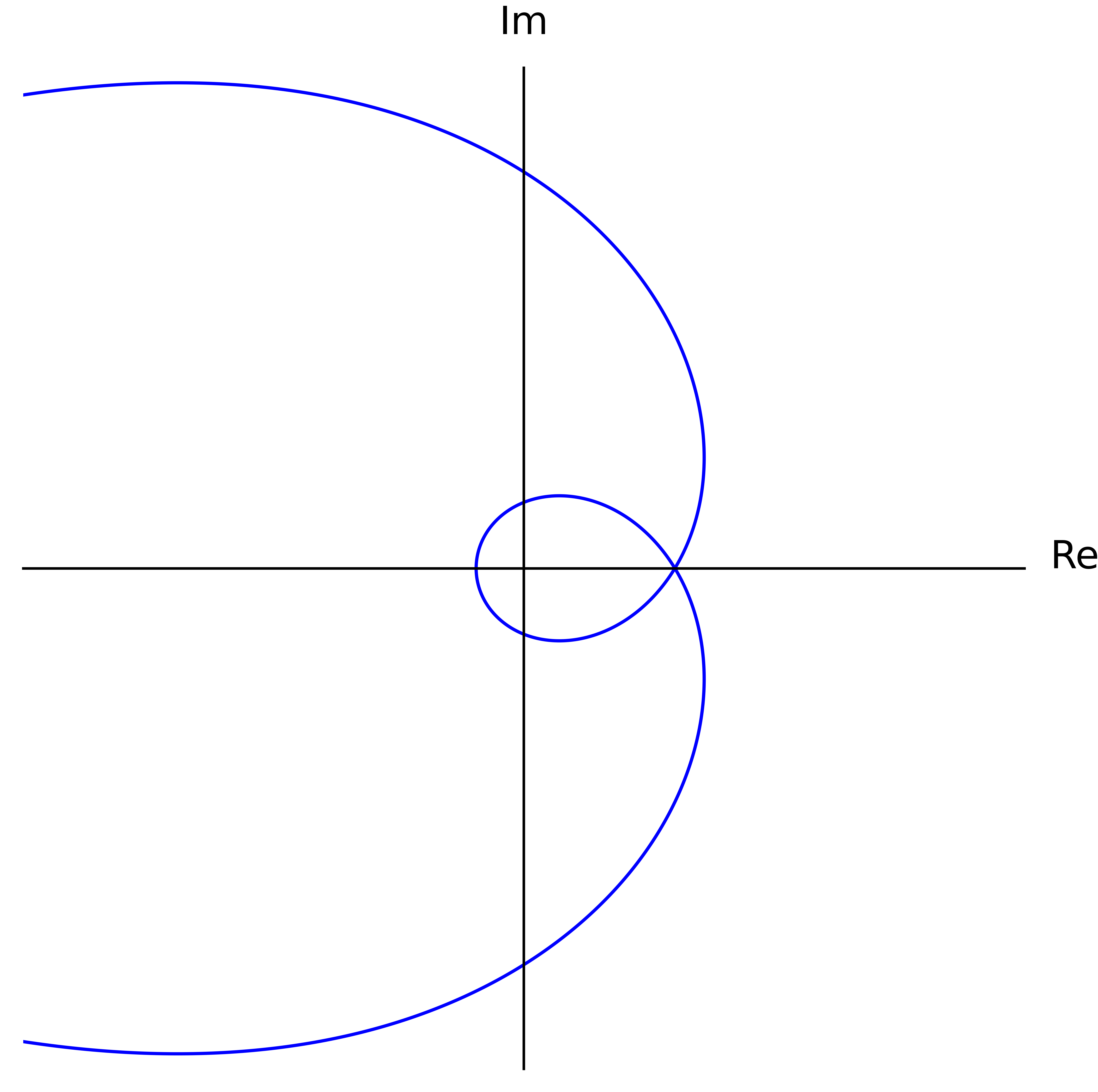
Parametric plot of the curve @@\gamma@@ generated using @@p(z) = (z-1)^5
(z+1)@@. The curve enters from the bottom-left, loops around the origin once,
then exits out the top right. If extended out to infinity, the ends of this
curve meet at @@-\infty@@. Hence, this curve has a winding number of two, or
@@+\frac{4}{2}@@.
</figcaption>
</figure>

<figure>
<img src="/assets/2026/01/01/winding_example_4.png" alt="Plot of a curve γ generated by a particular polynomial" style="max-height: 3in" />
<figcaption>
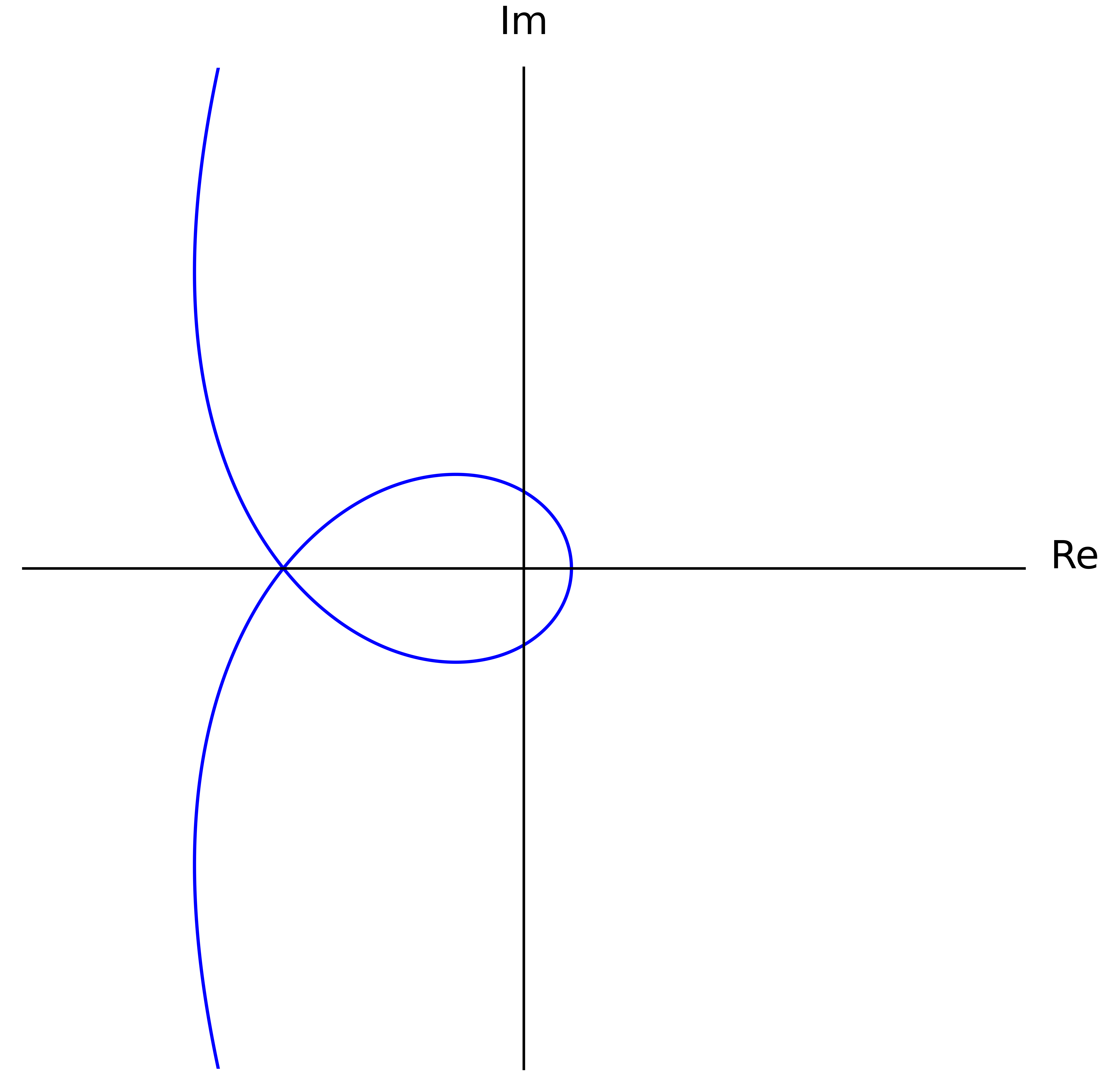
Same as above but generated with @@p(z) = (z-1)^4 (z+1)@@ instead. Again, this
curve enters from the bottom-left and exits out the top right. Unlike the last
example, the ends of the curve do not meet at infinity. In fact, they are at
@@-i \cdot \infty@@ and @@+i \cdot \infty@@. This curve has a winding number of
@@+\frac{3}{2}@@.
</figcaption>
</figure>

<h3 id="informal-proof">Informal Proof</h3>

<p>This fact can be intuited by observing what happens when considering a single
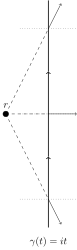
root @@r@@. There are two cases; for now, suppose @@\Re[r] &lt; 0@@. When @@t@@ is
a large negative number, the arrow pointing from @@r@@ to @@it@@ is directed
almost straight down, giving an angle of -90° or @@-\frac{\pi}{2}@@. As
@@t@@ increases, eventually @@it@@ comes abreast of @@r@@, and @@\Im[it] =
\Im[r]@@. The point @@it@@ passes to the right of @@r@@ since its real part
(zero) is greater than that of @@r@@, so the angle at this point is @@0@@.
Furthermore, the angle monotonically increased from @@-\frac{\pi}{2}@@ up to
@@0@@ to get to this point. Finally, as @@t@@ becomes a large positive number,
the angle smoothly increases up to @@\frac{\pi}{2}@@, as the arrow from @@r@@ to
@@it@@ points almost straight up. Overall, @@r@@ induces a change in angle of
@@+\pi@@. This same analysis can be done in the case where @@\Re[r] &gt; 0@@. In
that case, the angle sweeps from @@\frac{3\pi}{2}@@ to @@\pi@@ to
@@\frac{\pi}{2}@@. The initial and final angles are the same (modulo @@2\pi@@),
but the change in angle is @@-\pi@@ instead since we pass to the left of @@r@@.</p>

<figure>
<img src="/assets/2026/01/01/routh_hurwitz_example.svg" alt="A vertical path passing by a root, with arrows showing the direction from
    the root to various points on the path" style="max-height: 4in" />
<figcaption>
Here, the path @@\gamma(t) = it@@ passes to the right of a root @@r@@. Arrows
are drawn at various points along the path showing the direction from @@r@@ to
the point on @@\gamma@@. Notice that the angle the arrows make with the
horizontal monotonically increases from -90&deg; to +90&deg;.
</figcaption>
</figure>

<p>Effectively, the previous paragraph considered monomials of the form @@z - r@@.
But remember, a general polynomial<sup id="fnref:p_real_coefs:1" role="doc-noteref"><a href="#fn:p_real_coefs" class="footnote" rel="footnote">1</a></sup> can be written as a product of
these monomials. Let's say @@p(z) = \prod_{a=1}^n (z - r_a)@@. Angles add when
multiplying complex numbers, so the total change in angle over the path
@@\gamma(t) = p(it)@@ is just the sum of the changes in angles for each
@@\gamma_a(t) = it - r_a@@. From the previous paragraph, we know that</p>

<p>%%
\Delta \arg \left[ \gamma_a \right] = \begin{cases}
  +\pi &amp; \text{if } \Re[r_a] &lt; 0 \nl
  -\pi &amp; \text{if } \Re[r_a] &gt; 0 \nl
\end{cases},
%%</p>

<p>so</p>

<p>%%
\begin{align*}
\Delta \arg \left[ \gamma \right]
&amp;= \sum_{a=1}^n \begin{cases}
  +\pi &amp; \text{if } \Re[r_a] &lt; 0 \nl
  -\pi &amp; \text{if } \Re[r_a] &gt; 0 \nl
\end{cases} \nl
&amp;= \pi \cdot n_L - \pi \cdot n_R \nl
&amp;= \pi \cdot (n_L - n_R).
\end{align*}
%%</p>

<p>The winding number is just that divided by @@2\pi@@.</p>

<h3 id="formal-proof">Formal Proof</h3>

<p>The previous argument is a bit hand-wavy, but it seems to be borne out in the
algebra. If we want to be more formal, we compute</p>

<p>%%
\begin{align*}
\Delta \arg \left[ \gamma \right]
&amp;= \Im \left[ \int_\gamma \frac{1}{z} dz \right] \nl
&amp;= \Im \left[ \int_{-\infty}^{\infty} \frac{i \cdot p^\prime(it)}{p(it)} dt \right].
\end{align*}
%%</p>

<p>If</p>

<p>%%
p(z) = \prod_{a=1}^n (z - r_a),
%%</p>

<p>then</p>

<p>%%
p^\prime(z) = \sum_{a=1}^n \prod_{b \neq a} (z - r_b),
%%</p>

<p>so</p>

<p>%%
\begin{align*}
\frac{p^\prime(z)}{p(z)}
&amp;= \frac{\sum_{a=1}^n \prod_{b \neq a} (z - r_b)}{\prod_{b=1}^n (z - r_b)} \nl
&amp;= \sum_{a=1}^n \frac{\prod_{b \neq a} (z - r_b)}{\prod_{b=1}^n (z - r_b)} \nl
&amp;= \sum_{a=1}^n \frac{1}{z - r_a}.
\end{align*}
%%</p>

<p>Substituting gives</p>

<p>%%
\begin{align*}
\Delta \arg \left[ \gamma \right]
&amp;= \Im \left[ \int_{-\infty}^{\infty} i \cdot \sum_{a=1}^n \frac{1}{it - r_a} dt \right] \nl
&amp;= \sum_{a=1}^n \Im \left[ \int_{-\infty}^{\infty} \frac{i}{it - r_a} dt \right] \nl
&amp;= \sum_{a=1}^n \Delta \arg \left[ \gamma_a \right].
\end{align*}
%%</p>

<p>Now, here we have the same structure we have in the informal proof. We have a
sum over terms which each involve a single root of @@p@@. And it would seem that
each term is just the change in angle about the origin of the path @@\gamma_a(t)
= it-r_a@@. In fact, it turns out that each term evaluates to @@\pm \pi@@
depending on the sign of @@\Re[r_a]@@. To actually evaluate the integral, Claude
suggests decomposing @@r_a = x_a + iy_a@@, then using the fact that</p>

<p>%%
\frac{1}{a + ib} = \frac{a - ib}{a^2 + b^2}
%%</p>

<p>for @@a,b \in \RR@@. Doing so gives</p>

<p>%%
\begin{align*}
\Delta \arg \left[ \gamma_a \right]
&amp;= \Im \left[ \int_{-\infty}^{\infty} \frac{i}{it - r_a} dt \right] \nl
&amp;= \Im \left[ \int_{-\infty}^{\infty} \frac{i}{i(t - y_a) - x_a} dt \right] \nl
&amp;= \Im \left[ \int_{-\infty}^{\infty} \frac{i}{it - x_a} dt \right] \nl
&amp;= \Im \left[ \int_{-\infty}^{\infty} \frac{1}{t + ix_a} dt \right] \nl
&amp;= \Im \left[ \int_{-\infty}^{\infty} \frac{t - ix_a}{t^2 + x_a^2} dt \right] \nl
&amp;= -x_a \int_{-\infty}^{\infty} \frac{1}{t^2 + x_a^2} dt.
\end{align*}
%%</p>

<p>Finally, substituting @@t = |x_a| \sinh u@@ and @@dt = |x_a| \cosh u \, du@@
gives</p>

<p>%%
\begin{align*}
\Delta \arg \left[ \gamma_a \right]
&amp;= -\frac{x_a \cdot |x_a|}{x_a^2} \int_{-\infty}^{\infty} \frac{\cosh u}{\sinh^2 u + 1} du \nl
&amp;= -\sign(x_a) \int_{-\infty}^{\infty} \frac{1}{\cosh u} du \nl
&amp;= -\sign(x_a) \cdot \pi.
\end{align*}
%%</p>

<p>This is exactly what we got for each term with the informal proof, just written
a bit differently. Note that if we had substituted @@t = x_a \sinh u@@ instead,
we may have had to swap the limits on the integral depending on the sign of
@@x_a@@. That gives the same result, though.</p>

<h3 id="observations">Observations</h3>

<p>A few noteworthy corollaries follow from the Routh-Hurwitz theorem. First, the
degree of the polynomial @@n@@ is how many roots it has, which is just the sum
@@n_L + n_R@@. It follows that @@n_L - n_R@@ has the same parity as
@@n@@.<sup id="fnref:mod2_plus_minus" role="doc-noteref"><a href="#fn:mod2_plus_minus" class="footnote" rel="footnote">4</a></sup> As a result, the winding number of @@\gamma@@ will be
an integer for even degree polynomials, and a half-integer otherwise.
Furthermore, we know the behavior of @@\gamma@@ in the "far-field", where the
leading term of @@p@@ dominates. Assuming @@p@@ is monic for simplicity, for
even degree,</p>

<p>%%
\begin{align*}
p(-i \cdot \infty) &amp;\approx (-i \cdot \infty)^{2k} = (-1)^k \cdot \infty \nl
p(+i \cdot \infty) &amp;\approx (+i \cdot \infty)^{2k} = (-1)^k \cdot \infty,
\end{align*}
%%</p>

<p>and for odd degree</p>

<p>%%
\begin{align*}
p(-i \cdot \infty) &amp;\approx (-i \cdot \infty)^{2k+1} = (-1)^k \cdot -i \cdot \infty \nl
p(+i \cdot \infty) &amp;\approx (+i \cdot \infty)^{2k+1} = (-1)^k \cdot +i \cdot \infty.
\end{align*}
%%</p>

<p><sup id="fnref:far_field_not_monic" role="doc-noteref"><a href="#fn:far_field_not_monic" class="footnote" rel="footnote">5</a></sup><sup id="fnref:far_field_notation" role="doc-noteref"><a href="#fn:far_field_notation" class="footnote" rel="footnote">6</a></sup> Combining this with the earlier
observation, we can qualitatively describe @@\gamma@@:</p>

<ul>
  <li>When @@n@@ is even, @@\gamma@@ will enter from either side along the real
axis, and exit along the real axis on the same side it came from.</li>
  <li>When @@n@@ is odd, @@\gamma@@ will enter from either side along the imaginary
axis, and exit along the imaginary axis from the opposite side it came from.</li>
</ul>

<p>The winding number is a further constraint on top of this, though this
description already forces the winding number to be an integer or a half-integer
when @@n@@ is even or odd respectively.</p>

<h2 id="cauchy-index-formulation">Cauchy Index Formulation</h2>

<p>Sometimes, the Routh-Hurwitz theorem is written in terms of <a href="https://en.wikipedia.org/wiki/Cauchy_index" title="Wikipedia: Cauchy index">Cauchy
indices</a>. How this rewrite is done was initially quite mysterious to
me. It started to become clear once I realized that, if @@p(z) = \sum_{a=0}^n
k_a z^a@@ has real coefficients<sup id="fnref:p_real_coefs:2" role="doc-noteref"><a href="#fn:p_real_coefs" class="footnote" rel="footnote">1</a></sup>, then we can split into the even
and odd terms to get</p>

<p>%%
\begin{align*}
p(it)
&amp;= \sum_{a=0}^n k_a (it)^a
= \sum_{a=0}^n k_a i^a t^a \nl
&amp;= \sum_{a = 2b} k_a (-t^2)^b + it \sum_{a = 2b+1} k_a (-t^2)^b \nl
&amp;= p_e(-t^2) + it \cdot p_o(-t^2).
\end{align*}
%%</p>

<p>The upshot is that the real and imaginary parts of this polynomial path are
themselves given by polynomials. Specifically, @@p_e@@ and @@p_o@@ are
polynomials with the even and odd coefficients of @@p@@ respectively. They have
degree at most @@\lfloor \frac{n}{2} \rfloor@@ and @@\lfloor \frac{n-1}{2}
\rfloor@@ respectively. We let<sup id="fnref:pr_pi_def" role="doc-noteref"><a href="#fn:pr_pi_def" class="footnote" rel="footnote">7</a></sup></p>

<p>%%
\begin{align*}
p_r(t) &amp;= \Re[p(it)] = p_e(-t^2) \nl
p_i(t) &amp;= \Im[p(it)] = t \cdot p_o(-t^2).
\end{align*}
%%</p>

<p>For now, let's say @@p@@ has even degree. In that case, there is an elegant way
to think about the Cauchy index @@I_{-\infty}^\infty \frac{p_i(t)}{p_r(t)}@@.</p>

<p>For the uninitiated, the Cauchy index of some <a href="https://en.wikipedia.org/wiki/Rational_function" title="Wikipedia: Rational function">rational function</a>
over a real interval is computed by summing over all of its poles — that is,
every @@s@@ where its denominator is zero — in that interval. We only consider
poles where the denominator @@p_r@@ changes sign. If it doesn't, then that pole
just contributes @@0@@ to the sum. If it does change sign at @@s@@, then the
numerator @@p_i(s)@@ will be either positive or
negative.<sup id="fnref:cauchy_index_simplify" role="doc-noteref"><a href="#fn:cauchy_index_simplify" class="footnote" rel="footnote">8</a></sup> Combining those effects, overall the rational
function @@\frac{p_i(t)}{p_r(t)}@@ will change sign at @@s@@ through a vertical
asymptote. If it changes from negative to positive, then @@s@@ contributes
@@+1@@. If from positive to negative, @@-1@@. <a href="https://en.wikipedia.org/wiki/Cauchy_index" title="Wikipedia: Cauchy index">Wikipedia</a> has a good
example computation.</p>

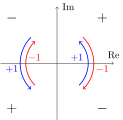
<figure>
<img src="/assets/2026/01/01/cauchy_winding_even.svg" alt="Sketch of the complex plane. The upper-right and lower-left quadrants are
    labeled with '+', while the lower-right and upper-left quadrants are labeled
    with '-'. Red arrows labeled '-1' point from the upper-right quadrant to the
    upper-left, and from the lower-left to the lower-right. Blue arrows labeled
    '+1' point in the opposite directions." style="max-height: 5in" />
<figcaption>
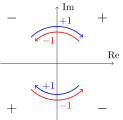
A sketch showing the sign of the rational function @@\frac{p_i(t)}{p_r(t)}@@ as
a function of where @@p(it)@@ is on the complex plane. Arrows are drawn to show
how transitions between quadrants contribute to @@I_{-\infty}^\infty
\frac{p_i(t)}{p_r(t)}@@. This diagram is important to the main result of this
section for <strong>even</strong> degree polynomials.
</figcaption>
</figure>

<p>In our case for @@I_{-\infty}^\infty \frac{p_i(t)}{p_r(t)}@@, the poles
considered by the Cauchy index correspond to the values of @@t@@ where
@@\gamma@@ crosses the imaginary axis. In other words, it captures when
@@\gamma@@ changes which side of the complex plane it's on — either the left
or the right half. When we change sides, we can pass the origin either clockwise
or counterclockwise. This "rotation information" is what's tracked by the Cauchy
index, as shown in the figure above. Transitioning counterclockwise contributes
@@-1@@ to the sum since @@\frac{p_i(t)}{p_r(t)}@@ goes from positive to negative
at that value of @@t@@. Likewise, transitioning clockwise contributes @@+1@@.
Now it turns out, this rotation information at each side-change is sufficient to
compute the final winding number. In the end, each counterclockwise transition
contributes @@+\frac{1}{2}@@, and each clockwise @@-\frac{1}{2}@@. For example,
suppose @@\gamma@@ happens to come in from the left, then pass under the origin
(counterclockwise). If no further transitions were to
happen<sup id="fnref:cauchy_example_nonphysical" role="doc-noteref"><a href="#fn:cauchy_example_nonphysical" class="footnote" rel="footnote">9</a></sup>, @@\gamma@@ would have to exit along the
positive real axis, and the final winding number would be forced to be
@@+\frac{1}{2}@@. If instead the path continued by passing above the origin
(counterclockwise), then it would be forced to exit along the negative real axis
assuming no further transitions, and the final winding number would be
@@+\frac{2}{2}@@. Similarly if instead it then passed under the origin
(clockwise), then again it would be forced to exit left, but this time with a
final winding number of zero. Ultimately, we can get away with only looking at
the side transitions since @@\gamma@@ can only enter and exit along the real
axis.</p>

<p>To summarize, all counterclockwise passes contribute @@+\frac{1}{2}@@ to the
winding number and @@-1@@ to the Cauchy index, while all clockwise passes count
for @@-\frac{1}{2}@@ and @@+1@@ respectively. Taking care of the signs, we have</p>

<p>%%
\begin{align*}
\frac{1}{2\pi} \Delta \arg \left[ \gamma \right] = \frac{1}{2}(n_L-n_R) &amp;= -\frac{1}{2} \cdot I_{-\infty}^\infty {\textstyle \frac{p_i(t)}{p_r(t)}} \nl
n_L - n_R &amp;= -I_{-\infty}^\infty {\textstyle \frac{p_i(t)}{p_r(t)}}.
\end{align*}
%%</p>

<p>This formula only works for even degree polynomials. For odd degree polynomials,
the logic is the same, but we're looking at transitions between the top and
bottom halves of the complex plane. Since these transitions happen where the
imaginary part is zero, the end result is related to the Cauchy index of
@@\frac{p_r(t)}{p_i(t)}@@ instead. In the end,</p>

<p>%%
n_L - n_R = \begin{cases}
-I_{-\infty}^\infty {\textstyle \frac{p_i(t)}{p_r(t)}} &amp; \text{if $n$ is even} \nl
+I_{-\infty}^\infty {\textstyle \frac{p_r(t)}{p_i(t)}} &amp; \text{if $n$ is odd} \nl
\end{cases}.
%%</p>

<figure>
<img src="/assets/2026/01/01/cauchy_winding_odd.svg" alt="Sketch of the complex plane. The upper-right and lower-left quadrants are
    labeled with '+', while the lower-right and upper-left quadrants are labeled
    with '-'. Red arrows labeled '-1' point from the lower-left quadrant to the
    upper-left, and from the upper-right to the lower-right. Blue arrows labeled
    '+1' point in the opposite directions." style="max-height: 5in" />
<figcaption>
Same as the previous figure, except considering the rational function
@@\frac{p_r(t)}{p_i(t)}@@ instead. This diagram is important for
<strong>odd</strong> degree polynomials.
</figcaption>
</figure>

<h2 id="eves-theorem">Eve's Theorem</h2>

<p>With all the groundwork we've laid so far, the proof of Eve's theorem is mostly
straightforward, though there is also a creative technique it uses to increase
its strength. In short, Eve's theorem says that if almost all of the roots of
some polynomial @@p@@ lie on one half of the complex plane — either the left
or the right half, then all the roots of @@p_o@@ are real. The original proof
uses the properties of Cauchy indices to prove this, but I find it more
instructive to think of it in terms of the path @@\gamma(t) = p(it)@@.</p>

<p>First though, we can perform a few simplifications. Without loss of generality,
let's assume most of the roots are on the left side, with real part at most
zero. If that's not the case, we can instead run this argument on @@q(z) :=
p(-z)@@. This has the effect of swapping the sides of each of the roots. But
note that</p>

<p>%%
p(-z) = p_e(z^2) - z \cdot p_o(z^2),
%%</p>

<p>so @@q_e(z) = p_e(z)@@ and @@q_o(z) = -p_o(z)@@. Since this argument shows that
all the roots of @@q_o@@ are real, it follows that all the roots of @@p_o@@ are
as well. Without loss of generality, we may also assume that no roots are on the
imaginary axis. The Routh-Hurwitz theorem doesn't handle that case, but Eve's
theorem does. If @@p(iy) = 0@@ for some @@y@@, then @@-y^2@@ is a common root of
@@p_e@@ and @@p_o@@; remember how we decomposed @@p(it)@@ earlier. So, we can
just factor that root out before proceeding with this argument.</p>

<h3 id="weak-version">"Weak" Version</h3>

<p>For now, assume all @@n@@ roots of @@p@@ are in the left half of the complex
plane. The full version of Eve's theorem weakens this requirement slightly,
making it stronger overall, but a lot of the proof ideas carry over. Regardless,
by the Routh-Hurwitz theorem, the winding number of @@\gamma@@ about the origin
is @@+\frac{n}{2}@@. We're going to use that winding number to lower-bound how
many real roots @@p_i@@ and thus @@p_o@@ have, ultimately showing all of
@@p_o@@'s roots are real.</p>

<p>Consider the case where @@n@@ is even. In order to get the winding number as
high as @@+\frac{n}{2}@@, @@\gamma@@ must cross the imaginary axis
counterclockwise at least @@n@@ times, using the ideas from the previous
section. And in fact, those crossings must be the only ones, since @@p_r@@ has
at most @@n@@ real roots because of the bounds on its degree. Finally, since
those crossings of the imaginary axis have to alternate above and below the
origin (just look at the figure), @@\gamma@@ must cross the real axis at least
@@n-1@@ times between them (by fencepost). This gives @@\Im[\gamma(t)] =
p_i(t)@@ at least @@n-1@@ real roots. And this is also exact since the degree of
@@p_i@@ for even @@n@@ is at most @@n-1@@.</p>

<p>Ignoring the extra root at zero, the roots of @@p_i@@ form @@\frac{1}{2}(n-2)@@
positive/negative root pairs, since @@\frac{1}{z} p_i(z)@@ is
<a href="https://en.wikipedia.org/wiki/Even_and_odd_functions" title="Wikipedia: Even and odd functions">even</a>.<sup id="fnref:root_pairs" role="doc-noteref"><a href="#fn:root_pairs" class="footnote" rel="footnote">10</a></sup> Hence, we can write</p>

<p>%%
\begin{align*}
p_i(z)
&amp;= z \cdot \prod_{a = 1}^{\frac{1}{2}(n-2)} (z + r_a)(z - r_a) \nl
&amp;= z \cdot \prod_{a = 1}^{\frac{1}{2}(n-2)} (z^2 - r_a^2) \nl
&amp;= z \cdot \prod_{a = 1}^{\frac{1}{2}(n-2)} -((-z^2) + r_a^2).
\end{align*}
%%</p>

<p>Pattern matching gives</p>

<p>%%
p_o(z) = \prod_{a = 1}^{\frac{1}{2}(n-2)} -(z + r_a^2),
%%</p>

<p>so @@p_o@@ has @@\frac{1}{2}(n-2)@@ real roots, at @@-r_a^2@@ for each @@a@@.
Finally, since the degree of @@p_o@@ is at most @@\frac{1}{2}(n-2)@@ when @@n@@
is even, we conclude that all the roots of @@p_o@@ are real.</p>

<p>The case for @@n@@ odd is analogous and in some respects even easier. Here,
@@p_i@@ has at exactly @@n@@ real roots due to the winding number forcing that
many crossings of the real axis. Ignoring the extra root at zero, we get
@@\frac{1}{2}(n-1)@@ root pairs. Those give rise to @@\frac{1}{2}(n-1)@@ real
roots in @@p_o@@, which accounts for all of them.</p>

<p>In the presence of stronger assumptions on the roots than what the full version
makes, we seem to actually have proven a statement stronger than what's given in
the consequent of Eve's theorem. First, we seem to have shown that all the roots
of @@p_o@@ are non-positive real numbers. Furthermore, our analysis of
@@\gamma@@ additionally showed that the real roots of @@p_i@@ are all distinct,
since @@\gamma@@ must physically cross the real axis @@n-1@@ times. Propagating
this through seems to show that all the roots of @@p_o@@ are distinct too, since
the root pair @@\pm r_a@@ only shows up once in @@p_i@@'s factorization.</p>

<h3 id="full-version">Full Version</h3>

<p>The actual formulation of Eve's theorem says something stronger: it also allows
a single root to be in the right half of the complex plane, while the remaining
@@n-1@@ roots stay in the left half. This makes @@\gamma@@'s winding number
@@\frac{1}{2}(n-2)@@.</p>

<p>For even @@n@@, analyzing @@\gamma@@ the same way as in the last section, we
only guarantee @@n-2@@ crossings and at least @@n-3@@ real roots for @@p_i@@
between them. Miraculously, this is still enough to show that all the roots of
@@p_o@@ are real. To see this, observe that if @@p_i(r) = 0@@, then the same is
true for @@r^*@@, @@-r@@, and @@-r^*@@. If @@p_i@@ had a complex root — one
that's not on the real nor imaginary axes, then all four of these numbers would
be distinct. Combining them with the @@n-3@@ real roots we already have, we'd
get @@n+1@@ roots in total, which is impossible since @@p_i@@ has degree at most
@@n@@. Therefore, all of @@p_i@@'s roots are either real or purely imaginary.
That means the square of each of its roots is a real number, so we can repeat
the process from the last section to get</p>

<p>%%
p_o(z) = \prod_{a = 1}^{\frac{1}{2}(n-2)} -(z + r_a^2).
%%</p>

<p>Here, each of @@p_o@@'s @@\frac{1}{2}(n-2)@@ roots @@-r_a^2@@ are real, though
they're not necessarily non-positive.</p>

<p>When @@n@@ is odd, we similarly conclude @@p_i@@ has at least @@n-2@@ real
roots, at which point the same argument in the last paragraph allows us to
conclude that all the roots of @@p_o@@ are real.</p>

<h3 id="application-to-knuths-algorithm">Application to Knuth's Algorithm</h3>

<p>Finally, we arrive at the algorithm that motivated this entire exploration.
We'll consider a polynomial @@p : \RR \to \RR@@. We want to make an algorithm
that evaluates @@p@@ at an arbitrary @@x \in \RR@@ using as few real-number
operations as possible. Knuth's approach to this problem is to split</p>

<p>%%
p(x) = p_e(x^2) + x \cdot p_o(x^2).
%%</p>

<p>Now suppose @@p_o@@ has a real root @@r@@. Then we can factor it out of @@p_o@@,
and we can divide it out of @@p_e@@ to get a real number as a remainder. In the
end,</p>

<p>%%
\begin{align*}
p_o(x) &amp;= (x - r) \cdot q_o(x) \nl
p_e(x) &amp;= (x - r) \cdot q_e(x) + c,
\end{align*}
%%</p>

<p>so</p>

<p>%%
\begin{align*}
p(x)
&amp;= (x^2 - r) \cdot q_e(x^2) + c + x \cdot (x^2 - r) \cdot q_o(x^2) \nl
&amp;= (x^2 - r) \cdot \left( q_e(x^2) + x \cdot q_o(x^2) \right) + c \nl
&amp;= (x^2 - r) \cdot q(x) + c.
\end{align*}
%%</p>

<p>We can apply this approach recursively to @@q@@ to get an algorithm for
evaluating @@p(x)@@. And it's a great algorithm! Assuming we precompute @@x^2@@,
each recursive step to reduce the degree of @@p@@ by two requires two additions
and just one multiplication. In total, to evaluate a polynomial of degree @@n@@,
we need @@n+O(1)@@ additions and @@\frac{1}{2}n+O(1)@@ multiplications, <a href="https://jeffe.cs.illinois.edu/teaching/497/08-polynomials.pdf" title="CS 497: Evaluating Polynomials">which
is the best possible</a>.</p>

<p>Sadly, running this algorithm to completion requires all the roots of @@p_o@@ to
be real. We could try to allow @@r@@ to be complex. Unfortunately, then the
algorithm starts requiring complex additions and multiplications, which are
twice and four times as expensive as the corresponding real operations
respectively, and the advantage of Knuth's algorithm fizzles out.</p>

<p>Luckily, we have Eve's theorem, which sometimes guarantees that all the roots of
@@p_o@@ are real. Furthermore, given an arbitrary polynomial @@p@@, we can
"preprocess" it to satisfy the premises of the theorem. Specifically, we can
shift most of its roots to the left half of the complex plane by constructing
@@q(x) := p(x + s)@@ for some sufficiently large @@s@@. We can then run Knuth's
algorithm to evaluate @@q@@ at @@x - s@@, giving @@p(x)@@.</p>

<div class="footnotes" role="doc-endnotes">
  <ol>
    <li id="fn:p_real_coefs" role="doc-endnote">
      <p>We'll assume that all polynomials have real coefficients.
    Unless otherwise stated, we'll also assume all polynomials map @@\CC \to
    \CC@@. <a href="#fnref:p_real_coefs" class="reversefootnote" role="doc-backlink">&#8617;</a> <a href="#fnref:p_real_coefs:1" class="reversefootnote" role="doc-backlink">&#8617;<sup>2</sup></a> <a href="#fnref:p_real_coefs:2" class="reversefootnote" role="doc-backlink">&#8617;<sup>3</sup></a></p>
    </li>
    <li id="fn:routh_hurwitz_real" role="doc-endnote">
      <p>This is not entirely accurate. The "meat" of the theorem
    concerns relating this difference to some generalized Sturm chain. But
    we don't need that part of the theorem here. <a href="#fnref:routh_hurwitz_real" class="reversefootnote" role="doc-backlink">&#8617;</a></p>
    </li>
    <li id="fn:winding_not_integer" role="doc-endnote">
      <p>Note that since @@\gamma@@ is not closed, the "winding
    number" need not be an integer. <a href="#fnref:winding_not_integer" class="reversefootnote" role="doc-backlink">&#8617;</a></p>
    </li>
    <li id="fn:mod2_plus_minus" role="doc-endnote">
      <p>More explicitly, this is because @@-1 \equiv 1 \mod 2@@. <a href="#fnref:mod2_plus_minus" class="reversefootnote" role="doc-backlink">&#8617;</a></p>
    </li>
    <li id="fn:far_field_not_monic" role="doc-endnote">
      <p>If @@p@@ is not monic, the signs of all of these
    expressions will change according to the sign of the leading
    coefficient, but they all change in the same way. <a href="#fnref:far_field_not_monic" class="reversefootnote" role="doc-backlink">&#8617;</a></p>
    </li>
    <li id="fn:far_field_notation" role="doc-endnote">
      <p>This abuses notation slightly. Really, just take
    @@\infty@@ to be some very large positive number. <a href="#fnref:far_field_notation" class="reversefootnote" role="doc-backlink">&#8617;</a></p>
    </li>
    <li id="fn:pr_pi_def" role="doc-endnote">
      <p>Different authors write this real/imaginary split in different
    ways. For instance, <a href="https://en.wikipedia.org/wiki/Routh%E2%80%93Hurwitz_theorem" title="Wikipedia: Routh–Hurwitz theorem">Wikipedia</a> defines @@P_0@@ to be
    what I would call @@p_r@@, and @@P_1@@ to be @@p_i@@. <a href="#fnref:pr_pi_def" class="reversefootnote" role="doc-backlink">&#8617;</a></p>
    </li>
    <li id="fn:cauchy_index_simplify" role="doc-endnote">
      <p>We never run into the case where the numerator and the
    denominator of the rational function are simultaneously zero. That's
    because we assume @@p@@ has no roots on the imaginary axis. To calculate
    the Cauchy index in that case, we divide out the common factor before
    proceeding. <a href="#fnref:cauchy_index_simplify" class="reversefootnote" role="doc-backlink">&#8617;</a></p>
    </li>
    <li id="fn:cauchy_example_nonphysical" role="doc-endnote">
      <p>It can't since it must exit the same way it came,
    but I'm using this to demonstrate a point. <a href="#fnref:cauchy_example_nonphysical" class="reversefootnote" role="doc-backlink">&#8617;</a></p>
    </li>
    <li id="fn:root_pairs" role="doc-endnote">
      <p>Strictly speaking, I also need to show that this evenness is
    preserved when we deflate @@\frac{1}{z} p_i(z)@@ by dividing out a root
    pair. It is, since @@(z+r)(z-r) = (z^2 - r^2)@@ is even. But, I'm just
    going to take this as a known fact. <a href="#fnref:root_pairs" class="reversefootnote" role="doc-backlink">&#8617;</a></p>
    </li>
  </ol>
</div>]]></content><author><name>Ammar Ratnani</name><email>ammrat13@gmail.com</email></author><category term="mathematics" /><summary type="html"><![CDATA[A while back, I was interested in polynomial evaluation algorithms. I went on a brief tangent involving the properties of polynomial roots, but ultimately I wanted to build up to understanding the proof of Eve's theorem. The theorem is what allows the functioning of Knuth's Algorithm, which I explored in a previous post. The proof of Eve's theorem depends heavily on the Routh-Hurwitz theorem, so this post will present a proof of that as well.]]></summary></entry><entry><title type="html">Multiple-Covering Sets and Spaces</title><link href="https://ammrat13.org/2025/08/09/multiple_covering.html" rel="alternate" type="text/html" title="Multiple-Covering Sets and Spaces" /><published>2025-08-09T00:00:00+00:00</published><updated>2025-08-09T00:00:00+00:00</updated><id>https://ammrat13.org/2025/08/09/multiple_covering</id><content type="html" xml:base="https://ammrat13.org/2025/08/09/multiple_covering.html"><![CDATA[<p>I've been playing around with polynomials recently. One thing struck me about
the association between the roots of a polynomial and its coefficients. <a href="https://en.wikipedia.org/wiki/Fundamental_theorem_of_algebra" title="Wikipedia: Fundamental theorem of algebra">As you
know</a>, the coefficients of a monic polynomial of degree @@n@@ are completely
determined by its set of @@n@@ roots. So, we can map vectors of roots
@@\begin{pmatrix} r_1 &amp; \cdots &amp; r_n \end{pmatrix}^\intercal \in \CC^n@@ to
their vectors of coefficients @@\begin{pmatrix} c_0 &amp; \cdots &amp; c_{n-1}
\end{pmatrix}^\intercal \in \CC^n@@ via</p>

<p>%%
\begin{align*}
p(x)
&amp;= x^n + c_{n-1} x^{n-1} + \cdots + c_1 x + c_0 \nl
&amp;= (x-r_1) \cdot \cdots \cdot (x-r_n).
\end{align*}
%%</p>

<p>Let's call this function @@\mathcal{V} : \CC^n \to \CC^n@@. Now, @@\mathcal{V}@@
is continuous — in fact it's holomorphic, as can be seen by just expanding the
product and looking at the resulting coefficients. Furthermore, the inverse is
"locally continuous". That's not the technical term; I invented it. What I mean
is that if @@\mathcal{V}(\mathbf{r}) = \mathbf{c}@@, then for any small
perturbation to @@\mathbf{c}@@ called @@\mathbf{c}^\prime@@, I can find a small
perturbation to @@\mathbf{r}@@ called @@\mathbf{r}^\prime@@ such that
@@\mathcal{V}(\mathbf{r}^\prime) = \mathbf{c}^\prime@@. I didn't prove this; I
just intuited it by <a href="https://en.wikipedia.org/wiki/Taylor_series" title="Wikipedia: Taylor series">Taylor</a>-expanding polynomial in question about each
root.</p>

<figure>
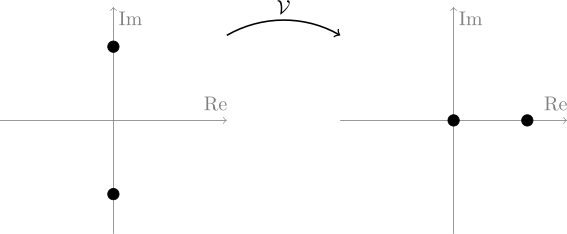
<img src="/assets/2025/08/09/viete_example.svg" />
<figcaption>
Example of the Vi&egrave;te map on the roots of the polynomial @@x^2 + 1@@.
</figcaption>
</figure>

<p>Apparently, this map has a name; @@\mathcal{V}@@ is the Viète map. That
name comes from <a href="https://math.stackexchange.com/q/63196" title="Mathematics StackExchange: Continuity of the roots of a polynomial in terms of its coefficients">this</a> StackExchange thread. It mainly looks at showing the
statement from the last paragraph — that the roots of a polynomial locally
depend continuously on its coefficients. Turns out, it's not obvious how to
prove that. My intuition works for square-free polynomials, and <a href="https://en.wikipedia.org/wiki/Geometrical_properties_of_polynomial_roots#Continuous_dependence_on_coefficients" title="Wikipedia: Geometrical properties of polynomial roots">this</a>
Wikipedia page says that the holomorphic implicit function theorem gives the
required result in that case. I also like the proof given by
<a href="/assets/2025/08/09/polyroots.pdf" title="On continuous dependence of roots of polynomials on coefficients">Alexandrian</a>,<sup id="fnref:1" role="doc-noteref"><a href="#fn:1" class="footnote" rel="footnote">1</a></sup> since it uses complex analysis rather than topology.</p>

<p>Regardless, I think another way to state my observation is: the set
@@\CC^n@@ <a href="https://en.wikipedia.org/wiki/Covering_space" title="Wikipedia: Covering space">covers</a> itself multiple times.<sup id="fnref:2" role="doc-noteref"><a href="#fn:2" class="footnote" rel="footnote">2</a></sup> In fact, it @@n!@@-covers
itself, since every permutation of the roots maps to the same sequence of
coefficients. I'm not entirely sure why, but this was surprising to me. In the
context of sets, there are things like <a href="https://en.wikipedia.org/wiki/Hilbert%27s_paradox_of_the_Grand_Hotel" title="Wikipedia: Hilbert's paradox of the Grand Hotel">Hilbert's Hotel</a> and
<a href="https://en.wikipedia.org/wiki/Banach%E2%80%93Tarski_paradox" title="Wikipedia: Banach–Tarski paradox">Banach–Tarski</a>. The latter is more relevant here, since (one formulation
of) it shows that @@S^2@@ can "map over" itself twice. Neither of these examples
use continuous functions though, and I thought enforcing continuity would
prevent this from happening. Obviously, not the case.</p>

<p>This isn't even the simplest example of multiple-covering I can think of. The
circle @@S^1 \cong \RR / 2\pi\ZZ@@ covers itself any number of times. For any
positive integer @@k@@, simply do @@t \mapsto k \cdot t@@. In a similar vein,
the punctured complex plane @@\CC \setminus \{0\}@@ @@k@@-covers itself via
the map @@z \mapsto z^k@@.</p>

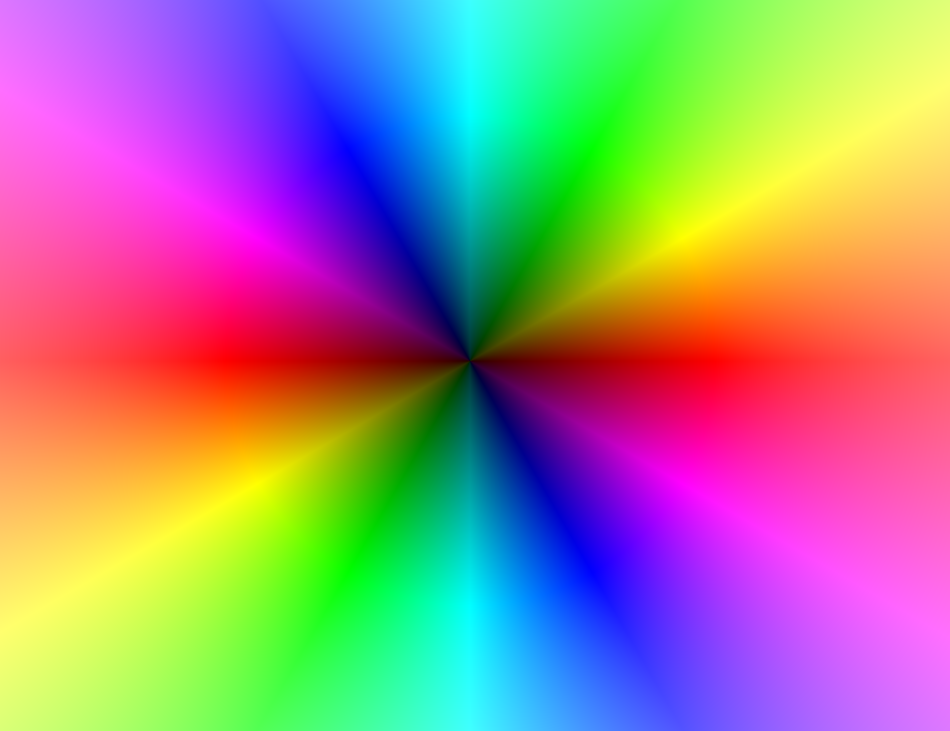
<figure>
<img src="/assets/2025/08/09/zsquared.png" width="50%" />
<figcaption>
A plot of the function @@z \mapsto z^2@@. Note that encircling the origin gives
every hue twice. Make with Samuel J. Li's
<a href="https://samuelj.li/complex-function-plotter" title="Samuel J. Li: Complex function plotter"> Complex function plotter</a>.
</figcaption>
</figure>

<hr />

<p>I started wondering if I could use @@\RR@@ to cover itself exactly @@k@@ times,
for any positive number @@k@@. At first, I considered a weaker condition:<sup id="fnref:3" role="doc-noteref"><a href="#fn:3" class="footnote" rel="footnote">3</a></sup></p>

<blockquote>
  <p><em>Definition:</em> I'll say that a continuous function @@f: X \to Y@@ @@k@@-hits
@@Y@@ if, for every @@y@@, there are exactly @@k@@ distinct @@x@@ such that
@@f(x) = y@@. If @@k \geq 2@@, then I'll say that @@f@@ multiple-hits @@Y@@.</p>
</blockquote>

<p>I make this definition by analogy to covering. It drops the requirement that
@@f@@ locally be a homeomorphism, meaning it also doesn't have to have a locally
continuous inverse.</p>

<p>At first, I thought it was impossible to multiple-hit @@\mathbb{R}@@ from
@@\mathbb{R}@@ itself. Polynomials have been on my mind recently, and indeed it
is impossible for polynomials.</p>

<blockquote>
  <p><em>Observation:</em> For any polynomial @@p : \RR \to \RR@@, there is some infinite
interval @@I@@ containing points such that, for any @@y \in I@@, @@p(x) = y@@
has at most one solution.</p>
</blockquote>

<p>First note that @@p@@ will eventually become monotonic as @@x \to \pm \infty@@.
So let @@p@@ be monotonic on @@L := (-\infty, x_\min)@@ and on @@R := (x_\max,
\infty)@@. The polynomial @@p@@ need not have the same "tonicity" on @@L@@ and
@@R@@; it could be monotonically increasing on one and monotonically decreasing
on the other. Regardless, the <a href="https://en.wikipedia.org/wiki/Extreme_value_theorem" title="Wikipedia: Extreme value theorem">extreme value theorem</a> gives that, on the
interval @@M := [x_\min, x_\max]@@, @@p@@ attains a minimum and maximum
@@y_\min@@ and @@y_\max@@ respectively.</p>

<p>Now consider two candidate intervals @@I_- = (-\infty, y_\min)@@ and @@I_+ =
(y_\max, \infty)@@. By construction, no @@x \in M@@ can cause @@p@@ to evaluate
to a @@y \in I_- \cup I_+@@, so any solutions there must come from @@L@@ or
@@R@@. Using the monotonicity of @@p@@ and the fact that</p>

<p>%% y_\min \leq p(x_\min) = p(x_\max) &lt; y_\max, %%</p>

<p>we see that in fact each of @@L@@ and @@R@@ contribute at most one solution to
@@y@@s in either @@I_-@@ or @@I_+@@ (but not both). Doing casework, we can
choose one of those intervals to be the returned result. 
<span aria-label="End of proof" class="end-of-proof"><span aria-hidden="true">□</span></span></p>

<p>This observation can be made even stronger: if some @@y \in I@@ has a solution,
then all of them do. That can be shown by using the fact @@\lim_{x \to \pm
\infty} p(x) = \pm \infty@@.</p>

<p>So polynomials are not enough. Still, the technique of "sign analysis", which I
originally learned for polynomials,<sup id="fnref:4" role="doc-noteref"><a href="#fn:4" class="footnote" rel="footnote">4</a></sup> can sometimes be applied to continuous
functions.</p>

<blockquote>
  <p><em>Definition:</em> Let @@f@@ by a continuous function such that @@f(x) = y@@ has
finitely many solutions @@x_1, \cdots, x_k@@. I define the <em>sign chain</em> of
@@f@@ at @@y@@, which I denote @@\chn{f}{y}@@, as the list of length @@k+1@@
containing whether @@f@@ is greater than (@@+@@) or less than (@@-@@) @@y@@ on
the subintervals @@(-\infty, x_1)@@, @@(x_1, x_2)@@, …, @@(x_k, \infty)@@.</p>
</blockquote>

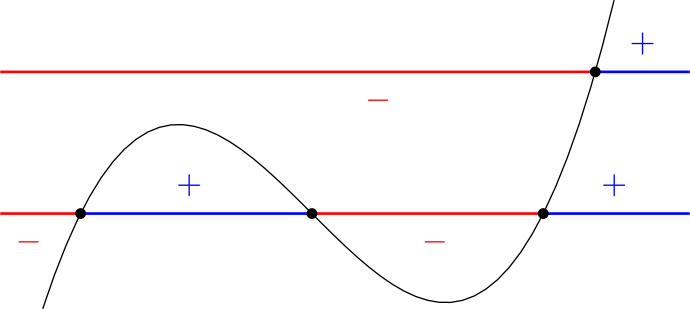
<p>So for example, consider the function @@x^3 - x@@. Its sign chain at @@y = 0@@
is @@[-, +, -, +]@@, while at @@y = 1@@ it's @@[-, +]@@. Note that the sign
chain doesn't have to alternate. Consider @@\chn{x^2}{0} = [+, +]@@.</p>

<figure>
<img src="/assets/2025/08/09/sign_chain_example.svg" />
<figcaption>
The sign chains of @@y = x^3 - x@@ at @@y = 0@@ and @@y = 1@@.
</figcaption>
</figure>

<p>This notion is well-defined. No subinterval can contain an @@x@@ where @@f(x) =
y@@. If one does, we missed a solution. Furthermore, no subinterval can contain
@@x_a, x_b@@ such that @@f(x_a) &lt; y@@ and @@f(x_b) &gt; y@@ or vice versa. If one
does, then the <a href="https://en.wikipedia.org/wiki/Intermediate_value_theorem" title="Wikipedia: Intermediate value theorem">intermediate value theorem</a> can find a solution we missed.</p>

<blockquote>
  <p><em>Definition:</em> If @@c@@ is a sign chain, I define the <em>sign</em> of that sign
chain, which I denote @@\sgn{c}@@, as even (@@+1@@) if consecutive elements of
@@c@@ differ an even number of times, and odd (@@-1@@) otherwise.
Equivalently, @@\sgn{c}@@ is even if the first and last elements of @@c@@ are
the same, and odd if they are different.</p>
</blockquote>

<p>So for example, @@\sgn{[-, +, -, +]} = -1@@, while @@\sgn{[+, +]} = +1@@.</p>

<p>Usually, we were interested in sign chains of polynomials at zero. Those are
particularly helpful for plotting, and they have some nice properties. For
example, the sign of any sign chain for any polynomial concides with the parity
of that polynomial's degree, and the sign difference between consecutive
elements of the sign chain at zero gives the parity of the multiplicity of the
corresponding root.</p>

<p>Returning to our original goal of multiple-hitting @@\RR@@ though, we have the
following.</p>

<blockquote>
  <p><em>Lemma:</em> Let @@f : \RR \to \RR@@ be a surjective continuous function, and let
@@f(x) = y@@ have only finitely many solutions @@x_1, \cdots, x_k@@ for some
@@y@@. Then, @@\sgn{\chn{f}{y}} = -1@@.</p>
</blockquote>

<p>We'll prove the contrapositive. Assume @@\sgn{\chn{f}{y}} = +1@@, and without
loss of generality assume the first entry in @@\chn{f}{y}@@ is a @@+@@. Then the
last entry is also a @@+@@ due to the sign of the sign chain. Ultimately @@f(x)
&gt; y@@ when @@x \in (-\infty, x_1) \cup (x_k, \infty)@@. Furthermore, the
extreme value theorem bounds @@f(x) \in [y_\min, y_\max]@@ when @@x \in [x_1,
x_k]@@. Note that, @@y \geq y_\min@@ since @@y = f(x_1)@@ and @@y = f(x_k)@@ by
definition. No matter where @@x@@ is located, we have that @@f(x) \geq y_\min@@,
so @@f@@ cannot be surjective. 
<span aria-label="End of proof" class="end-of-proof"><span aria-hidden="true">□</span></span></p>

<blockquote>
  <p><em>Theorem:</em> If @@f : \RR \to \RR@@ @@k@@-hits, then @@k@@ is odd.</p>
</blockquote>

<p>Start by picking any @@y@@. Let @@x_1, \cdots, x_k@@ be the solutions to @@f(x)
= y@@, and let @@c = \chn{f}{y}@@. Now we'll consider offsetting @@y@@ by a
small amount. For now, we'll consider shifting it up to @@y + \epsilon@@. If we
do this, every subinterval @@(x_i, x_{i+1})@@ of @@c@@ where @@f(x) &gt; y@@ —
every "interior" @@+@@ subinterval — gives at least two solutions to @@f(x) =
y + \epsilon@@. To see this, choose @@\epsilon@@ small enough that</p>

<p>%% f(x_i), f(x_{i+1}) = y &lt; y + \epsilon &lt; \max_{x \in (x_i, x_{i+1})} f(x). %%</p>

<p><sup id="fnref:5" role="doc-noteref"><a href="#fn:5" class="footnote" rel="footnote">5</a></sup> The intermediate value theorem gives at least two crossing points: one on
the way up to the maximum from @@f(x_i)@@, and one on the way back down from the
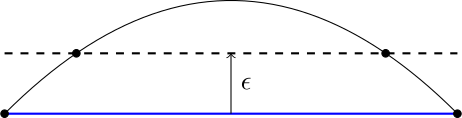
maximum to @@f(x_{i+1})@@.</p>

<figure>
<img src="/assets/2025/08/09/interior.svg" />
<figcaption>
The new solutions after nudging @@y@@ on an interior interval.
</figcaption>
</figure>

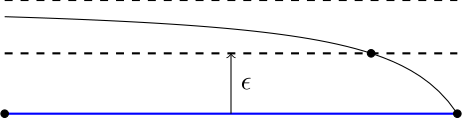
<p>Now for the "exterior" subintervals. Due to the previous lemma, exactly one of
those two subintervals of @@c@@ — either @@(-\infty, x_1)@@ or @@(x_k,
\infty)@@ — is @@+@@ and thus has @@f(x) &gt; y@@. Without loss of generality,
let's say its the left one. This subinterval gives at least one solution to
@@f(x) = y + \epsilon@@. Again, choose any @@\epsilon@@ small enough that</p>

<p>%% f(x_1) = y &lt; y + \epsilon &lt; \sup_{x \in (-\infty, x_1)} f(x). %%</p>

<p><sup id="fnref:6" role="doc-noteref"><a href="#fn:6" class="footnote" rel="footnote">6</a></sup> If we do that, we have @@f(x) &gt; y + \epsilon@@ for some @@x \in (-\infty,
x_1)@@, at which point the intermediate value theorem gives a point with
equality.</p>

<figure>
<img src="/assets/2025/08/09/exterior.svg" />
<figcaption>
The new solutions after nudging @@y@@ on an exterior interval.
</figcaption>
</figure>

<p>In the end, if @@n_+@@ is the number of @@+@@ intervals in @@c@@, then @@f(x) =
y + \epsilon@@ has at least @@2n_+ - 1@@ solutions. The @@n_+ - 1@@ interior
subintervals contribute at least two solutions each, and the one exterior
subinterval gives at least one more. Now since @@f@@ @@k@@-hits @@\RR@@, we have</p>

<p>%% 2n_+ - 1 \leq k. %%</p>

<p>We considered shifting @@y@@ up by a small amount here, but we could've shifted
it down by a small amount. Doing analogous steps gives</p>

<p>%% 2n_- - 1 \leq k. %%</p>

<p>And of course, every subinterval is either @@+@@ or @@-@@, so @@n_+ + n_- = k +
1@@, which is the length of the whole list @@c@@.</p>

<p>Now, algebra. We can sum the two inequalities to find that</p>

<p>%% 2n_+ + 2n_- \leq k + 2. %%</p>

<p>But doubling the equality constraint gives</p>

<p>%% 2n_+ + 2n_- = k + 2. %%</p>

<p>The only way for this to work is for both the inequalities to be tight. In other
words,</p>

<p>%%
\begin{align*}
  n_+,n_- &amp;= \frac{k+1}{2}.
\end{align*}
%%</p>

<p>Since @@n_+@@ and @@n_-@@ are both integers, this only works if @@k@@ is odd. 
<span aria-label="End of proof" class="end-of-proof"><span aria-hidden="true">□</span></span></p>

<p>(I really hope this proof is correct. I don't fully understand how badly behaved
continuous functions can be though!)</p>

<p>So that gives us some constraints on what multiple-hitting functions look like.
But can we get a concrete example? I found this:</p>

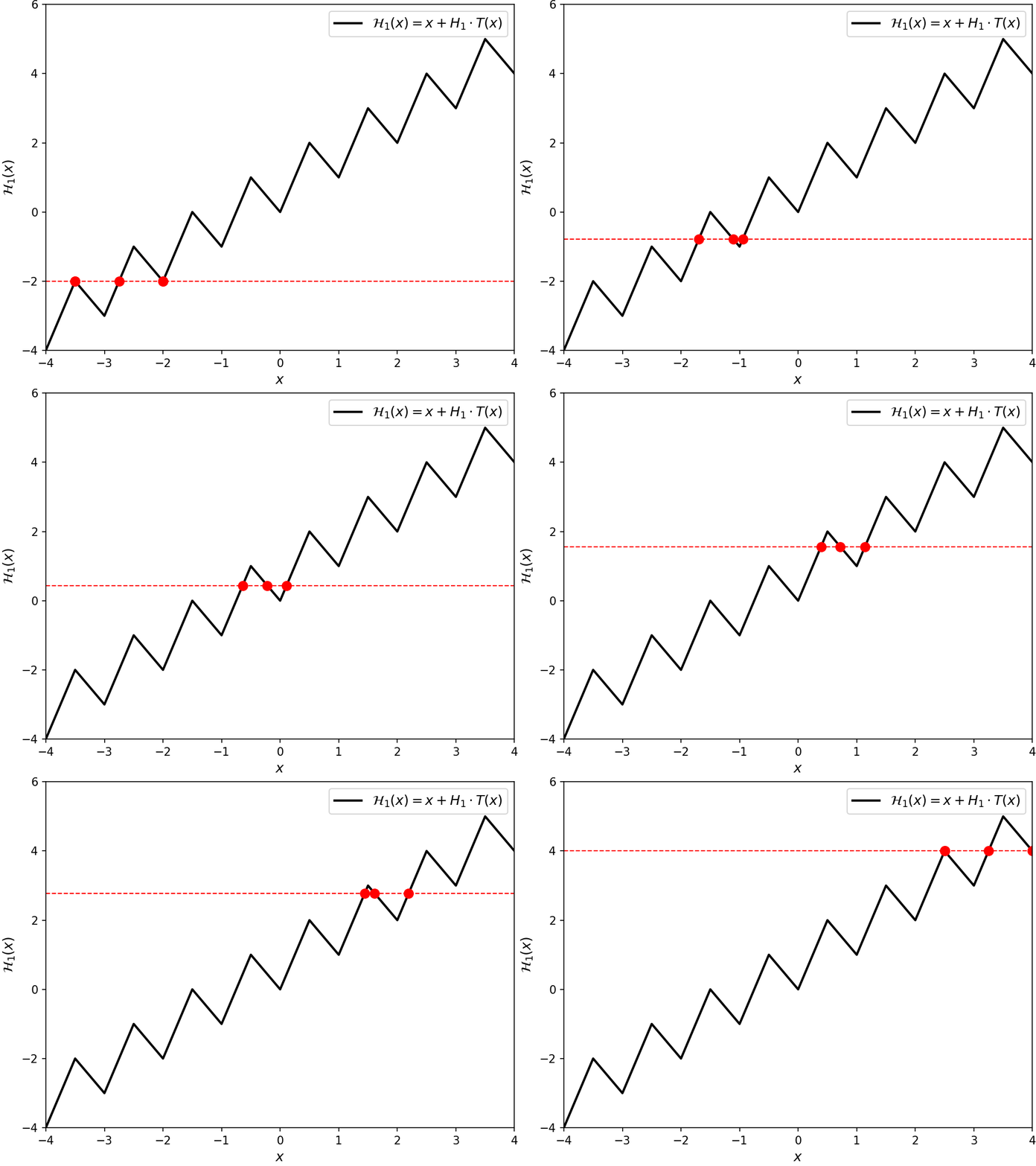
<p>%% \mathcal{H}_1(x) = x + H_1 \cdot T(x), %%</p>

<p>where</p>

<p>%%
T(x) = \begin{cases}
  \{x\} &amp; \text{if } \{x\} \leq \frac{1}{2} \nl
  1 - \{x\} &amp; \text{if } \{x\} \geq \frac{1}{2}
\end{cases},
%%</p>

<p>@@\{x\} = x - \lfloor x \rfloor@@ is the <a href="https://en.wikipedia.org/wiki/Fractional_part" title="Wikipedia: Fractional part">fractional part</a> of the real
number @@x@@, and @@H_1@@ happens to be @@3@@. The function @@T@@ is a <a href="https://en.wikipedia.org/wiki/Triangle_wave" title="Wikipedia: Triangle wave">triangle
wave</a> starting at zero with a period of one and spanning @@[0,
\frac{1}{2}]@@. This function seems to @@3@@-hit @@\RR@@, as shown in the plot
below. Sweeping up the @@y@@-axis, each "trough" creates a new solution which
then splits into two. These two solutions go to the two adjacent "peaks", where
they each merge with another solution, then annihilate. The scaling factor
@@H_1@@ times it so that a solution pair is annihilated precisely when a new one
is created, so overall the number of solutions always remains the same.</p>

<figure>
<img src="/assets/2025/08/09/h1_plot/h1_plot.gif" width="75%" />
<figcaption>
Plot of @@\mathcal{H}_1@@, along with the solutions as @@y@@ is swept from
@@-2@@ to @@4@@.
</figcaption>
</figure>

<p>In general, it seems this framework can be used to create functions that @@(2t +
1)@@-hit @@\RR@@, for all positive integers @@t@@. Because of the theorem above,
this framework gives examples of functions that @@k@@-hit @@\RR@@ for every
possible value of @@k@@ (except for the trivial @@k = 1@@ case). We just set</p>

<p>%% H_t = 2t + 1. %%</p>

<p>I got that value by solving for when the trough at @@x = 0@@ is at the same
height as the peak at @@x = -\frac{1}{2}(2t + 1)@@.</p>

<hr />

<p>Even though these @@\mathcal{H}_t@@ functions multiple-hit @@\mathbb{R}@@, they
don't multiple-cover @@\mathbb{R}@@ since their inverse isn't locally
continuous. To see this, observe that at @@x = 0@@ the output is @@y = 0@@. But
if nudge the output down slightly to @@y = -\epsilon@@, I can't make a small
nudge to the input to acheive that output, since it's in the middle of a trough.
I think this is fundamental:</p>

<blockquote>
  <p><em>Conjecture:</em> No simply connected topological space admits a (non-trivial)
multiple-covering.</p>
</blockquote>

<p>This statement is actually true; see <a href="https://math.stackexchange.com/a/2846730" title="If Y is simply connected, then it doesn't admit covering maps that aren't homeomorphisms">this</a> StackExchange thread and
<a href="https://www.partiallyordered.com/posts/covering-spaces" title="Covering spaces">this</a> blog post. I just don't know the machinery to prove it, so I mark it
as a conjecture.</p>

<p>If we require the covering space @@p : \tilde{X} \to X@@ to be path-connected, I
think I want to do the following. Suppose @@x \in X@@ has two preimages
@@\tilde{x}_0@@ and @@\tilde{x}_1@@. Let @@\tilde{\gamma}@@ be a path in
@@\tilde{X}@@ between those two points. Under @@p@@, that path maps to a loop
@@\gamma@@ in @@X@@. But since @@X@@ is simply connected, we can contract
@@\gamma@@ to a point. I want to continuously deform @@\tilde{\gamma}@@ so that
it always maps to @@\gamma@@ throughout the contraction.</p>

<p>In the end, @@\tilde{\gamma}@@ would be a path from @@\tilde{x}_0@@ to
@@\tilde{x}_1@@, while @@\gamma@@ is constant at @@x@@. We'd get an entire
continuous path of points mapping to the same point. And because @@p@@ is a
covering, this would give a large family of open sets in @@\tilde{X}@@, each
disjoint from each other, and each homeomorphic to a particular open set
containing @@x@@. This is certainly weird. It should be possible to derive a
contradiction from here, or at the very least to add more conditions to
@@\tilde{X}@@ to cause a contradiction. 
<span aria-label="End of proof" class="end-of-proof"><span aria-hidden="true">□</span></span></p>

<figure>
<img src="/assets/2025/08/09/path_covering.svg" />
<figcaption>
Diagram of the situation we have after contracting @@\gamma@@. We have a deck of
open sets in @@\tilde{X}@@, all homeomorphic to a particular open set in @@X@@,
and all mapped to from the interval @@[0,1]@@.
</figcaption>
</figure>

<p>At the very least, this conjecture is consistent with the datapoints we've
collected so far. The circle @@S^1@@ and the nonzero complex numbers @@\CC
\setminus \{0\}@@ both can be multiple-covered — by themselves in fact —
and are both not simply connected. You may object, saying that the map that
started this whole adventure @@\mathcal{V} : \CC^n \to \CC^n@@ is a
counterexample. Unfortunately, I lied. The Viète map fails to be a
covering space since, even though it is locally invertible, it is not uniquely
locally invertible. If I have @@\mathcal{V}(\mathbf{c}) = \mathbf{r}@@, and I
make a small adjustment to get @@\mathbf{r}^\prime@@, I may have multiple
choices for @@\mathbf{c}^\prime@@. As an example, consider @@\mathbf{r} = x^2@@
and @@\mathbf{c} = (x-0)\cdot(x-0)@@. If I perturb @@\mathbf{r}^\prime = x^2 -
\epsilon^2@@, then I can choose between @@\mathbf{c}^\prime = (x + \epsilon)
\cdot (x - \epsilon)@@ or @@(x - \epsilon) \cdot (x + \epsilon)@@. Order matters
here since we're viewing these as vectors.</p>

<p>We can restrict @@\mathcal{V}@@ by forcing its inputs to have distinct elements.
In that case, it would map from the <a href="https://en.wikipedia.org/wiki/Configuration_space_(mathematics)" title="Wikipedia: Configuration space (mathematics)">configuration space</a> @@\Conf{\CC}{n}@@
to some subset of @@\CC^n@@. It wouldn't map to the whole space though, so it
wouldn't constitute a multiple-cover. Still,</p>

<blockquote>
  <p><em>Theorem:</em> Assuming @@n \geq 2@@, @@\Conf{\CC}{n}@@ is not simply connected.</p>
</blockquote>

<p>Intuitively, we're starting with something that looks like a real vector space
of dimension @@2n@@ and removing a finite number of subspaces of dimension @@2n
- 2@@. This space is path connected because disconnecting @@\RR^{2n}@@ requires
removing a subspace of dimension @@2n-1@@ or higher. It's not simply connected
since we can create non-contractible loops by wrapping a path, occupying a
two-dimensional plane, around one of the subspaces we removed.</p>

<p>Formally, I'll just show that there exist non-contractible loops in
@@\Conf{\CC}{n}@@.<sup id="fnref:7" role="doc-noteref"><a href="#fn:7" class="footnote" rel="footnote">7</a></sup> Suppose for the sake of contradiction that the path</p>

<p>%% \gamma(t) = \begin{pmatrix} e^{2\pi i \cdot t} &amp; -e^{2\pi i \cdot t} &amp; z_3 &amp; \cdots &amp; z_n \end{pmatrix}^\intercal %%</p>

<p>is contractible to a point. It doesn't matter what the higher components @@z_3,
\cdots, z_n@@ are exactly, as long as they are distinct and don't lie on the
unit circle. Now look at the function</p>

<p>%% f(\mathbf{z}) = z_1 - z_2 %%</p>

<p>that subtracts the first two components of the supplied vector. If the domain of
@@f@@ is taken to be @@\Conf{\CC}{n}@@, then the range of @@f@@ is the punctured
complex plane @@\CC \setminus \{0\}@@ because @@z_1 \neq z_2@@.</p>

<p>Now, @@f \circ \gamma@@ is a continuous loop in that plane. In fact, it is the
loop that starts at @@2@@ and encircles the origin once counterclockwise. But if
@@\gamma@@ is contractible to a point, then @@f \circ \gamma@@ is as well —
indeed, a small adjustment to the input loop gives a small change to the output
loop. But it's known that continuously contracting a loop encircling the origin
down to a point is impossible. 
<span aria-label="End of proof" class="end-of-proof"><span aria-hidden="true">□</span></span></p>

<figure>
<img src="/assets/2025/08/09/noncontractible_path.svg" />
<figcaption>
An example of a path in @@\Conf{\CC}{n}@@ that can't be contracted to a point:
two points orbiting a common center, both reaching their midpoint at the same
time. Interestingly, if one point follows its path before the other, the path
may be contractible. Only having both points move in sync causes their
difference to encircle the origin.
</figcaption>
</figure>

<blockquote>
  <p><em>Corollary:</em> The image @@\mathcal{V}(\Conf{\CC}{n})@@ is not simply connected.</p>
</blockquote>

<p>From above, consider @@\mathcal{V} \circ \gamma@@. By assumption, the resulting
loop is contractible to a point, so all of the preimages of that loop can also
be contracted; this comes from the homotopy lifting property. But the argument
above shows that can't happen in this case. 
<span aria-label="End of proof" class="end-of-proof"><span aria-hidden="true">□</span></span></p>

<hr />

<p>I think I'm gonna end things off here. This was an interesting rabbit hole to
dive down. I've never had any formal training in topology or even analysis; I
studied to be a computer scientist, after all. Still, I think I learned a good
deal by trying to understand statements made in the languages of those areas.
Either way, I think I'd have an easier time picking them up if I have to in the
future.</p>

<div class="footnotes" role="doc-endnotes">
  <ol>
    <li id="fn:1" role="doc-endnote">
      <p><a href="https://aalexan3.math.ncsu.edu/articles/polyroots.pdf" title="On continuous dependence of roots of polynomials on coefficients">Original</a> <a href="#fnref:1" class="reversefootnote" role="doc-backlink">&#8617;</a></p>
    </li>
    <li id="fn:2" role="doc-endnote">
      <p>As written, this statement is actually false. I'll get to that later, but
just go with it for now. <a href="#fnref:2" class="reversefootnote" role="doc-backlink">&#8617;</a></p>
    </li>
    <li id="fn:3" role="doc-endnote">
      <p>Actually, I started with the even weaker condition that @@f(x) = y@@ has
more than one solution for every @@y@@. I found that @@f(x) = x \cdot
\sin(x)@@ satisfies that criteria. But it didn't seem in the spirit of what
I was looking for, since some values of @@y@@ get "more" solutions than
others. <a href="#fnref:3" class="reversefootnote" role="doc-backlink">&#8617;</a></p>
    </li>
    <li id="fn:4" role="doc-endnote">
      <p>I think this was covered in Algebra II, which I took in 9th grade. Of
course, these exact definitions and notations weren't given — just the
general idea. <a href="#fnref:4" class="reversefootnote" role="doc-backlink">&#8617;</a></p>
    </li>
    <li id="fn:5" role="doc-endnote">
      <p>We have that @@f(x)@@ attains its maximum value on the open @@+@@
subinterval @@(a, b)@@. The intermediate value theorem guarantees a maximum
on the closed interval @@[a, b]@@. But, @@f(a), f(b) = y@@, and every point
in the interior of the interval has @@f(x) &gt; y@@, so the endpoints can't
possibly be the maxima. <a href="#fnref:5" class="reversefootnote" role="doc-backlink">&#8617;</a></p>
    </li>
    <li id="fn:6" role="doc-endnote">
      <p>Here, the suprenum is taken to be @@\infty@@ if it doesn't exist. <a href="#fnref:6" class="reversefootnote" role="doc-backlink">&#8617;</a></p>
    </li>
    <li id="fn:7" role="doc-endnote">
      <p>I don't formally show that @@\Conf{\CC}{n}@@ is in fact path connected. <a href="#fnref:7" class="reversefootnote" role="doc-backlink">&#8617;</a></p>
    </li>
  </ol>
</div>]]></content><author><name>Ammar Ratnani</name><email>ammrat13@gmail.com</email></author><category term="mathematics" /><summary type="html"><![CDATA[I've been playing around with polynomials recently. One thing struck me about the association between the roots of a polynomial and its coefficients. As you know, the coefficients of a monic polynomial of degree @@n@@ are completely determined by its set of @@n@@ roots. So, we can map vectors of roots @@\begin{pmatrix} r_1 &amp; \cdots &amp; r_n \end{pmatrix}^\intercal \in \CC^n@@ to their vectors of coefficients @@\begin{pmatrix} c_0 &amp; \cdots &amp; c_{n-1} \end{pmatrix}^\intercal \in \CC^n@@ via]]></summary></entry><entry><title type="html">Algorithms for Fast Polynomial Evaluation</title><link href="https://ammrat13.org/2025/07/12/fast_polynomial_evaluation.html" rel="alternate" type="text/html" title="Algorithms for Fast Polynomial Evaluation" /><published>2025-07-12T00:00:00+00:00</published><updated>2025-07-12T00:00:00+00:00</updated><id>https://ammrat13.org/2025/07/12/fast_polynomial_evaluation</id><content type="html" xml:base="https://ammrat13.org/2025/07/12/fast_polynomial_evaluation.html"><![CDATA[<p>This post is a follow-on to my previous one on <a href="/2025/07/02/fast_cubic_evaluation.html" title="Ammar Ratnani's Site: Fast Cubic Evaluation">Fast Cubic Evaluation</a>. I got
to thinking about how the algorithms discussed there could be generalized to
polynomials of arbitrary degree — say @@p@@ of degree @@N@@. Estrin's Scheme
works out-of-the-box. Horner's Scheme and Knuth's Algorithm are unworkable in
hardware though, since naïvely translating them both gives a critical path
of length @@\order(N)@@.</p>

<p>The strategy I came up with was to factor the polynomial in question @@p@@ into
quadratics, writing<sup id="fnref:1" role="doc-noteref"><a href="#fn:1" class="footnote" rel="footnote">1</a></sup></p>

<p>%% p(x) = k \cdot (x^2 + a_1 x + b_1) \cdots (x^2 + a_{N/2} x + b_{N/2}). %%</p>

<p>This is always possible due to the fundamental theorem of algebra and the
complex conjugate root theorem. We write @@p@@ this way because it naturally
gives a parallel algorithm for evaluating @@p(x)@@. Each factor is evaluated in
parallel, then a reduction network is used to multiply them all together.</p>

<p>With this Factorization-Based Algorithm, each of the @@N/2@@ terms needs two
adders, but just one multiplier since the @@x^2@@ can be computed once and
reused across all the terms. The final reduction needs @@(N/2 + 1) - 1 = N/2@@
multipliers. In total, @@N@@ adders and @@N@@ multipliers are needed. So, this
algorithm matches the hardware requirements of Horner's Scheme. However, its
critical path is much shorter. Each factor has one multiplier and two adders on
its critical path, and the final reduction has a critical path of @@\lceil
\log(N/2+1) \rceil@@<sup id="fnref:2" role="doc-noteref"><a href="#fn:2" class="footnote" rel="footnote">2</a></sup> multipliers. Compare these figures to Estrin's Scheme,
which has @@\lceil \log(N+1) \rceil@@ multipliers and @@\lceil \log(N+1)
\rceil@@ adders on its critical path. Ultimately, preprocessing allows this
Factorization-Based Algorithm to achieve a shorter critical path than Estrin's
Scheme while also saving area.</p>

<p>Claude suggested that I add worked example for this algorithm. So, consider
@@N=5@@ and</p>

<p>%% p(x) = x^5 + 2x^4 + 3x^3 + 4x^2 + 5x + 6. %%</p>

<p>The polynomial @@p@@ has roots</p>

<p>%%
\begin{align*}
  r_1 &amp;\approx -1.492 \nl
  r_2 &amp;\approx -0.806 + 1.223i \nl
  r_3 &amp;\approx -0.806 - 1.223i \nl
  r_4 &amp;\approx 0.552 + 1.253i \nl
  r_5 &amp;\approx 0.552 - 1.253i.
\end{align*}
%%</p>

<p>The roots @@r_2@@ and @@r_3@@ are conjugates, as are @@r_4@@ and @@r_5@@. Those
roots have to be merged to form quadratics, while the remaining roots can be
merged. Ultimately, we write</p>

<p>%% p(x) = k \cdot (x + b_0) \cdot (x^2 + a_1 x + b_1) \cdot (x^2 + a_2 x + b_2), %%</p>

<p>where the constants are chosen such that</p>

<p>%%
\begin{align*}
  k &amp;= 1 \nl
  x + b_0 &amp;= (x - r_1) \nl
  x^2 + a_1 x + b_1 &amp;= (x - r_2) \cdot (x - r_3) \nl
  x^2 + a_2 x + b_2 &amp;= (x - r_4) \cdot (x - r_5).
\end{align*}
%%</p>

<p>This particular case gives</p>

<p>%%
\begin{align*}
  b_0 &amp;\approx 1.492 \nl
  a_1 &amp;\approx 1.612 \nl
  b_1 &amp;\approx 2.145 \nl
  a_2 &amp;\approx 1.103 \nl
  b_2 &amp;\approx 1.875.
\end{align*}
%%</p>

<p>All of the work above only has to be done once, offline. The hardware will only
see these coefficients, at which point it can run the data-flow graph given
below.</p>

<figure>
<pre class="mermaid">
flowchart TB
  xsqin[$$x$$]
  xsq[$$x^2$$]
  sq[$$\times$$]
  xsqin --&gt; sq
  xsqin --&gt; sq
  sq --&gt; xsq

  x0[$$x$$]
  b0[$$b_0$$]
  add0[$$+$$]
  x0 --&gt; add0
  b0 --&gt; add0

  xsq1[$$x^2$$]
  x1[$$x$$]
  a1[$$a_1$$]
  b1[$$b_1$$]
  mult1[$$\times$$]
  add1lo[$$+$$]
  add1hi[$$+$$]
  a1 --&gt; mult1
  x1 --&gt; mult1
  mult1 --&gt; add1lo
  b1 --&gt; add1lo
  xsq1 --&gt; add1hi
  add1lo --&gt; add1hi

  xsq2[$$x^2$$]
  x2[$$x$$]
  a2[$$a_2$$]
  b2[$$b_2$$]
  mult2[$$\times$$]
  add2lo[$$+$$]
  add2hi[$$+$$]
  a2 --&gt; mult2
  x2 --&gt; mult2
  mult2 --&gt; add2lo
  b2 --&gt; add2lo
  xsq2 --&gt; add2hi
  add2lo --&gt; add2hi

  red1[$$\times$$]
  red2[$$\times$$]
  add1hi --&gt; red1
  add2hi --&gt; red1
  add0 --&gt; red2
  red1 --&gt; red2

  red2 --&gt; Output
</pre>
<figcaption>
Data-flow graph of the Factorization-Based Algorithm on the worked example. Note
how @@x^2@@ is computed once and reused in multiple places.
</figcaption>
</figure>

<p>That's all I have. It's not particularly original, but the idea of breaking a
polynomial into factors does give rise to a pleasingly parallel algorithm. And
note that the factoring doesn't have to continue all the way down to quadratics.
It may be profitable to stop at some higher degree, especially since more
efficient serial algorithms exist and it may not be possible to exploit such a
high degree of parallelism. As a concrete example, perhaps when evaluating a
polynomial of degree @@N=128@@, you could stop at factoring @@N=16@@ and use
Knuth's Algorithm for those eight degree sixteen terms. Knuth's Algorithm would
only require nine multipliers instead of the usual sixteen, but it is serial
which makes the critical path longer. In other words, less area can be traded
for greater latency. Also, this same idea — of breaking polynomials down
recursively then using an efficient serial algorithm to evaluate them — is
present in the <a href="https://doi.org/10.1002/cpa.3160250405" title="Fast evaluation of polynomials by rational preparation">Rabin-Winograd Algorithm</a></p>

<p>Another note: this Factorization-Based Algorithm heavily uses multipliers. They
dominate the critical path, and either way more of them are used than in Knuth's
Algorithm. This is by design. During my time on <a href="https://doi.org/10.1109/VLSITechnologyandCir46783.2024.10631515" title="MINOTAUR: An Edge Transformer Inference and Training Accelerator with 12 MBytes On-Chip Resistive RAM and Fine-Grained Spatiotemporal Power Gating">MINOTAUR</a>, I observed that
<a href="https://cloud.google.com/blog/products/ai-machine-learning/bfloat16-the-secret-to-high-performance-on-cloud-tpus" title="BFloat16: The secret to high performance on Cloud TPUs">BFloat16</a> multipliers on our technology<sup id="fnref:3" role="doc-noteref"><a href="#fn:3" class="footnote" rel="footnote">3</a></sup> took half the time and less area
than BFloat16 adders. Hence, this algorithm tries to keep adders off the
critical path. If the balance were to shift in favor of addition, perhaps the
naïve scheme would work better.</p>

<p>Finally, Claude suggested I consider numerical stability. It is known that small
errors in roots can cascade into large errors in the final value. Considering
we're using BFloat16 with just seven mantissa bits, and I intend to store all
the coefficients with the same precision, the accuracy of the underlying model
could tank. For what it's worth, no accuracy penalty was observed on MINOTAUR
when using Horner's or Estrin's Schemes, or indeed when switching to piecewise
cubic activations. But it's still possible this aggressive factorization causes
too much error. But I haven't tested that, and frankly I don't think I will now
that I'm off MINOTAUR.</p>

<div class="footnotes" role="doc-endnotes">
  <ol>
    <li id="fn:1" role="doc-endnote">
      <p>Here, each @@a_i, b_i \in \RR@@. In general, all operations are done over
@@\RR@@ unless explicitly stated otherwise. <a href="#fnref:1" class="reversefootnote" role="doc-backlink">&#8617;</a></p>
    </li>
    <li id="fn:2" role="doc-endnote">
      <p>All @@\log@@s are done in base two. <a href="#fnref:2" class="reversefootnote" role="doc-backlink">&#8617;</a></p>
    </li>
    <li id="fn:3" role="doc-endnote">
      <p>MINOTAUR was designed for TSMC16 and a 200MHz clock. <a href="#fnref:3" class="reversefootnote" role="doc-backlink">&#8617;</a></p>
    </li>
  </ol>
</div>]]></content><author><name>Ammar Ratnani</name><email>ammrat13@gmail.com</email></author><category term="mathematics" /><category term="algorithms" /><summary type="html"><![CDATA[This post is a follow-on to my previous one on Fast Cubic Evaluation. I got to thinking about how the algorithms discussed there could be generalized to polynomials of arbitrary degree — say @@p@@ of degree @@N@@. Estrin's Scheme works out-of-the-box. Horner's Scheme and Knuth's Algorithm are unworkable in hardware though, since naïvely translating them both gives a critical path of length @@\order(N)@@.]]></summary></entry><entry><title type="html">Algorithms for Fast Cubic Evaluation</title><link href="https://ammrat13.org/2025/07/02/fast_cubic_evaluation.html" rel="alternate" type="text/html" title="Algorithms for Fast Cubic Evaluation" /><published>2025-07-02T00:00:00+00:00</published><updated>2025-07-02T00:00:00+00:00</updated><id>https://ammrat13.org/2025/07/02/fast_cubic_evaluation</id><content type="html" xml:base="https://ammrat13.org/2025/07/02/fast_cubic_evaluation.html"><![CDATA[<p>It's been a while; a lot's happened. I got accepted to Stanford's MS CS program,
and I even graduated from there last month. During my last quarter there, I took
<em>EE 372: Design Projects in VLSI Systems II</em>. In the iteration of the course I
took, <a href="https://priyanka-raina.github.io/" title="Priyanka Raina: Assistant Professor, Stanford University">Priyanka</a> essentially gave us the source code for <a href="https://doi.org/10.1109/VLSITechnologyandCir46783.2024.10631515" title="MINOTAUR: An Edge Transformer Inference and Training Accelerator with 12 MBytes On-Chip Resistive RAM and Fine-Grained Spatiotemporal Power Gating">MINOTAUR</a>, and
asked us to improve it however we saw fit. I mainly focused on improving the
vector unit — the part of the accelerator that handles activations,
element-wise operations, and other low arithmetic-intensity tasks.</p>

<p>I was not the only one working on the vector unit though. Another group looked
at changing the strategy it used to compute activation functions. Ultimately,
they settled on piecewise-cubic activations, with programmable coefficients and
interval bounds. I interacted with them, and I investigated ways to make the
computation of these cubic polynomials more efficient.</p>

<p>Let's say we have some</p>

<p>%% p(x) = c_3 x^3 + c_2 x^2 + c_1 x + c_0. %%</p>

<p>Naïvely implementing this in hardware, by evaluating all the
multiplications before computing the additions, gives a relatively poor result.
It requires six multipliers and three adders, and its critical path consists of
two multipliers and two adders.</p>

<figure>
<pre class="mermaid">
flowchart TB
    x3[$$x$$]
    x2[$$x$$]
    x1[$$x$$]

    c0[$$c_0$$]
    c1[$$c_1$$]
    c2[$$c_2$$]
    c3[$$c_3$$]

    c3m0[$$\times$$]
    c3m1[$$\times$$]
    c3m2[$$\times$$]
    c3 --&gt; c3m0
    x3 --&gt; c3m0
    x3 --&gt; c3m1
    x3 --&gt; c3m1
    c3m0 --&gt; c3m2
    c3m1 --&gt; c3m2

    c2m0[$$\times$$]
    c2m1[$$\times$$]
    c2 --&gt; c2m0
    x2 --&gt; c2m0
    c2m0 --&gt; c2m1
    x2 --&gt; c2m1

    c1m0[$$\times$$]
    c1 --&gt; c1m0
    x1 --&gt; c1m0

    a0[$$+$$]
    a1[$$+$$]
    a2[$$+$$]
    c3m2 --&gt; a0
    c2m1 --&gt; a0
    c1m0 --&gt; a1
    c0 --&gt; a1
    a0 --&gt; a2
    a1 --&gt; a2

    a2 --&gt; Output
</pre>
<figcaption>
Data-flow graph of the na&iuml;ve cubic evaluation algorithm. The @@\times@@
nodes multiply their two inputs, while the @@+@@ nodes add them. Furthermore,
the input @@x@@ is duplicated and used in multiple places.
</figcaption>
</figure>

<p>A better idea is to use <a href="https://en.wikipedia.org/w/index.php?title=Horner%27s_method&amp;oldid=1292763330" title="Horner's method">Horner's Scheme</a>, which decomposes @@p@@ as</p>

<p>%% p(x) = ((c_3 \cdot x + c_2) \cdot x + c_1) \cdot x + c_0. %%</p>

<p>It has a longer critical path, at three multipliers and three adders. But, it
uses less area — just the three multipliers and three adders. Possibly for
that reason, this was the initial scheme used in MINOTAUR. Area is particularly
important for its vector unit. Most of its operations are performed on 32-wide
vectors, pipelined and in parallel. So, any area savings are multiplied by 32.</p>

<figure>
<pre class="mermaid">
flowchart TB
    x3[$$x$$]
    x2[$$x$$]
    x1[$$x$$]

    c0[$$c_0$$]
    c1[$$c_1$$]
    c2[$$c_2$$]
    c3[$$c_3$$]

    c3m[$$\times$$]
    c2a[$$+$$]
    c3 --&gt; c3m
    x3 --&gt; c3m
    c3m --&gt; c2a
    c2 --&gt; c2a

    c2m[$$\times$$]
    c1a[$$+$$]
    c2a --&gt; c2m
    x2 --&gt; c2m
    c2m --&gt; c1a
    c1 --&gt; c1a

    c1m[$$\times$$]
    c0a[$$+$$]
    c1a --&gt; c1m
    x1 --&gt; c1m
    c1m --&gt; c0a
    c0 --&gt; c0a

    c0a --&gt; Output
</pre>
<figcaption>
Data-flow graph of Horner's Scheme.
</figcaption>
</figure>

<p>Another improvement over the naïve approach is to use <a href="https://doi.org/10.1145/1460361.1460365" title="Organization of computer systems: the fixed plus variable structure computer">Estrin's Scheme</a>,
which instead recursively factorizes @@p@@ as</p>

<p>%% p(x) = x^2 \cdot (c_3 x + c_2) + (c_1 x + c_0). %%</p>

<p>In total, Estrin's Scheme uses four multipliers and three adders. Its critical
path consists of two multipliers and two adders. In other words, for just an
additional multiplier compared to Horner's Scheme, this algorithm improves on
its critical path by a full Multiply-Accumulate (MAC). And in fact, when this
approach was implemented in MINOTAUR, it saved area over Horner's Scheme. Its
shorter critical path allowed the pipeline depth to be reduced by one stage,
eliminating an entire set of pipeline registers.</p>

<figure>
<pre class="mermaid">
flowchart TB
    xsq[$$x$$]
    xl[$$x$$]
    xr[$$x$$]

    c0[$$c_0$$]
    c1[$$c_1$$]
    c2[$$c_2$$]
    c3[$$c_3$$]

    sq[$$\times$$]
    xsq --&gt; sq
    xsq --&gt; sq

    ml[$$\times$$]
    al[$$+$$]
    c3 --&gt; ml
    xl --&gt; ml
    ml --&gt; al
    c2 --&gt; al

    mr[$$\times$$]
    ar[$$+$$]
    c1 --&gt; mr
    xr --&gt; mr
    mr --&gt; ar
    c0 --&gt; ar

    mt[$$\times$$]
    at[$$+$$]
    sq --&gt; mt
    al --&gt; mt
    mt --&gt; at
    ar --&gt; at

    at --&gt; Output
</pre>
<figcaption>
Data-flow graph of Estrin's Scheme.
</figcaption>
</figure>

<p>The above approaches were actually synthesized in MINOTAUR. It's possible that
they leave performance on the table though. Specifically, note that all the
algorithms given above take the "raw" coefficients @@c_3@@, …, @@c_0@@ as
input. But, Wikipedia's page on <a href="https://en.wikipedia.org/w/index.php?title=Polynomial_evaluation&amp;oldid=1296426370#Evaluation_with_preprocessing" title="Polynomial evaluation § Evaluation with preprocessing">Polynomial Evaluation</a> points out that
pre-processing these coefficients can decrease the number of multipliers and
adders required. Knuth's Algorithm<sup id="fnref:1" role="doc-noteref"><a href="#fn:1" class="footnote" rel="footnote">1</a></sup> provides a concrete way to do that.</p>

<p>Knuth's Algorithm points out that, by applying polynomial long-division, we can
write</p>

<p>%% p(x) = (x^2 + \alpha) (k_1 x + k_0) + \beta x + \gamma, %%</p>

<p>for some set of constants. The only knob we have is @@\alpha@@; once it's fixed,
the divisor @@x^2 + \alpha@@ is set and the rest of the constants can be
determined. The key idea is to judiciously set @@\alpha := \alpha^*@@ such that
@@\beta = 0@@. This can be done by picking</p>

<p>%%
\begin{align*}
    \alpha^* &amp;= \frac{c_1}{k_1^*} \nl
    \gamma^* &amp;= c_0 - \alpha^* k_0^* \nl
    k_1^* &amp;= c_3 \nl
    k_0^* &amp;= c_2,
\end{align*}
%%</p>

<p>which works so long as @@c_3 \neq 0@@. That case can be worked around for
MINOTAUR. A few multiplexers can be used to reconfigure the existing multipliers
and adders for Knuth's Algorithm to implement Horner's Scheme on quadratics. In
the end, Knuth's Algorithm prescribes</p>

<figure class="highlight"><pre><code class="language-python" data-lang="python"><span class="k">def</span> <span class="nf">preprocess</span><span class="p">(</span><span class="n">c</span><span class="p">:</span> <span class="nb">list</span><span class="p">[</span><span class="nb">float</span><span class="p">]):</span>
    <span class="n">cubic</span> <span class="o">=</span> <span class="n">c</span><span class="p">[</span><span class="mi">3</span><span class="p">]</span> <span class="o">!=</span> <span class="mi">0</span>
    <span class="k">if</span> <span class="n">cubic</span><span class="p">:</span>
        <span class="n">k1</span> <span class="o">=</span> <span class="n">c</span><span class="p">[</span><span class="mi">3</span><span class="p">]</span>
        <span class="n">k0</span> <span class="o">=</span> <span class="n">c</span><span class="p">[</span><span class="mi">2</span><span class="p">]</span>
        <span class="n">α</span> <span class="o">=</span> <span class="n">c</span><span class="p">[</span><span class="mi">1</span><span class="p">]</span> <span class="o">/</span> <span class="n">k1</span>
        <span class="n">ɣ</span> <span class="o">=</span> <span class="n">c</span><span class="p">[</span><span class="mi">0</span><span class="p">]</span> <span class="o">-</span> <span class="n">α</span> <span class="o">*</span> <span class="n">k0</span>
    <span class="k">else</span><span class="p">:</span>
        <span class="n">k1</span> <span class="o">=</span> <span class="n">c</span><span class="p">[</span><span class="mi">2</span><span class="p">]</span>
        <span class="n">k0</span> <span class="o">=</span> <span class="n">c</span><span class="p">[</span><span class="mi">1</span><span class="p">]</span>
        <span class="n">α</span> <span class="o">=</span> <span class="nb">float</span><span class="p">(</span><span class="s">'nan'</span><span class="p">)</span> <span class="c1"># Don't care
</span>        <span class="n">ɣ</span> <span class="o">=</span> <span class="n">c</span><span class="p">[</span><span class="mi">0</span><span class="p">]</span>
    <span class="k">return</span> <span class="p">(</span><span class="n">cubic</span><span class="p">,</span> <span class="n">k1</span><span class="p">,</span> <span class="n">k0</span><span class="p">,</span> <span class="n">α</span><span class="p">,</span> <span class="n">ɣ</span><span class="p">)</span>

<span class="k">def</span> <span class="nf">hardware</span><span class="p">(</span>
    <span class="n">x</span><span class="p">:</span> <span class="nb">float</span><span class="p">,</span>
    <span class="n">cubic</span><span class="p">:</span> <span class="nb">bool</span><span class="p">,</span>
    <span class="n">k1</span><span class="p">:</span> <span class="nb">float</span><span class="p">,</span> <span class="n">k0</span><span class="p">:</span> <span class="nb">float</span><span class="p">,</span> <span class="n">α</span><span class="p">:</span> <span class="nb">float</span><span class="p">,</span> <span class="n">ɣ</span><span class="p">:</span> <span class="nb">float</span><span class="p">,</span>
<span class="p">)</span> <span class="o">-&gt;</span> <span class="nb">float</span><span class="p">:</span>
    <span class="n">quotient</span> <span class="o">=</span> <span class="n">k1</span> <span class="o">*</span> <span class="n">x</span> <span class="o">+</span> <span class="n">k0</span>
    <span class="n">divisor</span> <span class="o">=</span> <span class="n">x</span> <span class="o">*</span> <span class="n">x</span> <span class="o">+</span> <span class="n">α</span>
    <span class="n">whole</span> <span class="o">=</span> <span class="n">quotient</span> <span class="o">*</span> <span class="n">divisor</span> <span class="k">if</span> <span class="n">cubic</span> <span class="k">else</span> <span class="n">quotient</span>
    <span class="k">return</span> <span class="n">whole</span> <span class="o">+</span> <span class="n">ɣ</span>

<span class="k">def</span> <span class="nf">evaluate</span><span class="p">(</span><span class="n">x</span><span class="p">:</span> <span class="nb">float</span><span class="p">,</span> <span class="n">c</span><span class="p">:</span> <span class="nb">list</span><span class="p">[</span><span class="nb">float</span><span class="p">])</span> <span class="o">-&gt;</span> <span class="nb">float</span><span class="p">:</span>
    <span class="k">return</span> <span class="n">hardware</span><span class="p">(</span><span class="n">x</span><span class="p">,</span> <span class="o">*</span><span class="n">preprocess</span><span class="p">(</span><span class="n">c</span><span class="p">))</span></code></pre></figure>

<p>Ignoring MUX overhead, it requires three multipliers and three adders, and it
has a critical path of two multipliers and two adders. Thus, it is strictly
better than both Horner's and Estrin's Schemes. It does require preprocessing,
but that's okay for MINOTAUR.</p>

<figure>
<pre class="mermaid">
flowchart TB
    xq[$$x$$]
    xd[$$x$$]

    alpha[$$\alpha$$]
    gamma[$$\gamma$$]
    k0[$$k_0$$]
    k1[$$k_1$$]

    mq[$$\times$$]
    aq[$$+$$]
    k1 --&gt; mq
    xq --&gt; mq
    mq --&gt; aq
    k0 --&gt; aq

    md[$$\times$$]
    ad[$$+$$]
    xd --&gt; md
    xd --&gt; md
    md --&gt; ad
    alpha --&gt; ad

    mt[$$\times$$]
    at[$$+$$]
    aq --&gt; mt
    ad --&gt; mt
    mt --&gt; at
    gamma --&gt; at

    at --&gt; Output
</pre>
<figcaption>
Data-flow graph of Knuth's Algorithm.
</figcaption>
</figure>

<p>To close, even though none of the algorithms described here are entirely new,
they don't seem to be widely known. For instance, I independently rediscovered
Estrin's Scheme, and I came to Knuth's Algorithm myself after seeing a different
algorithm inspired by it in a source I have since lost. Furthermore in my
experience with MINOTAUR, Horner's Scheme is often treated as the "default"
approach for polynomial evaluation in hardware, even when other approaches might
be better. Either way, it was some work to find these algorithms, so hopefully
this post can save someone else from doing redoing it.</p>

<p>Another question that remains is whether Knuth's Algorithm is "optimal".
According to <a href="/assets/2025/07/02/polynomials.pdf" title="CS 497: Concrete Models of Computation - Spring 2003 - Evaluating Polynomials (March 10)">CS 497</a><sup id="fnref:2" role="doc-noteref"><a href="#fn:2" class="footnote" rel="footnote">2</a></sup> at UIUC, it is known that Knuth's Algorithm uses
the lowest possible number of multiplications and additions
(or subtractions). But, it does not show that it achieves the best possible
critical path. As shown by Estrin's Scheme in MINOTAUR, it may be better to
optimize that instead of total area.</p>

<div class="footnotes" role="doc-endnotes">
  <ol>
    <li id="fn:1" role="doc-endnote">
      <p>There are multiple sources for Knuth's Algorithm. It seems <a href="https://doi.org/10.1145/355580.369074" title="Evaluation of polynomials by computer">this paper</a>
introduced it, but Sec. 2 of <a href="https://doi.org/10.1016/S0167-8191(97)00096-3" title="Data parallel evaluation of univariate polynomials by the Knuth-Eve algorithm">this one</a> has a better exposition of it in
my opinion. <a href="#fnref:1" class="reversefootnote" role="doc-backlink">&#8617;</a></p>
    </li>
    <li id="fn:2" role="doc-endnote">
      <p><a href="https://jeffe.cs.illinois.edu/teaching/497/08-polynomials.pdf" title="CS 497: Concrete Models of Computation - Spring 2003 - Evaluating Polynomials (March 10)">Original</a> <a href="#fnref:2" class="reversefootnote" role="doc-backlink">&#8617;</a></p>
    </li>
  </ol>
</div>]]></content><author><name>Ammar Ratnani</name><email>ammrat13@gmail.com</email></author><category term="mathematics" /><category term="algorithms" /><summary type="html"><![CDATA[It's been a while; a lot's happened. I got accepted to Stanford's MS CS program, and I even graduated from there last month. During my last quarter there, I took EE 372: Design Projects in VLSI Systems II. In the iteration of the course I took, Priyanka essentially gave us the source code for MINOTAUR, and asked us to improve it however we saw fit. I mainly focused on improving the vector unit — the part of the accelerator that handles activations, element-wise operations, and other low arithmetic-intensity tasks.]]></summary></entry><entry><title type="html">DEF CON CTF 2022 Qualifiers: Same Old</title><link href="https://ammrat13.org/2022/06/13/defcon_quals_2022_sameold.html" rel="alternate" type="text/html" title="DEF CON CTF 2022 Qualifiers: Same Old" /><published>2022-06-13T00:00:00+00:00</published><updated>2022-06-13T00:00:00+00:00</updated><id>https://ammrat13.org/2022/06/13/defcon_quals_2022_sameold</id><content type="html" xml:base="https://ammrat13.org/2022/06/13/defcon_quals_2022_sameold.html"><![CDATA[<p>My family came over for my sister's graduation, so I chose to spend time with
them instead of competing in the 2022 DEF CON CTF Qualifiers. Still, I briefly
looked over the challenges, and I later solved this "mic test" problem.</p>

<blockquote>
  <p><strong>sameold</strong></p>

  <p>Hack ___ planet!</p>

  <p>Submit a string that complies with the following rules:</p>

  <ul>
    <li>The string should start with the punycode of your team name. This is a good
time for you to figure out with which team you are playing.</li>
    <li>After your team name, you may add any number of alphanumeric characters.</li>
    <li><code class="language-plaintext highlighter-rouge">CRC32(the_intended_answer) == CRC32(your_string)</code></li>
  </ul>
</blockquote>

<p>Most teams solved this challenge by brute-force, which is surprisingly the
<a href="https://github.com/Nautilus-Institute/quals-2022/tree/main/sameold" title="sameold challenge solution">intended solution</a>. I can guess that this method "randomly" samples the
possible checksums, taking @@2^{32}@@ tries to find a solution on average. This
hunch is confirmed by all the example answers having six extra characters, where
@@n=6@@ is the smallest integer satisfying @@62^n \geq 2^{32}@@. Finding a
solution using fewer letters is possible but unlikely — @@21.7\%@@ probability
at most.</p>

<p>However, there is another approach that leverages the properties of a Cyclic
Redundancy Check (CRC). It is guaranteed to find a solution, and it does so much
faster than the straightforward but exponential method.</p>

<h2 id="introduction">Introduction</h2>

<h3 id="how-crcs-work">How CRCs Work</h3>

<p>First, it's necessary to understand some of the math underlying CRCs.
Ultimately, the goal of any checksum is to take in some data and derive from it
a "check value" of a fixed length — 32-bit in our case. They just have to
withstand random mutations, not adversarial changes to the input. As such, these
algorithms can (and should) be simpler than hashes. They should be
mathematically nice to ease reasoning about how they respond to different
classes of errors and how those responses may be used to recover the original
data from the corrupted copy.</p>

<p>In the specific case of CRCs, they treat each bit as an element of @@\FF_2@@: an
element of @@\{0,1\}@@ where addition is XOR and multiplication is AND. This
definition was chosen to make @@\FF_2@@ a <em>field</em>, a set where the usual
operations (addition, subtraction, multiplication, division) are defined and
behave the way you'd expect with regular numbers. To represent bitstrings, CRCs
work over @@\FF_2[x]@@: the ring of polynomials with coefficients in @@\FF_2@@,
with polynomial addition and multiplication defined in the usual way. For
example, the string <code class="language-plaintext highlighter-rouge">1010</code> is represented as the polynomial @@x^3 + x@@, where
@@x@@ is just a formal symbol not representing any underlying value. Again, this
choice was made to make CRCs easy to reason about mathematically. Polynomials
are some of the nicest objects out there, but they have just enough depth to
admit sophisticated algorithms.</p>

<p>To calculate the checksum, CRCs reduce the bitstream's polynomial with respect
to some modulus. For CRC-32, the modulus is
%%\begin{align*}
    \pi =&amp;\,
        1 + x + x^2 + x^4  + x^5 \nl
        &amp;+ x^7 + x^8 + x^{10} + x^{11} \nl
        &amp;+ x^{12} + x^{16} + x^{22} + x^{23} \nl
        &amp;+ x^{26} + x^{32},
\end{align*}%%
the symbol @@\pi@@ of course standing for πolynomial. You can construct the
message's polynomial and then take the remainder by polynomial long division,
but it's more economical to do the reduction after each operation. Effectively,
you work over @@\FF_2[x] / \langle\pi\rangle@@: the space of polynomials but you
treat those that differ by some multiple of @@\pi@@ as equal. Again, long
division can take any element to its "canonical" form.</p>

<p>That's CRCs in a nutshell. Treat your data as a polynomial @@p \in \FF_2[x] /
\langle\pi\rangle@@ and reduce it to its canonical form by polynomial long
division. Implementation is a bit more complicated than that, of course. For
instance, you actually reduce @@p \cdot x^{32}@@. That way, you can just append
the checksum to the message when sending it, and the check passes if the
recieved data is congruent to zero modulo @@\pi@@. Additionally, some
implementations perform superficial changes to the data. Some NOT the output.
Some reflect the output's bits (so bit 31 maps to bit 0, 30 to 1, …). Some
reflect the bits of each individual input byte.</p>

<p>Most importantly, many implementations use a table-driven approach, computing
one byte at a time instead of just one bit. Exploring that is worth an entire
post, but the upshot is that it's only equivalent to this method when the
algorithm is seeded with zero. Some implementations seed it with <code class="language-plaintext highlighter-rouge">0xffffffff</code>
instead, which has the effect of NOTing the first 32 bits of the input.
Equivalently, it prepends
%%\begin{equation*}
    \frac{1}{x^{32}} \cdot \left( \sum_{i=0}^{31} x^i \right)
\end{equation*}%%
to the message. In general, if the table method is seeded with @@p@@, it XORs
that with the first 32 bits of the input, or it equivalently prepends @@p \cdot
x^{-32}@@.</p>

<h3 id="the-choice-of-π">The Choice of π</h3>

<p>It's worth noting some properties of CRC-32's choice of @@\pi@@. That polynomial
is <em>irreducible</em> over @@\FF_2@@, meaning it can't be factored any further
without introducing numbers other than @@\{0,1\}@@. A nice result of this
choice is that @@\FF_{2^{32}} = \FF_2[x] / \langle\pi\rangle@@ is itself a
field. Every element has a multiplicative inverse, and it makes sense to talk
about things like @@x^{-32}@@. The polynomial @@\pi@@ is also <em>primitive</em>,
meaning the formal symbol @@x@@ generates the multiplicative group. Taking the
powers of @@x@@ will go over every other element (except zero) before cycling
back to @@x@@. Again, these choices were made to make reasoning about this
structure easier.</p>

<p>The notation @@\FF_{2^{32}}@@ is no accident either. It's a field with exactly
that many elements — a binary choice for each coefficient from @@x^0@@ to
@@x^{31}@@. It's also <em>the</em> field with that many elements, since all of them are
isomorphic. Additionally, all finite fields have prime power sizes, and it's
worth exploring why that is, since the same methods are used in the attack
later.</p>

<blockquote>
  <p><em>Lemma:</em> A field @@F@@ can be viewed as a vector space over any of its
subfields @@K@@.</p>
</blockquote>

<p>The required axioms can easily be checked. Those for vector addition are almost
trivially satisfied, as are those for identity and distributivity. The only
important thing to check happens with vector multiplication. We require that
%%\begin{equation*}
    a \cdot b\vect{v} = (ab) \cdot \vect{v}
\end{equation*}%%
where @@a,b \in K@@ and @@ab \in K@@. That's why we needed @@K@@ to be a
subfield. □</p>

<p>An easy example is @@\FF_{2^{32}}@@ itself. The elements @@1, x, x^2, \cdots@@
can be thought of as basis "vectors," scaled by either zero or one: an element
of @@\FF_2@@. This line of thinking extends quite well.</p>

<blockquote>
  <p><em>Theorem (from <a href="https://math.stackexchange.com/a/132383" title="Number of elements of a finite field">MathOverflow</a>):</em> A finite field @@F@@ has order @@|F| =
p^n@@ for @@p@@ prime.</p>
</blockquote>

<p>Consider the additive group generated by @@1@@, so
%%\begin{align*}
&amp; 0 \nl
&amp; 0 + 1 \nl
&amp; 0 + 1 + 1 \nl
&amp; \cdots.
\end{align*}%%
It can be checked that these elements form a subfield @@K \subseteq F@@.
Additionally, since @@F@@ is finite, continuting to add ones in this manner will
eventually start to repeat elements, meaning @@K \cong \ZZ/p\ZZ@@. For that to
be a field, @@p@@ must be prime.</p>

<p>By the lemma above @@F@@ is a vector space over @@K@@, and since it's finite,
it's finitely generated. Let @@\{b_1, \cdots, b_n\}@@ be a
basis, so every linear combination
%%\begin{equation*}
    \alpha_1 b_1 + \cdots + \alpha_n b_n
\end{equation*}%%
gives a unique element of @@F@@. With each @@\alpha@@ in @@K@@, we get @@p@@
possibilities for each coefficient, giving a total of @@p^n@@ different
elements. □</p>

<p>This is not the only proof of this theorem. Another, also from
<a href="https://math.stackexchange.com/a/1230045" title="Order of finite fields is $p^n$">MathOverflow</a>, uses Bézout's identity to show by contradiction that the
field would have zero divisors otherwise.</p>

<h2 id="approach">Approach</h2>

<p>With all the introductory material out of the way, we can start tackling the
actual problem. As a reminder, we want to find a string that starts with a
specific substring (say <code class="language-plaintext highlighter-rouge">DC</code>) whose CRC-32 is a particular value. I'll actually
restrict the search space a bit more. I'll look for a string that starts with
<code class="language-plaintext highlighter-rouge">DC</code> then contains exactly @@\ell@@ characters, each either @@c@@ or @@d@@. Let
@@\delta = d - c@@ and compute @@p@@ the CRC-32 of the original message: <code class="language-plaintext highlighter-rouge">DC</code>
followed by the character @@c@@ repeated @@\ell@@ times. Of course, this will
likely differ from the target polynomial @@t@@, but we can change the message by
substituting some instances of @@c@@ with @@d@@ — by adding instances of
@@\delta@@ shifted by the appropriate amount. Intuitively, changing the message
leads to predictable effects on the output — if you add something to the
input, you just add the same thing to the output. So, we look at the difference
and solve for the required change.</p>

<p>Specifically, we wish to solve for @@\alpha_i \in \FF_2@@ in
%%\begin{equation*}
    x^{32} \cdot \sum_{i=0}^{\ell-1} \alpha_i \cdot x^{8i}\delta = t - p.
\end{equation*}%%
The @@x^{8i}@@ term in the sum shifts the correction into the right place. For
example, setting @@i=0@@ will shift the correction to the last character in the
string, setting @@i=1@@ will be the second to last, and so on. Choosing
@@\alpha_i=1@@ means to substitute that character into @@d@@, while choosing it
zero means to leave it as @@c@@. The extra shift of @@x^{32}@@ corresponds to
the CRC algorithm multiplying the message by that before taking the remainder.</p>

<p>We can rearrange the above equation to read
%%\begin{equation*}
    \sum_{i=0}^{\ell-1} \alpha_i \cdot \left(x^8\right)^i = \frac{t - p}{x^{32}\delta}.
\end{equation*}%%
On the LHS we have a linear combination of constant elements, and on the RHS we
have a constant. To solve this, we suddenly remember that this field
@@\FF_{2^{32}}@@ can be expressed as a vector space over a subfield. Taking
@@K=\{0,1\}=\FF_2@@ allows us to operate under the standard basis
@@\{1,x,x^2,\cdots,x^{31}\}@@. The constants can be rewritten in this basis to
get
%%\begin{align*}
    \sum_{i=0}^{\ell-1} \alpha_i \vect{v}_i &amp;= \vect{y} \nl
    \matr{V}\vect{\alpha} &amp;= \vect{y},
\end{align*}%%
where @@\matr{V}@@ is the matrix with column vectors @@\vect{v}_i = x^{8i}@@.
This system can be easily solved, though not necessarily uniquely, as long as
@@\matr{V}@@'s columns span @@\FF_{2^{32}}@@.</p>

<h2 id="failure-resistance">Failure Resistance</h2>

<p>So when does that fail? Clearly, when @@\ell@@ is too small, there aren't enough
vectors for a baisis and thus too few for a spanning set. The least you can
possibly get away with is @@\ell = \dim\FF_{2^{32}} = 32@@. In some cases,
that's also sufficient.</p>

<h3 id="on-2w-periodic-bases">On "2<sup><em>w</em></sup>-Periodic" Bases</h3>

<p>Specifically, when the attacker can choose to substitute individual words
independently of each other, assuming a word's length is a power of two @@2^w@@,
@@\ell=32@@ is sufficient. This is because going through the above process with
this setup results in the vectors @@\vect{v}_i@@ being @@x^{2^w i}@@. I'll
prove that this set is a basis iff the set of @@x^i@@ is a basis, which it
obviously is for @@i = 0, \cdots, 31@@.</p>

<blockquote>
  <p><em>Theorem:</em> The set @@B = \{b_0,\cdots,b_{\ell-1}\}@@ of elements in
@@\FF_{p^n}@@ spans its field iff the set @@B^p =
\{b_0^p,\cdots,b_{\ell-1}^p\}@@ does.</p>
</blockquote>

<p>For the "only if" direction, observe that if @@v@@ can be expressed as a linear
combination of basis elements in @@B@@, then
%%\begin{align*}
    v^p
        &amp;= \left( \sum_{i=0}^{\ell-1} \alpha_i b_i \right)^p \nl
        &amp;= \sum_{i=0}^{\ell-1} \alpha_i^p b_i^p \nl
\end{align*}%%
by Freshman's Dream. Since the Frobenius endomorphism is bijective over finite
fields, one can make any target vector out of elements of @@B^p@@ by making its
preimage using @@B@@ then raising it to the @@p@@-th power.</p>

<p>For the "if" direction, we use a similar argument. To construct a target element
@@v@@, construct @@v^p@@ using elements of @@B^p@@, then construct @@v@@ by
taking the @@p@@-th root of all the coefficients and using them on the basis
@@B@@. Again, doing this is well defined since the Frobenius endomorphism is
bijective over @@\FF_{p^n}@@. □</p>

<blockquote>
  <p><em>Corollary:</em> Same as the above theorem, but with the set @@B^{p^k} =
\{b_0^{p^k},\cdots,b_{\ell-1}^{p^k}\}@@ instead of @@B^p@@, where @@k@@ is
an arbitrary natural number.</p>
</blockquote>

<p>Apply the above theorem @@k@@ times. □</p>

<p>The result we set out to prove is this corollary with @@p=2@@, @@k=w@@, and
@@b_i = x^i@@.</p>

<h3 id="on-n-consecutive-powers-of-primitive-elements">On <em>n</em> Consecutive Powers of Primitive Elements</h3>

<p>The result in the previous section was agnostic to our choice of @@b_i@@.
However, our basis is usually quite "nice". For example, in the last section, we
chose the standard basis @@\{1,x,x^2,\cdots,x^{31}\}@@. Moreover, since
multiplication by a constant is a linear automorphism, we could have chosen any
32 consecutive powers of @@x@@. These same results hold for some other elements
too.</p>

<p>In particular, it holds for primitive elements of @@\FF_{2^{32}}@@. This fact
could've been used to prove the result in the last section. Unfortunately, it
has limited utility since it requires consecutive powers of that element, which
might be hard to guarantee for non-powers of two.</p>

<blockquote>
  <p><em>Lemma:</em> If the minimal polynomial of @@g \in \FF_{p^n}@@ has degree at least
(so, exactly) @@n@@, then the set @@\{1,g,g^2,\cdots,g^{n-1}\}@@ is linearly
independent and therefore a basis for @@\FF_{p^n}@@.</p>
</blockquote>

<p>I'll prove by contraposition. Suppose there were some constants @@\alpha_i \in
\FF_p@@, not all zero, such that
%%\begin{equation*}
    \sum_{i=0}^{n-1} \alpha_i g^i = 0.
\end{equation*}%%
Then by definition @@g@@ satisfies this polynomial nonzero of degree at most
@@n-1@@, and its minimal polynomial must have degree less than or equal to that.
□</p>

<blockquote>
  <p><em>Theorem:</em> If @@g \in \FF_{p^n}@@ is primitive, then its minimal polynomial
has degree at least (exactly) @@n@@.</p>
</blockquote>

<p>Again, I'll proceed by contraposition. Without loss of generality, suppose @@g@@
satisfies some monic polynomial of degree @@d &lt; n@@. We can move all the lower
degree terms to one side to get
%%\begin{equation*}
    g^d = \sum_{i=0}^{d-1} \alpha_i g^i.
\end{equation*}%%
Then, all subsequent powers of @@g@@ can be expressed as a linear combination of
@@\{1,g,g^2,\cdots,g^{d-1}\}@@. Just keep substituting this identity until all
instances of @@g@@ have power at most @@d-1@@. Therefore, the set of elements
@@\langle g\rangle \subseteq \FF_{p^n}^\times@@ that can be reached via powers
of @@g@@ has at most @@p^d - 1@@ elements. We get @@p@@ choices for each
coefficient, minus one because zero can't be reached. This is strictly fewer
elements than are contained in the whole field, so @@g@@ cannot be primitive. □</p>

<blockquote>
  <p><em>Corollary:</em> If @@g \in \FF_{p^n}@@ is primitive, any @@n@@ consecutive powers
of @@g@@ are linearly independent and therefore form a basis.</p>
</blockquote>

<p>To show @@\{1,g,g^2,\cdots,g^n\}@@ is linearly independent, simply compose the
above theorem and the lemma before it. As for any @@n@@ consecutive powers, with
@@g^d@@ being the lowest power among them, linearly transform this basis via
multiplication with @@g^d@@. □</p>

<h2 id="future-work">Future Work</h2>

<p>Characterizing powers of two and consecutive powers is relatively easy. However,
real-world situations might not afford this structure. Attackers might only be
able to choose bits at irregular positions, and the above guarantees about how
many choices are needed to span might not hold. Future work might focus on
getting a tighter bound on which and how many elements are needed to guarantee a
spanning set.</p>

<p>Additionally, I assumed for simplicity that the attacker would choose once per
byte — either @@c@@ or @@d@@. They usually have more choices than that though,
and it would be good to take advantage of them. By introducing @@K@@ independent
displacement vectors @@\delta_k@@, it's possible to use an alphabet @@\Sigma@@
that has @@2^K@@ characters. In that case, you need to solve
%%\begin{align*}
    x^{32} \cdot \sum_{i=0}^{\ell-1}\sum_{k=1}^K \alpha_{i,k} \cdot x^{8i} \delta_k &amp;= t - p \nl
    \sum_{i=0}^{\ell-1}\sum_{k=1}^K \alpha_{i,k} \cdot x^{8i} \delta_k &amp;= \frac{t - p}{x^{32}}.
\end{align*}%%
Additionally, @@\Sigma@@ has to be an affine space over @@\FF_2@@, otherwise it
wouldn't be possible to safely take linear combinations of the vectors
@@\delta_k@@ as we require. Finally, while the bound on @@\ell@@ established
above still technically holds, in the case of multiple displacement vectors,
it's clearly very loose. Intuitively, we'd expect it to be close to
@@\frac{32}{K}@@. Future work could try to relax these restrictions and get a
tighter bound on the number of bytes needed.</p>

<h2 id="worked-example">Worked Example</h2>

<p>Suppose I want to find a string that starts with <code class="language-plaintext highlighter-rouge">DC</code>, only contains the letters
<code class="language-plaintext highlighter-rouge">G</code> and <code class="language-plaintext highlighter-rouge">T</code> after that, and whose CRC-32 is the same as the string <code class="language-plaintext highlighter-rouge">the</code>. I
compute the target CRC to be <code class="language-plaintext highlighter-rouge">0x3c456de6</code>, and undoing the post-processing by
reversing the bits and NOTing gives
%%\begin{align*}
    t =&amp;\,
        1 + x + x^6 + x^7 + x^8 \nl
        &amp;+ x^{10} + x^{11} + x^{12} + x^{14} \nl
        &amp;+ x^{16} + x^{19} + x^{22} \nl
        &amp;+ x^{27} + x^{28} + x^{31}.
\end{align*}%%
Taking @@\ell=32@@ gives the original message
<code class="language-plaintext highlighter-rouge">DCGGGGGGGGGGGGGGGGGGGGGGGGGGGGGGGG</code>, and computing its CRC gives <code class="language-plaintext highlighter-rouge">0xbaab7c95</code>,
or
%%\begin{align*}
    p =&amp;\,
        x + x^5 + x^7 + x^9 + x^{11} \nl
        &amp;+ x^{13} + x^{16} + x^{22} + x^{23} \nl
        &amp;+ x^{25} + x^{26} + x^{28} + x^{30}.
\end{align*}%%
This gives a difference of
%%\begin{align*}
    t-p =&amp;\,
        1 + x^5 + x^6 + x^8 + x^9 \nl
        &amp;+ x^{10} + x^{12} + x^{13} + x^{14} \nl
        &amp;+ x^{19} + x^{23} + x^{25} + x^{26} \nl
        &amp;+ x^{27} + x^{30} + x^{31}.
\end{align*}%%
The characters we can use have ASCII codes <code class="language-plaintext highlighter-rouge">0x47</code> and <code class="language-plaintext highlighter-rouge">0x54</code> respectively.
Remembering that the bytes will be reflected on the input, the polynomials are
%%\begin{align*}
    c &amp;= x + x^5 + x^6 + x^7 \nl
    d &amp;= x + x^3 + x^5 \nl
    \delta &amp;= x^3 + x^6 + x^7.
\end{align*}%%
I then compute
%%\begin{align*}
    \vect{y} =&amp;\, \frac{t-p}{x^{32}\delta} \nl
        =&amp;\, 1 + x + x^4 + x^6 + x^7 \nl
        &amp;+ x^9 + x^{18} + x^{19} + x^{21} \nl
        &amp;+ x^{22} + x^{24} + x^{25} + x^{26} \nl
        &amp;+ x^{27} + x^{29} + x^{30}.
\end{align*}%%
Solving gives
%%\begin{align*}
    \vect{\alpha} = [\,\,
        &amp;0, 1, 1, 0, 0, 0, 1, 1, \nl
        &amp;1, 1, 1, 1, 1, 1, 0, 1, \nl
        &amp;0, 1, 1, 1, 1, 0, 1, 1, \nl
        &amp;1, 1, 1, 0, 1, 1, 0, 0 \,\,],
\end{align*}%%
which corresponds to the message <code class="language-plaintext highlighter-rouge">DCGGTTGTTTTTGTTTTGTGTTTTTTTTGGGTTG</code>. Remeber
that @@\vect{\alpha}[0]@@ corresponds to the last character of the string.</p>

<h2 id="resources">Resources</h2>

<ul>
  <li><a href="https://github.com/ammrat13/ammrat13.org/blob/main/assets/2022/06/13/solve.sage" title="Code implementing this solution">Code implementing this solution</a></li>
</ul>

<h2 id="appendix-previous-results">Appendix: Previous Results</h2>

<p>This section lists facts I used to prove my main results.</p>

<blockquote>
  <p><em>Lemma (<a href="https://kconrad.math.uconn.edu/blurbs/galoistheory/finitefields.pdf" title="Finite fields">Conrad § 1.6</a>):</em> The multiplicative group @@F^\times@@ of a
finite field @@F@@ is cyclic.</p>
</blockquote>

<p>Remember that, over fields, polynomials can have at most as many roots as their
degree. If it has a root @@r@@, a factor of @@(X-r)@@ can be divided out. This
can be repeated until the polynomial is reduced to a constant. We can use that
fact to show the following: if @@F^\times@@ has at least one element of order
@@d@@, then it has exactly @@\varphi(d)@@ of them. Let @@g@@ be an element such
that @@g^d@@ is the lowest power of @@g@@ equaling the group identity @@1@@.
Every element @@X@@ in the group it generates @@\langle g\rangle@@ will satisfy
@@X^d - 1 = 0@@. There are @@d@@ such elements in this subgroup, so we've found
all the possible roots of that polynomial. To find objects in @@F^\times@@ of
order exactly @@d@@, it suffices to restrict our search to @@\langle g\rangle@@.
By basic number theory, out of the @@d@@ elements in that cycle with order
dividing @@d@@, exactly @@\varphi(d)@@ of them will have order exactly @@d@@.</p>

<p>Define @@\text{NumElementsOfOrder}(d)@@ to be the number of elements in
@@F^\times@@ such that their @@d@@-th power is their smallest power equaling
@@1@@. As discussed above, that function returns either @@\varphi(d)@@ or @@0@@.
Clearly, summing over all the values possible @@d@@ can take will give the size
of the group:
%%\begin{align*}
    |F^\times|
        &amp;= \sum_{d \text{ dividing } |F^\times|} \text{NumElementsOfOrder}(d) \nl
        &amp;\leq \sum_{d \text{ dividing } |F^\times|} \varphi(d) \nl
        &amp;\leq |F^\times|, \nl
\end{align*}%%
with the last step deriving from <a href="https://en.wikipedia.org/wiki/Euler%27s_totient_function#Divisor_sum" title="Totient function: Divisor sum">Gauss's formula</a>. Since the first sum
attains its maximum value, it must agree with the second sum on every term. In
particular, this means
%%\begin{align*}
    \text{NumElementsOfOrder}(|F^\times|)
        &amp;= \varphi(|F^\times|) \nl
        &amp;\neq 0.
\end{align*}%%
There is at least one element whose powers generate the whole group. □</p>

<p>This result isn't strictly needed, but remembering that the underlying group is
cyclic may make some of the later results more intuitive. Also, the methods used
are just cool, so I wanted to include it.</p>

<blockquote>
  <p><em>Lemma (<a href="https://en.wikipedia.org/wiki/Freshman%27s_dream" title="Freshman's dream">Freshman's Dream</a>):</em> Over a ring @@R@@ of prime characteristic
@@p@@, any @@a,b \in R@@ satisfy @@(a+b)^p = a^p+b^p@@.</p>
</blockquote>

<p>Simply expand via binomial theorem. All the "impure" terms drop out because
their coefficients are all multiples of @@p@@. Why? Remember that
%%\begin{align*}
    \binom{p}{k}
        &amp;= \frac{p!}{k! \cdot (p-k)!} \nl
        &amp;= \frac{1}{k!} \cdot p \cdot (p-1) \cdots (p-k+1).
\end{align*}%%
Since @@p@@ is prime, it's not possible for @@k!@@ to divide @@p@@ with @@k &lt;
p@@. So, the factor remains, and @@\binom{p}{k}@@ is divisible by @@p@@. The
only places this argument breaks are when @@k=p@@ and @@k=0@@. In those cases,
@@\binom{p}{k}=1@@. Thus, over this ring where multiples of @@p@@ vanish, only
the first and last terms of the binomial expansion remain. □</p>

<blockquote>
  <p><em>Lemma (<a href="https://en.wikipedia.org/wiki/Frobenius_endomorphism" title="Frobenius endomorphism">Frobenius Endomorphism</a>):</em> Over the finite field @@\FF_{p^n}@@,
the map @@X \mapsto X^p@@ is an automorphism — an isomorphism from
@@\FF_{p^n}@@ to itself.</p>
</blockquote>

<p>It can easily be verified that both the additive and multiplicative identities
are fixed by the function @@X^p@@. In fact, <a href="https://en.wikipedia.org/wiki/Fermat's_little_theorem" title="Fermat's little theorem">Fermat's Little Theorem</a> shows
that all of @@\FF_p@@ remains fixed. Freshman's Dream shows that this function
respects addition. Powers trivially respect multiplication, so @@X^p@@ is an
endomorphism — a homorphism from @@\FF_{p^n}@@ to itself.</p>

<p>All that remains is to show that @@X^p@@ is injective and therefore bijective.
<a href="https://math.stackexchange.com/a/2485017" title="When is the Frobenius endomorphism an automorphism?">This MathOverflow post</a> does that in one line, noting that @@\ker X^p =
\{0\}@@ since that's the only proper ideal in a finite field. In fact, the
same logic shows that any ring endomorphism over @@\FF_{p^n}@@ is an
automorphism.</p>

<p>I'll do it a different way though. Suppose for the sake of contradiction that
@@X^p@@ is not injective, so it maps two different elements of
@@\FF_{p^n}^\times@@ to the same thing. This is equivalent to saying that it
maps some @@g \neq 1@@ to the identity. That element @@g@@ satisfies @@X^p - 1 =
0@@, as do all the other elements of @@\langle g\rangle@@. Since that subgroup
has @@p@@ elements, we've found all solutions to @@X^p = 1@@, which is @@\ker
X^p@@ by definition. Recall that the size of a subgroup divides the size of the
whole group, so we get @@p@@ divides @@p^n-1@@, which is false. □</p>]]></content><author><name>Ammar Ratnani</name><email>ammrat13@gmail.com</email></author><summary type="html"><![CDATA[My family came over for my sister's graduation, so I chose to spend time with them instead of competing in the 2022 DEF CON CTF Qualifiers. Still, I briefly looked over the challenges, and I later solved this "mic test" problem.]]></summary></entry><entry><title type="html">NSA Codebreaker 2020: Proof of Life</title><link href="https://ammrat13.org/2021/02/06/nsa_codebreaker_2020_task6.html" rel="alternate" type="text/html" title="NSA Codebreaker 2020: Proof of Life" /><published>2021-02-06T00:00:00+00:00</published><updated>2021-02-06T00:00:00+00:00</updated><id>https://ammrat13.org/2021/02/06/nsa_codebreaker_2020_task6</id><content type="html" xml:base="https://ammrat13.org/2021/02/06/nsa_codebreaker_2020_task6.html"><![CDATA[<p><em>This post is lifted from a letter I wrote to Mr. Todd Mateer, the designer of
Task 6 for NSA Codebreaker 2020. I was one of the first to solve it, and he
inquired about my approach. The relevant files supporting files can be found on
<a href="https://github.com/ammrat13/ammrat13.org/tree/main/assets/2021/02/06" title="Code for this post">GitHub</a>.</em></p>

<blockquote>
  <p><strong>Task 6 - Proof of Life (1300 Points)</strong></p>

  <p>Satellite imaging of the location you identified shows a camouflaged building
within the jungle. The recon team spotted multiple armed individuals as well
as drones being used for surveillance. Due to this heightened security
presence, the team was unable to determine whether or not the journalist is
being held inside the compound. Leadership is reluctant to raid the compound
without proof that the journalist is there.</p>

  <p>The recon team has brought back a signal collected near the compound. They
suspect it is a security camera video feed, likely encoded with a systematic
Hamming code. The code may be extended and/or padded as well. We've used BPSK
demodulation on the raw signal to generate a sequence of half precision
floating point values. The floats are stored as IEEE 754 binary16 values in
little-endian byte order within the attached file. Each float is a sample of
the signal with 1 sample per encoded bit. You should be able to interpret this
to recover the encoded bit stream, then determine the Hamming code used. Your
goal for this task is to help us reproduce the original video to provide proof
that the journalist is alive and being held at this compound.</p>

  <ul>
    <li><a href="/assets/2021/02/06/challenge/signal.ham">Collected Signal (<code class="language-plaintext highlighter-rouge">signal.ham</code>)</a></li>
  </ul>
</blockquote>

<hr />

<p>Mr. Mateer,</p>

<p>Thank you again for reaching out to me about Task 6. I'm fairly new to
college-level CTFs, so it means a lot that you're commending my efforts. As you
suggested, I'll document here my thought process when solving the problem, and
tell you about what little background I have in coding theory.</p>

<p>To start, I wanted to take the signal we were given and make it into something
more readable. So, I wrote a simple Python program to parse each of the 16-bit
floats and print them out. I was worried I'd have to write a parser myself,
based off the Wikipedia article on the <a href="https://en.wikipedia.org/wiki/Half-precision_floating-point_format" title="Half-precision Floating-point Format">Half-precision Floating-point Format</a>
but thankfully Python's <code class="language-plaintext highlighter-rouge">struct</code> library supports 16-bit floats
<a href="https://bugs.python.org/issue11734" title="Python Supports 16-Bit Floats">since Python 3.6</a>.</p>

<figure class="highlight"><pre><code class="language-python" data-lang="python"><span class="c1"># From 01-initial_processing
</span><span class="kn">import</span> <span class="nn">struct</span>
<span class="kn">import</span> <span class="nn">sys</span>

<span class="n">file_name</span> <span class="o">=</span> <span class="n">sys</span><span class="p">.</span><span class="n">argv</span><span class="p">[</span><span class="mi">1</span><span class="p">]</span>
<span class="n">file_contents</span> <span class="o">=</span> <span class="nb">open</span><span class="p">(</span><span class="n">file_name</span><span class="p">,</span> <span class="s">'rb'</span><span class="p">).</span><span class="n">read</span><span class="p">()</span>
<span class="n">float_iter</span> <span class="o">=</span> <span class="n">struct</span><span class="p">.</span><span class="n">iter_unpack</span><span class="p">(</span><span class="s">'&lt;e'</span><span class="p">,</span> <span class="n">file_contents</span><span class="p">)</span>
<span class="k">for</span> <span class="n">f</span> <span class="ow">in</span> <span class="n">float_iter</span><span class="p">:</span>
    <span class="k">print</span><span class="p">(</span><span class="n">f</span><span class="p">[</span><span class="mi">0</span><span class="p">])</span></code></pre></figure>

<p>The result of this was a long list of floats, as expected. I didn't notice that
the task stated the signal had already been demodulated, so I went and tried to
plot the floats as a waveform. I thought the signal was still BPSK encoded and
that I'd have to demodulate it, so I wanted to at least see the data before
working with it.</p>

<p><img src="/assets/2021/02/06/zres_img/signal_time.svg" alt="Plot of Part of the Signal" /></p>

<p>It became clear that I wouldn't have to demodulate the signal. There weren't any
smooth sine curves like I'd expect the actual transmission to have. So, I went
on assuming that the transmission was already demodulated, with each float
presumably corresponding to a single bit. That is, the recon team did the first
step of BPSK demodulation for us, then sampled it using a bit-clock, but just
didn't convert it to binary. (Note that I did the task before the clarification
about one bit per float was given.)</p>

<p>To make the rest of the sections easier to follow, I'll diverge a bit from my
process while I was solving the problem. I'll make a file that just contains a
"bitstring" of the data. I use quotes since I'm just going to use the ASCII
characters "0" and "1" to represent the data. Having this makes the following
code much easier to follow. The actual Python code to do this is very much like
the initial decoding step. The inner part of the loop is the only change.</p>

<figure class="highlight"><pre><code class="language-python" data-lang="python"><span class="c1"># From 02-to_bitstring
</span><span class="k">for</span> <span class="n">f</span> <span class="ow">in</span> <span class="n">float_iter</span><span class="p">:</span>
    <span class="k">print</span><span class="p">(</span><span class="mi">1</span> <span class="k">if</span> <span class="n">f</span><span class="p">[</span><span class="mi">0</span><span class="p">]</span> <span class="o">&gt;</span> <span class="mi">0</span> <span class="k">else</span> <span class="mi">0</span><span class="p">,</span> <span class="n">end</span><span class="o">=</span><span class="s">''</span><span class="p">)</span></code></pre></figure>

<p>Coming back to my actual workflow, at this point it was simply a question of
getting details about the Hamming code the signal used. I'd recently watched
<a href="https://youtu.be/X8jsijhllIA" title="Hamming Codes and Error Correction">3Blue1Brown's video on Hamming codes</a>. It introduced the concept very well,
and gave me a few takeaways useful in this task. One was that Hamming codes use
blocks of size @@2^r@@ or @@2^r-1@@. So, if the signal was Hamming encoded, I'd
expect its length to have factors of that form:</p>

<figure class="highlight"><pre><code class="language-python" data-lang="python"><span class="n">sage</span><span class="p">:</span> <span class="n">divisors</span><span class="p">(</span><span class="mi">9572547</span><span class="p">)</span>
<span class="p">[</span><span class="mi">1</span><span class="p">,</span>
 <span class="mi">3</span><span class="p">,</span>
 <span class="mi">17</span><span class="p">,</span>
 <span class="mi">51</span><span class="p">,</span>
 <span class="mi">61</span><span class="p">,</span>
 <span class="p">...</span></code></pre></figure>

<p>The only factors of @@9\,572\,547@@ that looked promising were @@3=2^2-1@@ and
@@17=2^4+1@@. I first tried @@3@@ since it was the only factor that fit the
required form exactly. A Hamming code on three bits is just the three-bit
repetition code, so I quickly implemented that in Python. The script outputs
ASCII "0"s and "1"s, so I converted it to a sequence of bytes by piping the
result through the Perl command I found on <a href="https://unix.stackexchange.com/a/212208" title="How can I convert two-valued text data to binary (bit-representation)">StackExchange</a>.</p>

<figure class="highlight"><pre><code class="language-python" data-lang="python"><span class="c1"># From 03-three_bit_code
</span><span class="kn">import</span> <span class="nn">sys</span>

<span class="n">file_name</span> <span class="o">=</span> <span class="n">sys</span><span class="p">.</span><span class="n">argv</span><span class="p">[</span><span class="mi">1</span><span class="p">]</span>
<span class="n">file_handle</span> <span class="o">=</span> <span class="nb">open</span><span class="p">(</span><span class="n">file_name</span><span class="p">,</span> <span class="s">'r'</span><span class="p">)</span>

<span class="c1"># While the file has stuff in it
</span><span class="k">while</span> <span class="bp">True</span><span class="p">:</span>
    <span class="c1"># Check if we’re done
</span>    <span class="n">bit_chars</span> <span class="o">=</span> <span class="n">file_handle</span><span class="p">.</span><span class="n">read</span><span class="p">(</span><span class="mi">3</span><span class="p">)</span>
    <span class="k">if</span> <span class="nb">len</span><span class="p">(</span><span class="n">bit_chars</span><span class="p">)</span> <span class="o">!=</span> <span class="mi">3</span><span class="p">:</span>
        <span class="k">break</span>

    <span class="c1"># Check which bit is in the majority
</span>    <span class="n">bit_ints</span> <span class="o">=</span> <span class="nb">map</span><span class="p">(</span><span class="k">lambda</span> <span class="n">c</span><span class="p">:</span> <span class="nb">int</span><span class="p">(</span><span class="n">c</span><span class="p">)</span> <span class="o">-</span> <span class="nb">int</span><span class="p">(</span><span class="sa">b</span><span class="s">'0'</span><span class="p">),</span> <span class="n">bit_chars</span><span class="p">)</span>
    <span class="n">sum_over</span> <span class="o">=</span> <span class="nb">sum</span><span class="p">(</span><span class="n">bit_ints</span><span class="p">)</span>
    <span class="k">print</span><span class="p">(</span><span class="mi">1</span> <span class="k">if</span> <span class="n">sum_over</span> <span class="o">&gt;=</span> <span class="mi">2</span> <span class="k">else</span> <span class="mi">0</span><span class="p">,</span> <span class="n">end</span><span class="o">=</span><span class="s">''</span><span class="p">)</span></code></pre></figure>

<figure class="highlight"><pre><code class="language-bash" data-lang="bash"><span class="nv">$ </span>perl <span class="nt">-pe</span> <span class="s1">'BEGIN { binmode \*STDOUT } chomp; $_ = pack "B*", $_'</span></code></pre></figure>

<p>Unsuprisingly, this didn't work. I just got garbage data out the other end. So,
I reasoned that the data probably came in packets of seventeen, with some extra
padding in each group. To actually see how this might be being done, I took my
"bitstring" and <code class="language-plaintext highlighter-rouge">fold</code>ed it to seventeen characters.</p>

<figure class="highlight"><pre><code class="language-bash" data-lang="bash"><span class="nv">$ </span><span class="nb">cat </span>02-to_bitstring/result.txt | <span class="nb">fold</span> <span class="nt">-w</span> 17 | <span class="nb">head
</span>01010010010110110
01001010001011110
10010001100110110
11000101101111010
00000000101110110
10000000001101000
00000101010101010
11001001001100110
00100000010011000
01100010010100010</code></pre></figure>

<p>I quickly noticed that the last bit in each group of seventeen was almost always
zero, and I assumed that it was just a padding bit. Using this, I was able to
approximate the error rate in this data. There were @@689@@ lines ending with a
padding bit of one and @@563\,090@@ lines total, giving an error probability of
about @@0.12\%@@ per bit. More importantly, I now had groups of sixteen, a
common size for Hamming codes. I assumed the data was using a @@(15,11)@@
Hamming code with an extra parity bit, backing this by the fact many lines had
even parity, as expected.</p>

<p>Now, I wanted to work out which bits were parity and which were data. I was
given that the code was systematic, and looking up the definition on
<a href="https://en.wikipedia.org/wiki/Systematic_code" title="Systematic Code">Wikipedia</a> gives that the "plaintext" data appears inside the encoded data
somewhere. So, I made the assumption that the first few groups had no errors,
found an <a href="http://www.ecs.umass.edu/ece/koren/FaultTolerantSystems/simulator/Hamming/HammingCodes.html" title="Hamming Code">online Hamming code calculator</a>, and started plugging in
consecutive bits of the data.</p>

<p>I had no luck with this method. Counting the expected number of parity ones and
zeros seldom gave consistent matches. Slowly it dawned on me that the data
probably didn't use the "standard" Hamming code, and that I'd have to figure out
what it was using. Granted, this makes sense since the task asks for the
parity-check matrix, which wouldn't be very useful unless it was non-standard.</p>

<p>But before diving head-first into error correction, I wanted to make sure I was
at least on the right track. The Wikipedia article on <a href="https://en.wikipedia.org/wiki/Hamming_code" title="Hamming code">Hamming codes</a> gives
systematic code-generation and parity-check matricies for the @@(7,4)@@ case. It
seems that systematic Hamming codes have the left-most minor of @@\mathbf{G}@@
be the identity matrix, meaning the first @@11@@ bits (in our case) would be the
original data, assuming no errors. To test this, I took the first @@11@@ bits in
each group of @@17@@ and wrote the data into a file using the Perl command from
earlier.</p>

<figure class="highlight"><pre><code class="language-bash" data-lang="bash"><span class="nv">$ </span><span class="nb">cat </span>02-to_bitstring/result.txt                                        <span class="se">\</span>
    | <span class="nb">fold</span> <span class="nt">-w</span> 17                                                        <span class="se">\</span>
    | <span class="nb">sed</span> <span class="nt">-E</span> <span class="nt">-e</span> <span class="s1">'s/[0-1]{6}$//g'</span>                                        <span class="se">\</span>
    | <span class="nb">tr</span> <span class="nt">-d</span> <span class="s1">'\n'</span>                                                        <span class="se">\</span>
    | perl <span class="nt">-pe</span> <span class="s1">'BEGIN { binmode \*STDOUT } chomp; $_ = pack "B*", $_'</span>   <span class="se">\</span>
    <span class="o">&gt;</span> 04-sixteen_bit_code_no_correction/result.avi</code></pre></figure>

<p>Miraculously, this worked, kind of. It produced a file recognized as an AVI by
<code class="language-plaintext highlighter-rouge">file</code>. However, VLC complained that the file's index was missing, and trying to
play the video anyway resulted in garbage. Nonetheless, the fact that the magic
bytes were correct gave me the confidence to move forward with this form of
error correction.</p>

<p>To proceed, I first tried to find the code-generation matrix. I read a bit on
them, and most of the material was familar to me.
<a href="https://youtu.be/X8jsijhllIA" title="Hamming Codes and Error Correction">3Blue1Brown's aforementioned video</a> mentioned XOR, priming me to think back
to my experience working with @@\mathbb{F}_2@@. Most of the Linear Algebra we
did in Georgia Tech's MATH 1564 was over @@\mathbb{R}@@, but we discussed how
the theory can be extended to an arbitrary field, so working over
@@\mathbb{F}_2@@ wasn't that much of a stretch.</p>

<p>Before going forward however, I'll introduce some notation for vectors. For some
row or column vector @@\mathbf{v}@@, I denote its @@k@@-th component as @@v_k@@.
In order to denote a sequence of vectors, I'll write
@@\mathbf{v}^{(1)},\mathbf{v}^{(2)},\cdots@@. This way, I can still reference
the components of each vector. For instance, @@v^{(j)}_i@@ denotes the @@i@@-th
component of the @@j@@-th vector in the sequence @@\mathbf{v}@@.</p>

<p>From my previous experiment, it became clear that the code-generation matrix
@@\mathbf{G} \in M_{11\times16}(\mathbb{F}_2)@@ had form</p>

<p>%% \mathbf{G} = \begin{bmatrix}\mathbf{I}_{11} &amp; \mathbf{A}\end{bmatrix}. %%</p>

<p>To solve for @@\mathbf{A} \in M_{11\times5}(\mathbb{F}_2)@@, I considered its
column vectors @@\mathbf{a}^{(i)}@@ as well as some messages, each consisting of
eleven data bits @@\mathbf{d}^{(j)}@@ and five parity bits @@\mathbf{p}^{(j)}@@.
I assumed the messages to be uncorrupted, hoping I could recognize and replace
ones that were. Under that assumption</p>

<p>%% \mathbf{d}^{(j)} \cdot \mathbf{a}^{(i)} = p^{(j)}_{i} %%</p>

<p>for @@i=1,\cdots,5@@ and any @@j@@, where I use @@\cdot@@ to mean a dot-product.
To write this in matrix form, we can take @@N@@ messages in total and define
(using @@\mathbf{d}^{(j)}@@ and @@\mathbf{p}^{(j)}@@ as row vectors)</p>

<p>%%
\begin{align*}
    \mathbf{D} &amp;= \begin{bmatrix}\mathbf{d}^{(1)}\nl\mathbf{d}^{(2)}\nl\vdots\nl\mathbf{d}^{(N)}\nl\end{bmatrix} \nl
    \mathbf{P} &amp;= \begin{bmatrix}\mathbf{p}^{(1)}\nl\mathbf{p}^{(2)}\nl\vdots\nl\mathbf{p}^{(N)}\nl\end{bmatrix}
\end{align*}
%%</p>

<p>to get</p>

<p>%% \mathbf{D}\mathbf{A} = \mathbf{P}. %%</p>

<p>I arbitrarily read in the first @@N=20@@ groups, however any group of @@11@@ or
more uncorrupted messages would've worked. I wrote some SageMath code to do the
calculations (in <code class="language-plaintext highlighter-rouge">05-solve_a</code>), and fed it <code class="language-plaintext highlighter-rouge">02-to_bitstring</code>'s result. The
output was</p>

<p>%%
\mathbf{A} = \begin{bmatrix}
    1 &amp; 1 &amp; 0 &amp; 1 &amp; 0 \nl
    1 &amp; 0 &amp; 1 &amp; 1 &amp; 0 \nl
    1 &amp; 0 &amp; 0 &amp; 1 &amp; 1 \nl
    1 &amp; 1 &amp; 0 &amp; 0 &amp; 1 \nl
    1 &amp; 1 &amp; 1 &amp; 0 &amp; 0 \nl
    0 &amp; 0 &amp; 1 &amp; 1 &amp; 1 \nl
    0 &amp; 1 &amp; 0 &amp; 1 &amp; 1 \nl
    0 &amp; 1 &amp; 1 &amp; 0 &amp; 1 \nl
    1 &amp; 0 &amp; 1 &amp; 0 &amp; 1 \nl
    1 &amp; 1 &amp; 1 &amp; 1 &amp; 1 \nl
    0 &amp; 1 &amp; 1 &amp; 1 &amp; 0 \nl
\end{bmatrix}.
%%</p>

<p>From there, I found the parity-check matrix using the formula on the
<a href="https://en.wikipedia.org/wiki/Parity-check_matrix" title="Parity-Check matrix">Parity-Check Matrix</a>'s Wikipedia article:</p>

<p>%%
\begin{align*}
    \mathbf{H} &amp;= \begin{bmatrix} -\mathbf{A}^\top &amp; \mathbf{I}_5 \end{bmatrix} \nl
        &amp;= \begin{bmatrix} \mathbf{A}^\top &amp; \mathbf{I}_5 \end{bmatrix} \nl
        &amp;= \begin{bmatrix}
            1 &amp; 1 &amp; 1 &amp; 1 &amp; 1 &amp; 0 &amp; 0 &amp; 0 &amp; 1 &amp; 1 &amp; 0 &amp; 1 &amp; 0 &amp; 0 &amp; 0 &amp; 0 \nl
            1 &amp; 0 &amp; 0 &amp; 1 &amp; 1 &amp; 0 &amp; 1 &amp; 1 &amp; 0 &amp; 1 &amp; 1 &amp; 0 &amp; 1 &amp; 0 &amp; 0 &amp; 0 \nl
            0 &amp; 1 &amp; 0 &amp; 0 &amp; 1 &amp; 1 &amp; 0 &amp; 1 &amp; 1 &amp; 1 &amp; 1 &amp; 0 &amp; 0 &amp; 1 &amp; 0 &amp; 0 \nl
            1 &amp; 1 &amp; 1 &amp; 0 &amp; 0 &amp; 1 &amp; 1 &amp; 0 &amp; 0 &amp; 1 &amp; 1 &amp; 0 &amp; 0 &amp; 0 &amp; 1 &amp; 0 \nl
            0 &amp; 0 &amp; 1 &amp; 1 &amp; 0 &amp; 1 &amp; 1 &amp; 1 &amp; 1 &amp; 1 &amp; 0 &amp; 0 &amp; 0 &amp; 0 &amp; 0 &amp; 1 \nl
        \end{bmatrix}.
\end{align*}
%%</p>

<p>This solves the first half of the task.</p>

<p>As for the second half, we start by finding all the possible syndromes as
@@\mathbf{s}^{(i)}=\mathbf{H}\cdot\mathbf{e}^{(i)}@@, where @@\mathbf{e}^{(i)}@@
is the @@i@@-th basis vector in @@\mathbb{F}_2^{16}@@. I used these syndromes
for <a href="https://en.wikipedia.org/wiki/Decoding_methods#Syndrome_decoding" title="Syndrome Decoding">Syndrome Decoding</a>, again heavily referencing the Wikipedia article. It
appears the basic idea is to observe that
@@\mathbf{H}\cdot\mathbf{m}^\top=\mathbf{0}@@ for any "valid" message
@@\mathbf{m}@@. If it experiences a one bit error — it's added to
@@(\mathbf{e}^{(i)})^\top@@ — then the result of computing the parity check
will simply be @@\mathbf{s}^{(i)}@@, due to the linearity of transposition and
of matrix multiplication. We then look-up this syndrome and see what error could
cause it.</p>

<p>During the task, I computed all the syndromes as
@@\mathbf{H}\cdot\mathbf{I}_{16}@@, however it occurs to me now that the result
is just @@\mathbf{H}@@. So here, I just used that as our syndrome look-up table.</p>

<p>I went through each of the 16-bit groups, computed its syndrome, and if it
wasn't @@\mathbf{0}@@, I looked up the column in @@\mathbf{H}@@ and subtracted
out the error. If I couldn't find the syndrome, I just gave up. There might be a
way to correct two- or more-bit errors with the information we have, but we'll
see later it's not needed. Again, I wrote some SageMath code to do the
calculations for me, and piped the result through the Perl script to get a
binary file.</p>

<figure class="highlight"><pre><code class="language-bash" data-lang="bash"><span class="nv">$ </span>sage 06-sixteen_bit_code_one_bit_correction/code.sage 02-to_bitstring/result.txt <span class="se">\</span>
    | perl <span class="nt">-pe</span> <span class="s1">'BEGIN { binmode \*STDOUT } chomp; $_ = pack "B*", $_'</span>              <span class="se">\</span>
    <span class="o">&gt;</span> 06-sixteen_bit_code_one_bit_correction/result.avi</code></pre></figure>

<p>The result produced by <code class="language-plaintext highlighter-rouge">06-sixteen_bit_code_one_bit_correction</code> is still very
corrupted, but it's nonetheless playable by VLC. The video starts by showing an
empty room, with the timestamp in the top left. The screen then fades to black,
then fades back in with the hostage being dragged to the chair in the center of
the room, all amidst significant data corruption. The timestamp was sufficiently
legible while the hostage was being shown, so I read it and submitted it,
solving the second half of the task.</p>

<p>That's more or less how I solved Task 6. I have no idea how closely I followed
the intended solution, and I would like you to send it to me if you feel
comfortable doing so. I also wrote down some of the information I came across on
Wikipedia when researching how to do this challenge. Please do correct me if any
of that is wrong. Finally, please ask me any questions you have about this
writeup. I noticed this task was much easier than last year's Task 7, but I
guess most of the difficulty will be in Part 2. Other than that, it was an
interesting challenge. As a person recreationally interested in math, I liked
getting to apply some of the more "advanced" stuff I've learned. I look forward
to seeing more challenges from you.</p>

<p>Thank you,</p>

<p>Ammar Ratnani</p>]]></content><author><name>Ammar Ratnani</name><email>ammrat13@gmail.com</email></author><summary type="html"><![CDATA[This post is lifted from a letter I wrote to Mr. Todd Mateer, the designer of Task 6 for NSA Codebreaker 2020. I was one of the first to solve it, and he inquired about my approach. The relevant files supporting files can be found on GitHub.]]></summary></entry><entry><title type="html">CSAW CTF 2020 Finals: Eccentric</title><link href="https://ammrat13.org/2021/01/15/csaw_2020_finals_eccentric.html" rel="alternate" type="text/html" title="CSAW CTF 2020 Finals: Eccentric" /><published>2021-01-15T00:00:00+00:00</published><updated>2021-01-15T00:00:00+00:00</updated><id>https://ammrat13.org/2021/01/15/csaw_2020_finals_eccentric</id><content type="html" xml:base="https://ammrat13.org/2021/01/15/csaw_2020_finals_eccentric.html"><![CDATA[<p>I was a finalist for <a href="https://csaw.io">CSAW CTF 2020</a>. I was on the Mad H@tters'
team, and I swept the cryptography challenges. They were all interesting, and I
felt I'd write down some of my thoughts on them. Curiously, the question ranked
the easiest was the one I found most difficult. So, I'm devoting this entire
post to it.</p>

<hr />

<blockquote>
  <p><strong>Eccentric (100 Points)</strong></p>

  <p>'Don't worry, I'm using ECC.' - every crypto script kiddy ever</p>

  <ul>
    <li><code class="language-plaintext highlighter-rouge">nc crypto.chal.csaw.io 5002</code></li>
    <li><a href="/assets/2021/01/15/challenge/handout.txt"><code class="language-plaintext highlighter-rouge">handout.txt</code></a></li>
  </ul>
</blockquote>

<p>The handout specifies a finite field of prime order @@\FF{p}@@, as well as an
elliptic curve @@E@@ over it of the form @@y^2 = x^3 + ax + b@@. It also gives
us two points on the curve @@P = dG@@, and asks us to solve for the integer
@@d@@.</p>

<p>This is a <a href="https://wikipedia.org/wiki/Discrete_logarithm">discrete-log problem</a>,
which is hard to solve in general. In CTFs, however, there's generally some
additional structure in place to make the problem easier. For a challenge like
this, they might use a weak elliptic curve — a curve in some class for which
there are known attacks. The challenge is often just finding the exploit, hence
the low point value.</p>

<p>Indeed, that is the case here. Plugging @@E@@ into SageMath gives that the
number of points on the elliptic curve @@\#E@@ is equal to @@p@@.
<a href="https://wikipedia.org/wiki/Elliptic-curve_cryptography#Domain_parameters">Wikipedia</a>
lists such curves as insecure, providing some references but sadly not
describing any attacks against them. It does, however, link to <a href="/assets/2021/01/15/pdf/Smart.pdf" title="The Discrete Logarithm Problem on Elliptic Curves of Trace One">a paper</a> by
Nigel Smart. Moreover, Smart's attack shows up within the first few results of
Googling attacks on this class of curves.</p>

<p>I found a <a href="https://crypto.stackexchange.com/q/71525">StackExchange thread</a> which
linked to <a href="/assets/2021/01/15/pdf/Novotney.pdf" title="Weak Curves In Elliptic Curve Cryptography">a paper</a> by Novotney surveying weak elliptic curves. It had some
SageMath code at the back implementing Smart's attack. During the competition, I
just copied the program, and it worked. But I didn't understand how. The math
is actually pretty involved, and it took me about a month of reading and
re-reading to gain some deeper understanding of it.</p>

<hr />

<p>The first piece of the attack has to do with @@p@@-adic numbers. I've thought a
lot about how to briefly summarize them, and what follows is my best attempt.</p>

<p>Consider the numbers @@1=\hex{0001}@@ and @@257=\hex{0101}@@. They're far apart
in the conventional sense, but in another sense they're very close together. So
close, in fact, that an 8-bit computer has a hard time telling them apart.
Recall that most arithmetic instructions on an @@n@@-bit computer are executed
modulo @@2^n@@, and both of these numbers are congruent to @@1\modulo{256}@@.</p>

<p>In some sense, eight bits of "precision" isn't enough - you'd need nine to
distinguish the two numbers. But it goes deeper. You'd need thirteen bits of
precision to distinguish @@1@@ and @@4097=\hex{1001}@@. In this sense, @@1@@ is
closer to @@4097@@ than it is to @@257@@, and @@257@@ is just as far away from
@@1@@ as it is from @@4097@@.</p>

<p>What I've just described is the @@2@@-adic metric. Starting from the <em>least</em>
significant digit, how many bits of "precision" do we need to distinguish two
numbers? With this metric, we also get the @@2@@-adic integers @@\ZZ_2@@, which
are all the numbers that can be expressed as a sum of <em>non-negative</em> powers of
two, or all the "binary" integers. Even though @@\ZZ_2@@ contains many of the
expected values — all the natural numbers for instance, it also contains many
unexpected numbers. For example, @@-1\in\ZZ_2@@. How? Note that in two's
complement, we can express @@-1@@ as all ones. If we take ones stretching all
the way to the left: @@\rep{1}=\cdots111@@, we should get a number
indistinguishable from negative one no matter how many bits of precision we use.
Thus @@-1=\rep{1}@@ under the @@2@@-adic metric. Incidentally, this was the
subject of a <a href="https://youtu.be/XFDM1ip5HdU">3Blue1Brown video</a>. In fact, all the
negative numbers are present, and the trick for negation — flipping the bits
and adding one — works as well. We even get some fractions like
@@\frac{1}{3}=\rep{01}1@@.</p>

<p>Sadly, we don't get everything. We don't get @@\frac{1}{2}@@, @@\frac{1}{4}@@,
@@\frac{1}{6}@@, … . For those, we need the @@2@@-adic rationals
@@\QQ_2@@, which is just like @@\ZZ_2@@ except we allow negative powers of two.
This makes @@\QQ_2@@ a field, unlike @@\ZZ_2@@ which is just a ring. Note that
we can have numbers with expansions stretching infinitely to the left, but not
to the right since they'll just diverge under our new metric. And of course,
what I've said here for @@2@@ can be generalized to any prime number @@p@@. It
doesn't generalize to composites, though, since they lose field structure, in
part because they lack closure. For example, @@\frac{1}{5}\notin\QQ_{10}@@.</p>

<p>I've glossed over a lot of details here. For instance, the distance between two
numbers is not just how many bits you need to distinguish them @@b@@, but rather
@@p^{-b}@@. Also, I didn't explain in detail how computations work. Addition is
done term-by-term with carries, and we know to negate and thus subtract.
However, multiplication is a bit more complicated, needing an infinite FOIL as
with power series, and division requires reverse-engineering multiplication
again like power series.</p>

<p>I also still need to give some definitions:</p>

<blockquote>
  <p>The <em>degree</em>, or more commonly <em>order</em>, of a @@p@@-adic number is the lowest
power of @@p@@ that shows up in its expansion. For instance in @@\QQ_5@@, the
degree of @@3@@ is zero, that of @@5@@ is one, and that of @@\frac{1}{50}@@ is
negative two.</p>
</blockquote>

<blockquote>
  <p>A <em>@@p@@-adic unit</em> is a @@p@@-adic number with degree zero. Alternatively,
it's a member of @@\ZZ_p@@ not congruent to zero modulo @@p@@. For example in
@@\QQ_5@@, @@3@@ and @@-1@@ are units while @@-5@@ and @@\frac{1}{10}@@ are
not.</p>
</blockquote>

<blockquote>
  <p>Unofficially, a <em>@@p@@-adic fraction</em> is a member of @@\QQ_p\setminus\ZZ_p@@.
That is, a @@p@@-adic rational which is not an integer. For instance in
@@\QQ_5@@, @@\frac{1}{5}@@ is a fraction while @@\frac{1}{4}@@ is not.</p>
</blockquote>

<p>But, I think the main takeaways from this section are two different ways of
thinking about the @@p@@-adics. First, they can be seen as formal power series
in the "variable" @@p@@. Arithmetic is defined in exactly the same way, with
carries being the only exception. Just as two power series are "fairly close" if
they differ by @@\BigO{x^{100}}@@, two @@p@@-adics are "farily close" if they
require @@100@@ digits of precision to distinguish. Many concepts, like degrees
and units, carry over as well. Because of this similarity, the @@p@@-adics
actually play really nicely with formal power series, as we'll see later.</p>

<p>Second and more importantly, @@\ZZ_p@@ can be thought of as @@\ZZ/p^\infty\ZZ@@,
whatever that's supposed to mean. It contains all the rings @@\ZZ/p^k\ZZ@@, each
embedded in the last @@k@@ digits, so @@\ZZ_p@@ can easily be used to reason
about them. For example, division over @@\ZZ_p@@ (when it works) looks like
inversion modulo @@p@@ when looking at the ones digit. In addition, working over
@@\QQ_p@@ is often nicer than working over finite fields. Thus, one might solve
a problem in @@\FF{p}@@ by "lifting" it to @@\QQ_p@@, solving it there, then
"reducing" by taking the result modulo @@p@@ — by looking at the ones place in
the expansion.</p>

<hr />

<p>Let's focus on the reduction step first. Suppose we have some point @@P=(x,y)@@
on the curve @@E[\QQ_p]@@, and we'd like to find some corresponding point on
the reduced curve over @@\FF{p}@@. Our first instinct might be to take
everything modulo @@p@@ as described above. I denote this process with an
overbar, abusing notation for points and curves. We get a reduced point
@@\bar{P}=(\bar{x},\bar{y})@@, as well as a reduced curve @@\bar{E}@@ defined by
@@y^2=x^3+\bar{a}x+\bar{b}@@. This'll work as long as all the numbers involved
are @@p@@-adic integers. If @@a@@ or @@b@@ are fractional, we can't do anything
and the process fails. If @@x@@ or @@y@@ are fractional, however, we can
sensibly map @@P@@ to the group identity @@\ecid@@, thus putting it in the
kernel of this reduction homomorphism.</p>

<p>Oh by the way, this mapping @@\rho:E[\QQ_p]\to\bar{E}[\FF{p}]@@ is a group
homomorphism — a transformation which respects group addition. It doesn't take
much effort to get the intuition behind this, but the details are somewhat
hairy. We'll use the same notation as
<a href="https://en.wikipedia.org/wiki/Elliptic_curve_point_multiplication">Wikipedia</a>
for elliptic curve operations. It's immediately clear that @@\rho@@ respects
"most" point additions. As long as two points (that <em>don't</em> map to @@\ecid@@)
don't share an @@\bar{x}@@, their calculation of @@\lambda@@ wouldn't care about
this transformation, again since division in @@\QQ_p@@ when taken modulo @@p@@
looks exactly like division in @@\FF{p}@@. Even if they do share an @@\bar{x}@@,
the computation still works if they have different @@\bar{y}@@. The numerator in
@@\lambda@@ would have degree zero while the denominator would have degree at
least one. The results for @@\lambda@@, @@x@@, and @@y@@ would be fractional, so
the sum would map to @@\ecid@@, as expected.</p>

<p>Now for the details. Feel free to skip to the last paragraph of this section if
you don't care about them. Otherwise, consider the trickier case when both
points @@P,Q\notin\kernl{\rho}@@ share an @@\bar{x}@@ and a @@\bar{y}@@. We'd
like to show that the resulting @@\lambda@@ is congruent modulo @@p@@ to that of
point-doubling. To do this, we'll assume @@x_P-x_Q=p^k\chin{x}@@ and similarly
that @@y_P-y_Q=p^k\chin{y}@@, where @@\chin{x}@@ is a unit but @@\chin{y}@@ may
not be. However, we do know @@\chin{y}@@ has degree at least @@-k+1@@ since
@@y_P-y_Q@@ has a zero in its ones place. Now we can solve for @@\chin{y}@@ in
%%
\begin{align*}
\left(y_Q+p^k\chin{y}\right)^2 &amp;= \left(x_Q+p^k\chin{x}\right)^3 + a\left(x_Q+p^k\chin{x}\right) + b \nl
y_Q^2 + 2y_Qp^k\chin{y} + p^{2k}\chin{y}^2 &amp;= x_Q^3 + 3x_Q^2p^k\chin{x} + 3x_Qp^{2k}\chin{x}^2 + p^{3k}\chin{x}^3 + ax_Q + ap^k\chin{x} + b.
\end{align*}
%%
That looks bad, until we realize we can simplify it as
%%
\begin{align*}
2y_Qp^k\chin{y} &amp;= 3x_Q^2p^k\chin{x} + ap^k\chin{x} + \BigO{p^{k+1}} \nl
2y_Q\chin{y} &amp;= 3x_Q^2\chin{x} + a\chin{x} + \BigO{p} \nl
\chin{y} &amp;= \frac{3x_Q^2 + a}{2y_Q}\chin{x} + \BigO{p}.
\end{align*}
%%
Finally see that
%%
\begin{align*}
\lambda &amp;= \frac{p^k\chin{y}}{p^k\chin{x}} = \frac{\chin{y}}{\chin{x}} \nl
&amp;= \frac{3x_Q^2 + a}{2y_Q} + \BigO{p},
\end{align*}
%%
which, when taken modulo @@p@@, becomes the equation for @@\lambda@@ in
point-doubling, as required.</p>

<p>Now, we just need to handle showing homomorphism in the cases I've been avoiding
up to this point. Namely, those where: 1. exactly one summand is in
@@\kernl{\rho}@@, or 2. both summands are. We can quickly show Case 2 given
Case 1. Suppose @@I,J\in\kernl{\rho}@@, but their sum @@P=I+J@@ is not.
Subtracting @@J@@ from both sides, it follows that @@P-J@@ reduces to @@\ecid@@.
However, using Case 1 and that @@\overline{-J}=-\bar{J}@@ (for all @@J@@ in
fact) we get @@\overline{P-J}=\bar{P}@@ which is not the identity, a
contradiction.</p>

<p>As for Case 1, let @@\bar{I}=\ecid@@ and consider @@P+I@@. We just need to
verify that @@x_{P+I}\equiv x_P\modulo{p}@@ and the same for @@y@@. To do this,
we'll first write down the formula for the @@x@@-coordinate in point addition:
%%
\begin{align*}
x_{P+I} &amp;= \lambda^2 - x_I - x_P \nl
&amp;= \left(\frac{y_P-y_I}{x_P-x_I}\right)^2 - x_I - x_P \nl
&amp;= \frac{y_P^2 - 2y_Py_I + y_I^2 - x_P^2x_I + 2x_Px_I^2 - x_I^3}{x_P^2 - 2x_Px_I + x_I^2} - x_P.
\end{align*}
%%
Again, that looks bad, until we make the following observations: that
@@\degr{x_P}=0@@ and that @@\degr{y_I}=\frac{3}{2}\degr{x_I}@@. The former is
true by the assumption @@P\notin\kernl{\rho}@@. The latter follows directly from
the defining equation of the elliptic curve, combined with the fact @@x_I@@ and
@@y_I@@ are fractional. By considering these degrees, and simplifying @@y_I^2@@,
a lot of the expression vanishes. Letting @@\chin{d}=\degr{x_I}-\degr{y_I}@@, we
get
%%
\begin{align*}
x_{P+I} &amp;= \frac{-2y_Py_I + 2x_Px_I^2}{x_I^2} - x_P + \BigO{p^{\chin{d}+1}} \nl
&amp;= x_P - \frac{2y_Py_I}{x_I^2} + \BigO{p^{\chin{d}+1}} \nl
&amp;= x_P + \BigO{p}.
\end{align*}
%%
So the @@x@@-coordinate is correct. What about the @@y@@-coordinate? Again,
we'll write down the formula:
%%
\begin{align*}
y_{P+I} &amp;= \lambda\cdot(x_P - x_{P+I}) - y_P \nl
&amp;= \frac{y_P-y_I}{x_P-x_I}\cdot\left(\frac{2y_Py_I}{x_I^2} + \BigO{p^{\chin{d}+1}}\right) - y_P \nl
&amp;= \frac{2y_P^2y_I-2y_Py_I^2}{x_Px_I^2-x_I^3} - y_P + \lambda\BigO{p^{\chin{d}+1}}
\end{align*}
%%
Since @@\degr{\lambda}@@ is just @@-\chin{d}@@, we get that
@@\lambda\BigO{p^{\chin{d}+1}}@@ simplifies to @@\BigO{p}@@. Thus
%%
\begin{align*}
y_{P+I} &amp;= \frac{2y_P^2y_I-2y_Py_I^2}{x_Px_I^2-x_I^3} - y_P + \BigO{p} \nl
&amp;= \frac{2y_Py_I^2}{x_I^3} - y_P + \BigO{p} \nl
&amp;= \frac{2y_Px_I^3}{x_I^3} - y_P + \BigO{p} \nl
&amp;= y_P + \BigO{p}.
\end{align*}
%%</p>

<p>So we've created a reduction mapping @@\rho:E[\QQ_p]\to\bar{E}[\FF{p}]@@.
Despite doing so in the most obvious way possible, it turns out this
transformation is quite nice. It's a group homomorphism, which is the most we
can ask for. I guess it goes to show how closely @@\QQ_p@@ is related to
@@\FF{p}@@. Sadly, we won't really use @@\rho@@ in Smart's attack. The most
we'll see is that the points in @@\kernl{\rho}@@ are precisely those with
fractional coordinates, which is true almost by definition. Instead, we'll spend
most of our time going the opposite direction. We'll lift our elliptic curve
from @@\FF{p}@@ to @@\QQ_p@@ and do all our math there.</p>

<hr />

<p>So we have some point on a curve @@P\in E[\FF{p}]@@ and we'd like to find some
new point @@P^*\in E^*[\QQ_p]@@ that reduces to our original point under the
reduction homomorphism described above: @@\rho(P^*)=P@@. In some sense, we'd
like to "invert" the reduction by lifting. Of course, there are (probably)
infinitely many @@P^*@@ and @@E^*@@ that'll work — we just need to find one.
How?</p>

<p><a href="https://wikipedia.org/wiki/Hensel%27s_lemma">Hensel's lifting lemma</a> makes this
very easy. Novotney's <a href="/assets/2021/01/15/pdf/Novotney.pdf" title="Weak Curves In Elliptic Curve Cryptography">paper</a> covers it. Here's a very roundabout explanation
of what the lemma says, which will hopefully provide some intuition as to why
we're using it. Suppose we have some polynomial @@f@@ and we'd like to find one
of its roots @@n\in\ZZ_p@@. <em>A priori</em> we won't know all the digits of @@n@@,
but suppose we know the last @@k@@ digits. Then, Hensel's lemma allows us to
find the next digit in the expansion, so that we know the last @@k+1@@ digits of
@@n@@. This process can then be repeated indefinitely — we can find the last
@@k+2@@ digits, then @@k+3@@, <em>ad infinitum</em>.</p>

<p>How's this useful? Well, by moving everything to the LHS, we can see our
original elliptic curve @@E@@ as a polynomial @@y^2-x^3-ax-b@@ for which we know
a root @@P=(x,y)@@ in @@\FF{p}@@. Remember that @@\FF{p}@@ is just the ones
place of @@\ZZ_p@@, so we can apply Hensel's lifting lemma with @@k=1@@. We can
choose one of the variables to treat as a constant, say @@x@@, then repeatedly
lift the other to find a root of this polynomial in @@\ZZ_p\subset\QQ_p@@, and
thus find a point @@P^*\in E^*[\QQ_p]@@.</p>

<p>That's the idea, but there are some details to be mindful of. First, I used
@@a@@ and @@b@@ as the coefficients in the polynomial above. That usually works,
but will cause Smart's attack to fail about @@\frac{1}{p}@@-th of the time. It
fails when the lifted curve, defined by @@a@@ and @@b@@ over @@\QQ_p@@, happens
to be isomorphic to that over @@\FF{p}@@. Smart actually notes this in his
<a href="/assets/2021/01/15/pdf/Smart.pdf" title="The Discrete Logarithm Problem on Elliptic Curves of Trace One">paper</a>, and this
<a href="https://crypto.stackexchange.com/a/70508">StackExchange thread</a> provides a
solution for these "canonical lifts". Note that @@E^*@@ isn't unique — we can
lift the original curve @@E@@ in infinitely many ways. So, before trying to lift
@@P@@ to @@P^*@@, just add a random multiple of @@p@@ to both @@a@@ and @@b@@.
Now, @@E^*@@ will be defined by these new values @@a^*@@ and @@b^*@@, but
will still reduce to our original curve @@E@@ when taken modulo @@p@@.</p>

<p>Second, I chose to keep @@x@@ constant and lift @@y@@. Usually, either will
work, but not always. As we'll see below, at each iteration of the lift we
require that @@f^\prime@@ is not a multiple of @@p@@. If we iterate with @@x@@
held constant, then @@f^\prime(y)=2y@@ is guaranteed to satisfy that condition
since our initial @@y@@ is not congruent to zero modulo @@p@@. If we hold @@y@@
constant instead, then @@f^\prime(x)=3x^2-a^*@@ which can be a multiple of
@@p@@.</p>

<p>With that out of the way, let's look at the surprisingly simple proof. But
first, we need to clarify what exactly we're trying to prove. The formulation
from three paragraphs ago isn't exactly easy to work with, but we can make it
so. Suppose we have the last @@k@@ digits of @@n@@, a root of @@f@@ in
@@\ZZ_p@@. This is equivalent to saying we have a root @@r@@ of @@f@@ modulo
@@p^k@@. We'd like to find the next digit in the expansion of @@n@@ — some
root @@s@@ of @@f@@ modulo @@p^{k+1}@@. Moreover, we require that @@s\equiv
r\modulo{p^k}@@. The last @@k@@ digits are set once they're "discovered", and we
never go back to change them.</p>

<p>This formulation is much nicer. Now we just need to solve for @@s@@! Though, we
do need one more trick. We start by
<a href="https://en.wikipedia.org/wiki/Taylor_series">Taylor-expanding</a> @@f@@ about
@@r@@. This is why we require @@f@@ to be a polynomial: they have finite Taylor
series. So we expand
%%
\begin{align*}
f(s) &amp;\equiv \sum_{i=0}^N \frac{f^{(i)}(r)}{i!} (s-r)^i &amp;\mod p^{k+1} &amp;\nl
&amp;\equiv f(r) + f^\prime(r)\cdot(s-r) + \sum_{i=2}^N \frac{f^{(i)}(s)}{i!}(s-r)^i &amp;\mod p^{k+1} &amp;.
\end{align*}
%%
Since we require @@s-r\equiv0\modulo{p^k}@@, all the terms in the sum will be
divisible by @@p^{2k}@@ and thus vanish. We also require that
@@f(s)\equiv0\modulo{p^{k+1}}@@, eliminating the RHS. Now we solve
%%
\begin{align*}
0 &amp;\equiv f(r) + f^\prime(r)\cdot(s-r) &amp;\mod p^{k+1} &amp;\nl
s &amp;\equiv r - f(r) \cdot f^\prime(r)^{-1} &amp;\mod p^{k+1} &amp;.
\end{align*}
%%</p>

<p>As an aside, the actual statement of Hensel's lemma is much more general than
what I've given here. We just don't need the extra power.</p>

<hr />

<p>So we can lift @@P\in E[\FF{p}]@@ to another point @@P^*\in E^*[\QQ_p]@@,
as well as convert back by reducing modulo @@p@@. But what does this get us? I
said that working over @@\QQ_p@@ is much nicer than working over a finite field,
but how so? We need one more transformation before we can understand Smart's
attack. It's breifly discussed in Leprevost's <a href="/assets/2021/01/15/pdf/Leprevost.pdf" title="Generating Anomalous Elliptic Curves">paper</a>, but it's covered in
much more detail in Chapter IV.1 of Silverman's <a href="https://link.springer.com/book/10.1007/978-0-387-09494-6" title="The Arithmetic of Elliptic Curves">book</a>.</p>

<p>Suppose we have some elliptic curve @@E[\QQ_p]@@ with domain parameters @@a@@
and @@b@@. Silverman makes the following change of variables (which I denote as
the function @@\theta@@):
%%
\begin{align*}
z &amp;= -\frac{x}{y} \nl
w &amp;= -\frac{1}{y}.
\end{align*}
%%
I'm honestly not sure what motivated this choice. He mentions that it brings
@@\ecid@@ to the origin in the @@z@@-@@w@@-plane, which is in line with his
investigation of points in the "neighborhood" around @@\ecid@@. He also talks
about uniformizers, but I don't have the background to understand what he's
saying.</p>

<p>What he does next is even stranger. He first rewrites the equation of @@E@@ in
terms of @@z@@ and @@w@@ as
%%
w = z^3 + azw^2 + bw^3,
%%
then recursively substitutes it into itself over and over again! This process
"converges" to a power series in @@z@@. This seems surprising at first, but it's
actually quite easy to see this. Note that, every time we recursively substitute
@@w@@, the minimum possible degree of any term containing a @@w@@ increases by
at least one. That is, every substitution "determines" at least one more
coefficient in the power series. Another way to see this, and the way Silverman
presents it, is through Hensel's lemma. We repeatedly lift modulo powers of
@@z@@.</p>

<p>So we have this power series
%%
w = \sum_{i=0}^\infty A_i z^{3+i}
%%
which describes some of the points on our original elliptic curve @@E@@. It
doesn't describe all of them, though — only those whose value of @@z@@ causes
this series to converge. Convergence over @@\RR@@ is tricky, and that over
@@\FF{p}@@ is impossible, but it's fairly simple to show over @@\QQ_p@@. Under
the @@p@@-adic metric, this power series converges when @@\degr{z}\geq1@@. That
happens when @@\degr{x}&gt;\degr{y}@@, which is true if and only if both @@x@@ and
@@y@@ are fractional. That is, this series converges for and only for points in
the kernel of the reduction homomorphism described two sections ago:
@@P\in\kernl{\rho}@@.</p>

<p>Thus we can think of some of the points on @@E@@ in terms of their @@z@@-value,
from which we can derive @@w@@. But that doesn't really help us unless we can do
math with @@z@@ alone. Luckily, our choice of @@\theta@@ makes point arithmetic
easy. Ultimately, this is because it maps lines to lines, with vertical lines
mapping to lines through the origin. As a result, three points that are colinear
in @@x@@-@@y@@-space will be colinear in @@z@@-@@w@@-space, and vice-versa since
@@\theta@@ is invertible.</p>

<p>Because of this line-preservation property, we can derive the formula for point
addition in terms of @@z@@. Recall that we define three colinear points
@@P@@,@@Q@@,@@R@@ as summing to @@\ecid@@. Suppose we know @@P@@ and @@Q@@ and
wish to find @@R@@. We'll do so much the same way we would for any other
elliptic curve. We start by finding the line between @@P@@ and @@Q@@ — the one
with slope
%%
\begin{align*}
\lambda &amp;= \frac{w_P - w_Q}{z_P - z_Q} \nl
&amp;= \sum_{i=0}^\infty A_i \frac{z_P^{3+i} - z_Q^{3+i}}{z_P - z_Q} \nl
&amp;= \sum_{i=0}^\infty \left( A_i \sum_{j=0}^{i+2} z_P^j z_Q^{i+2-j} \right) \nl
&amp;= \BigO{z^2}
\end{align*}
%%
and @@w@@-intercept
%%
\nu = w_P - \lambda z_P = w_Q - \lambda z_Q.
%%
We then substitute @@w=\lambda z + \nu@@ and solve for @@z_R@@ in
%%
c(z-z_P)(z-z_Q)(z-z_R) = z^3 + azw^2 + bw^3 - w.
%%
Expanding then equating the cubic and quadratic coefficients gives
%%
\begin{align*}
c &amp;= 1 + a\lambda^2 + b\lambda^3 \nl
-c\cdot(z_P + z_Q + z_R) &amp;= 2a\lambda\nu + 3b\lambda^2\nu,
\end{align*}
%%
from which we get
%%
z_R = -z_P - z_Q - \frac{2a\lambda\nu+3b\lambda^2\nu}{1+a\lambda^2+b\lambda^3}.
%%
However, this isn't the formula for point addition. We defined @@P+Q+R@@ to
equal @@\ecid@@ since they're colinear. Thus, @@P+Q=-R@@. We invert a point in
@@x@@-@@y@@-space by negating its @@y@@-coordinate. So in @@z@@-@@w@@-space, we
invert a point by negating both its @@z@@- and @@w@@-values. Thus
%%
z_{P+Q} = z_P + z_Q + \frac{2a\lambda\nu+3b\lambda^2\nu}{1+a\lambda^2+b\lambda^3}.
%%</p>

<p>That fraction looks nasty to work with. Thankfully, we don't need to. Note that
@@\lambda@@ only contains terms of degree two or higher, and the same is thus
true for the numerator in that last term. The denominator is a unit power series
— a formal power series with a nonzero constant term. So, it's invertible as a
power series in @@z_P@@ and @@z_Q@@, and more importantly it won't change the
degree of the numerator after division. Therefore
%%
z_{P+Q} = z_P + z_Q + \BigO{z^2},
%%
which simplifies things greatly.</p>

<p>So we have this very simple addition law when we view points in @@E[\QQ_p]@@
in terms of their @@z@@-coordinates after transforming with @@\theta@@. We
define this new space of @@z@@-values @@\hat{E}[p\ZZ_p]@@ as the set
@@p\ZZ_p@@ endowed with this group operation, denoted @@\oplus@@ to distinguish
it from regular addition. Note that @@\theta:\kernl{\rho}\to\hat{E}@@ is a group
homomorphism by construction. More importantly however, note the structure in
the lower digits of @@\hat{E}@@. The ones place of any number in that set is
zero by definition, but the @@p@@s digit is more interesting. Under @@\oplus@@,
it looks exactly like @@\FF{p}@@ under addition, which makes sense since it's
the least significant non-zero digit and since none of the higher order terms in
the addition law affect it.</p>

<p>We know how to solve the discrete-log problem in @@\FF{p}^+@@ — it's just
inversion modulo @@p@@. So, we can take advantage of this structure to construct
an attack. Of course, we have to be mindful of the fact @@\theta@@ is only
defined for points that reduce to @@\ecid@@ modulo @@p@@, but we can work around
that.</p>

<hr />

<p>After covering all that background material, we're finally ready to see Smart's
attack. Let's look back at the CTF problem that started this whole post. We have
some elliptic curve @@E[\FF{p}]@@, defined by @@a@@ and @@b@@, with order
@@\#E=p@@. Furthermore, we're given two points on the curve related by
@@P-dG=\ecid@@, and we're asked to solve for @@d@@.</p>

<p>Smart's attack starts by lifting @@E@@ and its points to a curve over @@\QQ_p@@.
We get that
%%
P^* - dG^* \in \kernl{\rho}
%%
since reduction modulo @@p@@ is a group homomorphism. Now, we'd like to use the
mapping @@\theta@@, described in the last section, to exploit that simple
addition law. We know
%%
\theta(P^* - dG^*) = k p + \BigO{p^2},
%%
and we'd like to say something along the lines of
%%
\theta(P^*) - d\cdot\theta(G^*) \equiv k p \mod p^2,
%%
since from there, solving for @@d@@ is straightforward. But, we run into two
issues. First, @@P^*,G^*\notin\kernl{\rho}@@, so passing them to @@\theta@@ is
ill-defined. Second, since we don't know what @@d@@ is, we don't know @@k@@
either, and solving in terms of it is kind of useless.</p>

<p>To fix both of these problems at once, we require @@\#E=p@@. Why? We're going
to multiply both sides of the equation by @@p@@. On the LHS, note that
@@pG=\ecid@@, so @@pG^*\in\kernl{\rho}@@ and taking @@\theta@@ of it is
well-defined. Likewise for @@P@@. Meanwhile, multiplying the RHS by @@p@@ will
cause it to vanish modulo @@p^2@@. We can see this either as the @@p@@s digit of
the RHS operating in @@\FF{p}^+@@ or as multiplication by @@p@@ corresponding to
a "shift" in a number's @@p@@-adic expansion.</p>

<p>Thus we get
%%
\begin{align*}
p \cdot \theta( P^* - dG^* ) &amp;= k p^2 + \BigO{p^3} \nl
\theta( pP^* - d \cdot pG^* ) &amp;= \BigO{p^2} \nl
\theta(pP^*) - d \cdot \theta(pG^*) &amp;= \BigO{p^2},
\end{align*}
%%
from which it's easy to solve for @@d@@ as
%%
d = \frac{\theta(pP^*)}{\theta(pG^*)} + \BigO{p}.
%%
Of course, we only care about @@d@@ modulo @@\#E@@, so we can drop the
@@\BigO{p}@@ term and simply look at the ones place of the result.</p>

<p>This method allows us to find @@d@@ for the curve given in <code class="language-plaintext highlighter-rouge">handout.txt</code>. We can
give it to the challenge server and get the flag:</p>

<figure class="highlight"><pre><code class="language-plaintext" data-lang="plaintext">flag{wh0_sa1d_e11ipt1c_curv3z_r_s3cur3??}</code></pre></figure>

<hr />

<h2 id="resources">Resources</h2>

<p>This post may or may not have helped you understand Smart's attack. Ultimately,
there's no substitute for practice — for struggling through the material
yourself. I've linked a few resources below, some which I've mirrored on my site
in case the original link breaks. I found Koc's and Novotney's papers
particularly helpful.</p>
<ul>
  <li><a href="/assets/2021/01/15/pdf/Koc.pdf" title="A Tutorial on p-adic Arithmetic">Koc, C. K. (2002). A Tutorial on p-adic Arithmetic. <em>Electrical and Computer
Engineering</em>, <em>Oregon State University</em>, <em>Corvallis</em>, <em>Oregon</em>, <em>97331</em>.
<code class="language-plaintext highlighter-rouge">http://www.cryptocode.net/docs/r09.pdf</code></a></li>
  <li><a href="/assets/2021/01/15/pdf/Smart.pdf" title="The Discrete Logarithm Problem on Elliptic Curves of Trace One">Smart, N. P. (1999). The discrete logarithm problem on elliptic curves of
trace one. <em>Journal of cryptology</em>, <em>12</em>(3), 193-196.
<code class="language-plaintext highlighter-rouge">https://link.springer.com/content/pdf/10.1007/s001459900052.pdf</code></a></li>
  <li><a href="https://link.springer.com/book/10.1007/978-0-387-09494-6" title="The Arithmetic of Elliptic Curves">Silverman, J. H. (2009). <em>The arithmetic of elliptic curves</em> (Vol. 106).
Springer Science &amp; Business Media.
<code class="language-plaintext highlighter-rouge">https://link.springer.com/book/10.1007/978-0-387-09494-6</code></a></li>
  <li><a href="/assets/2021/01/15/pdf/Leprevost.pdf" title="Generating Anomalous Elliptic Curves">Leprevost, F., Monnerat, J., Varrette, S., &amp; Vaudenay, S. (2005). Generating
anomalous elliptic curves. <em>Information processing letters</em>, <em>93</em>(5), 225-230.
<code class="language-plaintext highlighter-rouge">http://www.monnerat.info/publications/anomalous.pdf</code></a></li>
  <li><a href="/assets/2021/01/15/pdf/Novotney.pdf" title="Weak Curves In Elliptic Curve Cryptography">Novotney, P. (2010). Weak Curves In Elliptic Curve Cryptography.
<code class="language-plaintext highlighter-rouge">https://www.wstein.org/edu/2010/414/projects/novotney.pdf</code></a></li>
</ul>]]></content><author><name>Ammar Ratnani</name><email>ammrat13@gmail.com</email></author><summary type="html"><![CDATA[I was a finalist for CSAW CTF 2020. I was on the Mad H@tters' team, and I swept the cryptography challenges. They were all interesting, and I felt I'd write down some of my thoughts on them. Curiously, the question ranked the easiest was the one I found most difficult. So, I'm devoting this entire post to it.]]></summary></entry><entry><title type="html">Edge Coloring Complete Graphs of Even Order</title><link href="https://ammrat13.org/2020/12/31/edge_coloring_complete_graphs_of_even_order.html" rel="alternate" type="text/html" title="Edge Coloring Complete Graphs of Even Order" /><published>2020-12-31T00:00:00+00:00</published><updated>2020-12-31T00:00:00+00:00</updated><id>https://ammrat13.org/2020/12/31/edge_coloring_complete_graphs_of_even_order</id><content type="html" xml:base="https://ammrat13.org/2020/12/31/edge_coloring_complete_graphs_of_even_order.html"><![CDATA[<p>Recently, I rediscovered a special case of <a href="https://en.wikipedia.org/wiki/Baranyai%27s_theorem">Baranyani's
Theorem</a>. Specifically, that
of @@r=2@@, a result which has apparently been known since the 1800s. It states
that every complete graph with an even number of vertices @@n@@ has a proper
<a href="https://en.wikipedia.org/wiki/Edge_coloring">edge coloring</a> with @@n-1@@
colors. Alternatively, it is possible to partition the edges of @@K_n@@ into
@@n-1@@ sets (colors) such that no two edges in the same set share an endpoint.
Clearly, this is the least possible number of colors — each vertex has @@n-1@@
edges going out of it. The theorem states that, for even @@n@@, it is possible
to attain this minimum.</p>

<hr />

<p>I actually discovered this fact in a context completely separate from graph
theory. This semester, I served as a TA for <a href="/assets/2020/12/31/CS2110Syl.pdf">CS
2110</a> at Georgia Tech. It was fun, though time
consuming, and I thought a lot about how to best teach struggling students. I
remembered that pair programming is a common technique used to guide new
developers, but it could never be implemented in the course. Nonetheless, I went
on a tangent thinking about how one could implement pair programming in a class.
Ideally, the same students wouldn't work together all the time — usually the
teacher would mix them around. How long it would take before we're forced to
repeat, and a student is paired with someone they've already worked with?</p>

<p>I assumed the number of students @@n@@ was even for simplicity. Each day, we
take @@\frac{1}{2}n@@ subsets of size two, making sure none of them share an
element. We also want to never repeat subsets. In that case, the longest we can
possibly sustain this process is clearly</p>

<p>%%
\frac{\text{# Total Subsets}}{\text{# Subsets per Day}}
= \frac{\binom{n}{2}}{\frac{1}{2}n}
= n-1
%%</p>

<p>days. I still had to show we can't be cut short, though, and that's what I set
out to do.</p>

<hr />

<figure>
%%
\begin{align*}
\{1,2\} \, \{3,4\} \, \{5,6\} \nl
\{1,3\} \, \{2,5\} \, \{4,6\} \nl
\{1,4\} \, \{2,6\} \, \{3,5\} \nl
\{1,5\} \, \{2,4\} \, \{3,6\} \nl
\{1,6\} \, \{2,3\} \, \{4,5\}
\end{align*}
%%
<figcaption>
Grouping six students into distinct pairs over five days
</figcaption>
</figure>

<p>I started as I usually do, taking small examples and trying to find some
pattern. One of the first things I noticed was that a greedy algorithm wouldn't
always work. In the case above, for example, a greedy approach fails on the
second day (row). After taking @@\{1,3\}@@, the algorithm takes @@\{2,4\}@@
then is forced to repeat @@\{5,6\}@@. There might've been some ordering with
which this approach would work, and we see later that this is the case, but I
decided to look elsewhere.</p>

<p>Another pattern I noticed had to do with the first and last lines in the
arrangement above. It's not immediately obvious from the figure, so consider the
"re-arrangement" below.</p>

<p>%%
\begin{align*}
\{1,2\} \, \{3,4\} \, \{5,6\} \nl
\{2,3\} \, \{4,5\} \, \{1,6\}
\end{align*}
%%</p>

<p>The first row contains subsets of adjacent numbers starting at @@1@@ and going
up. The same is true for the last row, except it starts at @@2@@ (and wraps
around). Another way see this configuration is to start by taking the sets with
adjacent elements in the "natural" order — @@\{1,2\}@@, @@\{2,3\}@@, all
the way up to @@\{6,1\}@@ — then to place all these sets, alternating days
as we go. This was a nice observation, but I couldn't immediately elaborate on
it. I would later use it in a different form.</p>

<p>Most of my effort focused on looking for some recursive pattern — some way to
create the case of @@n+2@@ from that of @@n@@. Initially, the problem would seem
to lend itself to induction. The structure above, with the subsets @@\{1,x\}@@
along the right side, looked convenient to work with, and I tried inducting with
that. I put the sets @@\{1,2\}@@ along the first @@n-3@@ rows, then worked to
"swap" the @@2@@ with some other number (in another set), using the remaining
@@2@@ rows to put the "destroyed" sets in. I spent a lot of time here, but never
quite got it to work.</p>

<hr />

<figure>
%%
\begin{align*}
\begin{pmatrix} 2 &amp; 1 &amp; 4 &amp; 3 &amp; 6 &amp; 5 \end{pmatrix} \nl
\begin{pmatrix} 3 &amp; 5 &amp; 1 &amp; 6 &amp; 2 &amp; 4 \end{pmatrix} \nl
\begin{pmatrix} 4 &amp; 6 &amp; 5 &amp; 1 &amp; 3 &amp; 2 \end{pmatrix} \nl
\begin{pmatrix} 5 &amp; 4 &amp; 6 &amp; 2 &amp; 1 &amp; 3 \end{pmatrix} \nl
\begin{pmatrix} 6 &amp; 3 &amp; 2 &amp; 5 &amp; 4 &amp; 1 \end{pmatrix} \nl
\end{align*}
%%
<figcaption>
The same data as the last figure, but framed in terms of permutations
</figcaption>
</figure>

<p>That's not to say I didn't make progress, though. One effective way I found to
think about this problem was to imagine each pair of students as a permutation,
specifically a two-cycle. Each day (row) is then a product of two-cycles, and
we're given the constraint that each column must be a permutation as well. This
reframing gives a nice table, which I find easier to think about.</p>

<p>An observation I made soon after was the existence of "three-cycles". In the
example above, we have the two-cycle @@\begin{pmatrix}1&amp;2\end{pmatrix}@@ on day
one, and @@\begin{pmatrix}1&amp;3\end{pmatrix}@@ on day two. This implies that
@@\begin{pmatrix}2&amp;3\end{pmatrix}@@ cannot be on days one or two, and must be on
some other day (five in this case). I thought this could be made into some
algorithm to arrange the cycles with. But, I gave up on it after realizing how
much overlap there would be between different three-cycles. Again, I would see
this observation later in a different form.</p>

<p>Another observation arising from this framing, and one which I found quite
powerful, was the idea of "pointing". For example, in the above arrangement, the
@@1@@ on the first day is paired with @@2@@ — the first column of the first
row has a @@2@@. So it can be seen as pointing to the @@2@@ (the second column)
on the <em>second</em> day. Similarly, the @@2@@ on the second day points to the @@5@@
on the <em>third</em> day, and so on until we cycle back to the first day. Repeatedly
following these pointers gives "paths", @@(1,2,5,3,6,1)@@ in this case. This
path is "bad" since it repeats a number. "Good" paths are aptly named since the
recursive construction from the last section, the one involving @@\{1,x\}@@
sets, can made to work with it. (More on this later.)</p>

<figure>
<img src="/assets/2020/12/31/pointing_paths.svg" />
<figcaption>
    A visualization of the path given above. Note that we complete the cycle,
    going back to the first day, as shown by the dashed circles at the bottom.
    Even though it only repeats a number on that last connection, it's still
    bad
</figcaption>
</figure>

<p>In the day-ordering given above, there is no good path starting with any of the
numbers. The days can be reordered to give favorable results, though.
Nonetheless, I couldn't prove that good orderings <em>always</em> exist, and in fact
they don't. While writing this post, I found that the configuration given above
is a counterexample. I know this because I wrote some code to check all possible
permutations of the days and starting locations.</p>

<p>I also tried shoe-horning new days into old ones, integrating into existing
paths regardless of whether they were good or bad, but I didn't make much
headway there either.</p>

<hr />

<p>No, the real breakthrough came when I was studying for <a href="https://math.gatech.edu/courses/math/3012">MATH
3012</a>. A major part of the course was
graph theory. My notes on it were the longest out of all the units, with an
entire page devoted to definitions. Most of them were straightforward, but I
found the definition for edges peculiar. We defined an edge as a subset of size
two of the vertex set, at least in the simple and undirected case.</p>

<p>I had the insight to model each pair of students as an edge in a graph. Then,
I'd have to show that @@K_n@@ can be edge-colored with @@n-1@@ colors (for @@n@@
even). The different colors correspond to different days, and forcing the
minimum possible number of colors ensures noone is left out on any day — we
need all @@\frac{1}{2}n@@ possible edges per color to meet the chromatic number
requirement.</p>

<p>The first thing I did was check if something like this was already known, which
of course <a href="https://en.wikipedia.org/wiki/Edge_coloring#Examples">it was</a>. I
chose not to look at the proof, though. I wanted to find it myself.</p>

<p>In retrospect, it should've been obvious that I was dealing with a graph
problem. The pattern I noticed with "adjacent subsets" — @@\{1,2\}@@, then
@@\{2,3\}@@, all the way up to @@\{6,1\}@@ — is simply that even cycles
can be two-colored. Specifically, I was looking at the cycle on the "rim" of
@@K_n@@, shown below. Similarly, the pattern I noticed with three-cycles is just
that triangles have chromatic number @@3@@.</p>

<p><img src="/assets/2020/12/31/rim_coloring.svg" alt="The rim of K_6, colored with two colors" /></p>

<p>Moreover, my idea with pointers is fundamentally a statement about graphs. A
good path is just a path in @@K_n@@ that traverses each of the @@n-1@@ colors
exactly once. Graphs with such a path can be used to (recursively) create an
edge-coloring for @@K_{n+2}@@ with @@(n+2)-1@@ colors. How?</p>

<p>First note that recoloring some of the old edges in @@K_n@@ with the two new
colors won't break its proper coloring, at least not inherently. As long as none
of the new colors' edges share a vertex, the resulting coloring will be proper.
Phrased differently, the only way to break a proper coloring by recoloring edges
is through the edges recolored.</p>

<p>With that in mind, we can take the good path @@P=(x_1,x_2,\cdots,x_n)@@ and
integrate it with the two new vertices @@u@@ and @@v@@. Consider the cycle
starting at @@u@@, then following the good path @@P@@, then ending at @@v@@
before cycling back. We'll color that even cycle with the two new colors @@c_n@@
and @@c_{n+1}@@. Without loss of generality, let the edges @@\{u,x_1\}@@ and
@@\{x_n,v\}@@ be colored with @@c_n@@. As for all the other new edges, color
@@\{u,x_i\}@@ the same color that @@\{x_{i-1},x_i\}@@ was before it was
overwritten, and similarly color @@\{x_i,v\}@@ whatever @@\{x_i,x_{i+1}\}@@
was. The diagram below might be helpful.</p>

<p><img src="/assets/2020/12/31/good_path_recursion.svg" alt="An example of recursion with good paths" /></p>

<p>Sadly, recursing in this way doesn't guarantee the existence of a good path in
the resulting graph. Like before, I made some effort to use this argument even
in the absence of good paths, but I didn't have much luck.</p>

<hr />

<p>While working on that, I made some other observations that would be important.
But before that, I'd like to define some terms.</p>

<blockquote>
  <p>A <em>day</em> is a set of @@\frac{1}{2}n@@ edges in @@K_n@@ not sharing any
vertices.</p>
</blockquote>

<p>I devoted a lot of time to finding days. Why? A coloring we're searching for can
be seen as a collection of @@n-1@@ different days that don't share any edges.
These days would encompass all @@\binom{n}{2}@@ possible edges, and thus provide
an @@n-1@@ edge coloring, with each day corresponding to a color. As a sidenote,
this term was borrowed from the original problem I was working on.</p>

<blockquote>
  <p>The <em>length</em> of an edge is the distance between its two endpoints, only going
along the rim of the graph.</p>
</blockquote>

<p>I found this to be a useful notion. Often, it was helpful to consider only edges
between vertices an even or an odd number apart, especially when thinking of the
vertices as elements of @@(\mathbb{Z}/n\mathbb{Z})^+@@. (More on that later.) I
also found it useful to give special treatment to <em>midlines</em> — edges of length
@@\frac{1}{2}n@@, particularly when thinking geometrically. Of course, it has
drawbacks. Edge length only makes sense when considering @@K_n@@ drawn out as a
regular polygon. The lengths @@\ell@@ and @@n-\ell@@ are the same since it
fundamentally works modulo @@n@@. But, I found the notion helpful despite its
caveats.</p>

<p>As for my observations, I first noticed that, for odd multiples of two, it's
possible to make days with a nice geometric structure. We can take a midline and
all the edges perpendicular to it to be in the same day. This one arrangement
generates @@\frac{1}{2}n@@ different days through @@180^\circ@@ rotational
symmetry, and encompasses all midlines and edges of even length. However, this
construction doesn't work when @@n@@ is an even multiple of two since it
contains two midlines instead of just one, leading to double counting. I tried
to make a similar construction for that case, sometimes trying to recurse down
by two as before, but to no avail.</p>

<figure>
<img src="/assets/2020/12/31/midline_color.svg" />
<figcaption>
    An example of the above construction when @@n=6@@.
</figcaption>
</figure>

<p>Thankfully, I later noticed that I didn't need to worry about the even multiples
of two. Why? In that case, we can see @@K_n@@ as two different complete
@@K_{\frac{n}{2}}@@ graphs with vertices connected by a bipartite complete graph
@@K_{\frac{n}{2},\frac{n}{2}}@@. It's straightforward to edge-color the latter
with @@\frac{1}{2}n@@ colors. Moreover, since @@\frac{1}{2}n@@ is even by
assumption, we can recursively color the two @@K_{\frac{n}{2}}@@s with the
colors that remain.</p>

<p>Now, I was just left with coloring the edges of odd length, and this is where I
got stuck. I couldn't find a geometric way to color them for odd multiples of
two. For even multiples, I could take all the edges parallel to a given edge on
the rim, but I'd already decided to handle that case with recursion. Trying that
same strategy with odd multiples double counted midlines.</p>

<p>Separately from my geometric arguments, I had tried looking at the graph through
the lens of "number theory". Numbering all the vertices counterclockwise (or
clockwise) starting at zero gives something akin to @@\mathbb{Z}/n\mathbb{Z}@@.
I looked at cycles in that ring generated by multiplication and addition.
Multiplication wasn't that useful since it left out zero, but addition was. In
particular, I noticed that by fixing an odd number @@\ell@@, I could color all
edges of length @@\ell@@ with just two colors. Why? Since @@n@@ is even but
@@\ell@@ is odd, the cycle @@\langle\ell\rangle@@ generated by @@\ell@@ will
have an even number of elements, and even cycles can be two colored. Note that
@@\langle\ell\rangle@@ may have multiple cosets, but they're all disjoint, so
their edges can reuse the same two colors.</p>

<p>This essentially solved my problem of coloring edges of odd length. There are
only @@\frac{1}{4}n-\frac{1}{2}@@ possible values @@\ell@@ can take. We'll thus
use @@\frac{1}{2}n-1@@ colors for the edges of odd length, plus the
@@\frac{1}{2}n@@ for the midlines and edges of even length, giving @@n-1@@
colors total. Of course, I didn't realize this at the time. Instead, I tried to
find a number theoretic approach to coloring the edges of even length, again to
no avail. I only realized my geometric and number theoretic approaches could be
combined when I saw some of the pretty pictures generated by the latter, such as
the one below.</p>

<figure>
<img src="/assets/2020/12/31/num_theoretic_picture.svg" />
<figcaption>
    A nice picture generated by my number theoretic approach. It takes edges of
    length @@\ell=3@@, and only shows one of the colors
</figcaption>
</figure>

<hr />

<p>So then, my path was clear. I'd first recurse down to an odd multiple of two,
then use my geometric approch to color all the midlines and edges of even
length, and finally use my number theoretic approach to color the remaining
edges. I wrote a Python program to do this and tested my algorithm all the way
up to @@K_{500}@@. I also wrote some SageMath code to display the results. It's
not efficient in the slightest, and it's not even the best algorithm to do this,
but it gets the job done.</p>

<p><img src="/assets/2020/12/31/K10_colored.png" alt="My coloring of K_{10}" /></p>

<p>And so, I'd finished about a month of work. My last two posts have been quite
long. I plan to only do that when it comes naturally, and not to force myself to
wrote long-form content if I don't have any. Besides that, I enjoyed
rediscovering this theorem, or rather a special case of it. I find solved
problems a good source of puzzles. They're quite challenging, but still within
the realm of a student's understanding. That's why I do them.</p>

<hr />

<h2 id="resources">Resources</h2>
<ul>
  <li><a href="https://github.com/ammrat13/ammrat13.org/blob/main/assets/2020/12/31/code/even_complete_edge_coloring.py">Code to check my algorithm</a></li>
  <li><a href="https://github.com/ammrat13/ammrat13.org/blob/main/assets/2020/12/31/code/display_even_complete_edge_coloring.sage">Code to display the results</a></li>
  <li><a href="https://github.com/ammrat13/ammrat13.org/blob/main/assets/2020/12/31/code/has_good_ordering.py">Code to ensure no good paths</a></li>
</ul>]]></content><author><name>Ammar Ratnani</name><email>ammrat13@gmail.com</email></author><summary type="html"><![CDATA[Recently, I rediscovered a special case of Baranyani's Theorem. Specifically, that of @@r=2@@, a result which has apparently been known since the 1800s. It states that every complete graph with an even number of vertices @@n@@ has a proper edge coloring with @@n-1@@ colors. Alternatively, it is possible to partition the edges of @@K_n@@ into @@n-1@@ sets (colors) such that no two edges in the same set share an endpoint. Clearly, this is the least possible number of colors — each vertex has @@n-1@@ edges going out of it. The theorem states that, for even @@n@@, it is possible to attain this minimum.]]></summary></entry><entry><title type="html">A Proof of Pólya&apos;s Enumeration Theorem</title><link href="https://ammrat13.org/2020/12/13/polya_enumeration_proof.html" rel="alternate" type="text/html" title="A Proof of Pólya&apos;s Enumeration Theorem" /><published>2020-12-13T00:00:00+00:00</published><updated>2020-12-13T00:00:00+00:00</updated><id>https://ammrat13.org/2020/12/13/polya_enumeration_proof</id><content type="html" xml:base="https://ammrat13.org/2020/12/13/polya_enumeration_proof.html"><![CDATA[<p>This semester, I took <a href="http://math.gatech.edu/courses/math/3012">MATH 3012</a>, a
discrete math course with Dr. Ernest Croot. It was an interesting class,
especially because discrete structures aren't discussed heavily in high-school
and early college, despite them being a core part of computer science.</p>

<p>Until now, my main exposure to discrete math had been through math competitions,
and I was kind of bad at them. The counting problems always messed me up (since
I never practiced them). As such, combinatorics has always held a special place
in my heart — a field of math that's widely applicable, but one that I'm not
particularly good at.</p>

<p>Dr. Croot began the course by showing us a wide variety of problems in the
domain of discrete math. Stuff like simple counting problems, stars and bars,
graph coloring, the travelling salesman problem, … . One
problem he mentioned was counting colorings in the presence of symmetry. He gave
the example of a necklace and counting the distinct colorings on it with
rotational symmetry. I think he did an example with @@k@@ colors and @@3@@
beads, deriving the formula:
%% \frac{k^3 - k}{3} + k. %%
The first term counts the colorings where all the beads aren't the same color,
each generating three equivalent arrangements. The second term enumerates those
where all beads are the same and the coloring is thus invariant under rotation.</p>

<p>He then asked us to think about the equivalent formulas for non-prime numbers of
beads or when we allow for reflection. If the derivation in this simple case was
so complicated, just imagine how bad those would be! Just look at the example
below: four beads and two colors, with a flip along the vertical as symmetry.
The case of two beads of each color is particularly ugly.
<img src="/assets/2020/12/13/colorings_reflection.svg" alt="The case of four beads and two colors under reflection" /></p>

<p>My professor mentioned Pólya's Enumeration Theorem as an easier way. I noticed a
chapter of the same name in the book, though it was quite late in the text and
we wouldn't get around to it.</p>

<hr />

<p>My gut reaction for a plan of attack was group theory. I read through Nathan
Carter's <a href="http://books.google.com?id=F_H3DwAAQBAJ"><em>Visual Group Theory</em></a> last
semester, and I was surprised as to how ubiquitous groups really are. Since
they, in some sense, represent the symmetries of a system, it felt intuitive to
look at this problem through the lens of group theory.</p>

<p>In particular, it felt like a good idea to look at all the subgroups of the
relevant symmetry group @@G@@. For a particular subgroup @@H@@, we might color
all the elements of a particular coset the same color, ensuring that not all
cosets share the same color. We would thus count (for @@k@@ colors)
%% \frac{k^{[G:H]} - k}{[G:H]} %%
distinct colorings when @@H \neq G@@, and @@k@@ otherwise.</p>

<p>There are several problems with this. First, we'd require that @@H \triangleleft
G@@ for this to work. We'd also have to somehow sum over all the normal
subgroups of @@G@@, and avoid double counting when subgroups contain each other.
But worst of all, we're not even counting the right thing! We need to count with
respect to the objects @@G@@ acts on, not @@G@@ itself!</p>

<p>Nonetheless, the idea of using group theory was a good one. Indeed, Pólya's
theorem is formulated in terms of it. The proof considers a group @@G@@ acting
on a set @@X@@. It then takes @@G@@ to act on the set of its @@k@@-colorings
@@[k]^X@@ in the following way. For @@c \in [k]^X@@, we take @@g \cdot c@@ to
color @@g \cdot x@@ the same way @@c@@ colored @@x@@. In other words, @@g@@ can
be seen as permuting the elements of @@X@@, so we permute the colors alongside
their associated elements.</p>

<p>We'll consider two colorings the same if they differ only by an action in @@G@@,
and we want to count the number of distinct colorings in @@[k]^X@@. Pólya's
Enumeration Theorem asserts that the number we're after is
%% \left|[k]^X/G\right| = \frac{1}{|G|}\sum_{g \in G} k^{\cyc{g}}, %%
where @@\cyc{g}@@ first considers @@g@@ as a permutation on the elements of
@@X@@ (where @@x \mapsto g \cdot x@@), then counts how many cycles it has.
Remember that all permutations can be decomposed into a product of disjoint
cycles.</p>

<p>This result, to me, is quite odd. It's summing over all the elements of @@G@@,
even if the subgroups generated by them overlap. I'd think the sum would
overcount, and it does by exactly a factor of @@|G|@@, which is strange to me.
It's even stranger that the proof is so simple. The <a href="https://en.wikipedia.org/wiki/P%C3%B3lya_enumeration_theorem">Wikipedia
Article</a> says the
theorem derives from Burnside's Lemma, which itself is a simple application of
the Orbit-Stabilizer Theorem.</p>

<hr />

<p>Orbit-Stabilizer was covered in <em>Visual Group Theory</em>, but I forgot the proof
and (genuinely) had a fun time rediscovering it. It seems that, for a fixed @@x
\in X@@, we give a bijection from the <em>left</em> cosets of @@\Stab{x}@@ to the
elements of @@\Orb{x}@@, thus showing @@|\Orb{x}|=[G:\Stab{x}]@@. We create this
function in the most natural way possible: we map the coset @@g\cdot\Stab{x}@@
to the object @@g \cdot x@@.</p>

<p>This is indeed a function. If @@g\cdot\Stab{x}=h\cdot\Stab{x}@@, then
@@h^{-1}g\cdot\Stab{x}=\Stab{x}@@. From here it follows that @@h^{-1}g@@
stabilizes @@x@@, so @@g@@ and @@h@@ act on @@x@@ in the same way. The argument
can be reversed to show that this function is injective — if @@g \cdot x = h
\cdot x@@, then they give the same coset of @@\Stab{x}@@. Finally,
surjectiveness is clear since any @@g \cdot x \in \Orb{x}@@ is mapped to by
@@g\cdot\Stab{x}@@.</p>

<hr />

<p>Burnside's Lemma really is a simple application of Orbit-Stabilizer once you
know what to look for. But, I didn't see it initially. For some reason, I tried
to prove that all elements of @@\Orb{x}@@ share the same stabilizing subgroup. I
think I wanted to consider @@G/\Stab{x}@@ as an element's "orbiting subgroup"
and do something with that. Of course, this would require showing that
@@\Stab{x} \triangleleft G@@, but it turns out that's equivalent to all elements
sharing the same stabilizer. Why? Consider all @@s \in \Stab{x}@@ and note that
@@g^{-1}sg \cdot x = x@@ if and only if @@sg \cdot x = g \cdot x@@.</p>

<p>But it doesn't matter since this statement is blatantly false. The <a href="https://en.wikipedia.org/wiki/Group_action#Fixed_points_and_stabilizer_subgroups">Wikipedia
Article</a>
on Group Actions states that:</p>
<blockquote>
  <p>[A stabilizer] is a subgroup of @@G@@, though typically not a normal one …
[but] the stabilizers of elements in the same orbit are conjugate to each
other.</p>
</blockquote>

<p>Moreover, I'm fairly sure the following is a counterexample. Below is a "Cayley
diagram" depicting a set of three elements acted on by @@D_3@@, where the red
arrows are rotation @@r@@ and the blue arrows are flips @@f@@.</p>

<p><em>Edit 12/25/2020: It occurs to me that the example below is just @@D_3@@ acting
on a single vertex. Doing @@r@@ will cycle the vertices, and @@f@@ will keep the
top vertex in place while swapping the other two.</em>
<img src="/assets/2020/12/13/stabilizer_nonnormal.svg" alt="An example of a set with nonequal stabilizers" /></p>

<p>As for the actual proof, we can just count the number of distinct orbits in
@@X@@. This is equivalent to considering two elements of @@X@@ the same if they
differ only by an action in @@G@@. We sum as
%%
\begin{align*}
|X/G| &amp;= \sum_{O \in (X/G)} 1 \nl
&amp;= \sum_{O \in (X/G)} \sum_{x \in O} \frac{1}{|O|},
\end{align*}
%%
where we take @@O@@ to range over all the different orbits. Initially, it may
seem like we haven't done too much, but we can easily clean this up. First, note
that the cardinality of the orbit @@O@@ to which @@x@@ belongs is usually
denoted @@|\Orb{x}|@@. Second, since all the orbits partition the set @@X@@, and
since we just sum over all the elements of all the orbits, we can collapse the
double summation into one. These simplifications, along with Orbit-Stabilizer,
give
%%
\begin{align*}
|X/G| &amp;= \sum_{x \in X} \frac{1}{|\Orb{x}|} \nl
&amp;= \frac{1}{|G|} \sum_{x \in X} |\Stab{x}|.
\end{align*}
%%</p>

<p>The next part is kind of tricky. We make the following observation:
%% \sum_{x \in X} |\Stab{x}| = \sum_{g \in G} \nstab{g}, %%
where @@\nstab{g}@@ denotes the number of different elements of @@X@@ that @@g@@
stabilizes. Why is this true? We can see both sides as counting the number of
pairs @@(g,x)@@ that are "stable" — the number of pairs such that @@g \cdot x
= x@@. We can choose to sum over the second "coordinate", as in the LHS, or the
first, as in the RHS.</p>

<p>We can subsitute this observation into our result from above to arrive at
Burnside's Lemma:
%% |X/G| = \frac{1}{|G|} \sum_{g \in G} \nstab{g}. %%</p>

<hr />

<p>From Burnside, it's not too far to Pólya. We'll just fix some @@g \in G@@ and
ask what colorings of @@X@@ it stabilizes. The form of the answer gives us a big
hint. We seem to be choosing a color for each of the cycles in @@g@@ (when
applied to @@X@@). So, it makes sense to guess that, for a coloring to be
stable, each cycle of @@g@@ must have all its elements colored the same.</p>

<p>Indeed this is the case, and we can see this by creating a stable coloring in
perhaps the most natural way possible. Arbitrarily pick some @@x_1 \in X@@ and
color it one of the @@k@@ colors (giving us @@k@@ choices). Then, apply @@g@@.
Since this coloring is to be stable, we must have @@g \cdot x_1@@ colored the
same as @@x_1@@. The same is true for @@g^2 \cdot x_1@@, @@g^3 \cdot x_1@@, and
so on until we get back to where we started. We've thus colored the cycle
"generated" by @@x_1@@ with one of @@k@@ colors. But, we may not be done, so
choose some @@x_2@@ we haven't seen before, and repeat. We do the same for
@@x_3@@, @@x_4@@, all the way up to @@x_{\cyc{g}}@@.</p>

<p>When creating a stable coloring, we got @@k@@ choices for each of the
@@\cyc{g}@@ different @@x_i \in X@@. Therefore, there are @@k^{\cyc{g}}@@ stable
colorings for some arbitrary @@g@@. Finally, we can use Burnside's Lemma to see
that the number of distinct colorings in @@[k]^X@@ is (as required)
%% \left|[k]^X/G\right| = \frac{1}{|G|}\sum_{g \in G} k^{\cyc{g}}. %%</p>

<p>As an aside, it's worth mentioning that @@\cyc{g}@@ is well defined for all @@g
\in G@@. I touched on the fact that @@g@@ can be viewed as a permutation on the
elements of @@X@@. In some sense, @@g@@ is part of the symmetric group on
@@|X|@@ elements. It's well known that all permutations can be uniquely
decomposed into a product of disjoint cycles, giving our well-definedness. So,
our process from the last two paragraphs will give the same answer every time,
even though it wouldn't initially seem like it.</p>

<hr />

<p>Well, that was an adventure. It took me back as well — it's been almost a year
since I last looked at group theory. I'm always surprised at how often it comess
up, from ECC to RSA to matrix determinants to sorting and now counting.
Moreover, it was just a fun exercise to try and figure out this theorem's proof.
And, I now know more having done it, which is the most I can ask.</p>]]></content><author><name>Ammar Ratnani</name><email>ammrat13@gmail.com</email></author><summary type="html"><![CDATA[This semester, I took MATH 3012, a discrete math course with Dr. Ernest Croot. It was an interesting class, especially because discrete structures aren't discussed heavily in high-school and early college, despite them being a core part of computer science.]]></summary></entry></feed>